SAN FRANCISCO – It was merely a matter of time, and now it has been confirmed.
The first known case of the omicron variant has been detected in the U.S. just days after its rapid spread in South Africa prompted worldwide concern, U.S. officials said Wednesday.
The California and San Francisco Departments of Public Health confirmed that a recent case of COVID-19 found on an individual in the city was caused by omicron. The person was a traveler who returned from South Africa on Nov. 22 and was fully vaccinated. Genome sequencing conducted at the University of California-San Francisco confirmed the variant.
“We knew that it was just a matter of time before the first case of omicron would be detected in the United States,” presidential adviser Anthony Fauci said at a White House news briefing.
Dr. Grant Colfax, director of San Francisco’s Department of Public Health, said at a news conference that the infected person had mild symptoms and has recovered. The individual had the full Moderna vaccine regimen but not the booster shot, he said. Close contacts have been notified and tested negative so far.
Much like President Joe Biden earlier this week, Colfax said the presence of omicron is a source of concern but not a reason to panic, even though he believes omicron is most likely more infectious than the delta variant.
The severity of illness omicron causes and its ability to elude vaccine-induced protection remain unknown, but Colfax said the experts he has consulted believe vaccination remains a critical element of the fight against the variant.
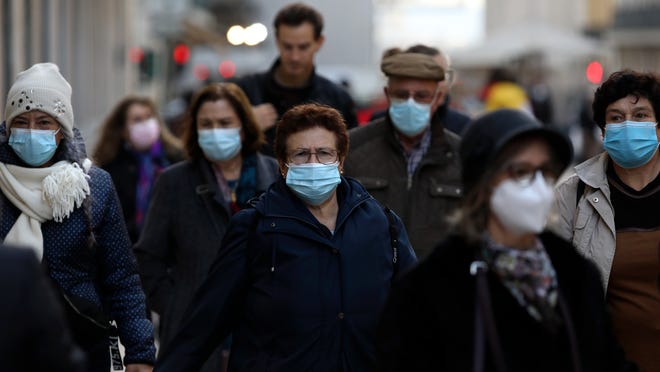
“So our message is the same as it was yesterday,” he said. “To best protect against this variant, get vaccinated for goodness sakes if you have not been vaccinated. Get your booster if you’re eligible. Continue to wear those masks inside where required.”
Fauci also reiterated the Biden administration’s strong encouragement for unvaccinated Americans to get the shots, and for the vaccinated to receive boosters, calling both, “the solution to this problem.”
About 37{cfdf3f5372635aeb15fd3e2aecc7cb5d7150695e02bd72e0a44f1581164ad809} of the eligible U.S. population, including 29{cfdf3f5372635aeb15fd3e2aecc7cb5d7150695e02bd72e0a44f1581164ad809} of adults, are not fully vaccinated.
Asked if Americans should change their holiday plans, Fauci said those who are inoculated should feel safe not wearing a mask if gathering indoors with others who are vaccinated. But when in a public setting where the vaccination status of others is not known, Fauci said it is “very prudent” to wear a mask. “That’s what I do,” he said.
The Centers for Disease Control and Prevention, which recently increased surveillance at four international airports – JFK in New York and Newark in New Jersey, as well as those in San Francisco and Atlanta – said it has been preparing for the arrival of omicron and pointed out the delta variant remains the dominant strain in the country.
“We will continue to work diligently with other U.S. and global public health and industry partners to learn more (about omicron),” a CDC statement said.
California Gov. Gavin Newsom said in a tweet that it should be assumed the variant has found its way elsewhere in the U.S. as well.
“There’s no reason to panic – but we should remain vigilant,” Newsom said. “That means get vaccinated. Get boosted. Wear a mask indoors.”
Experts had been warning that the variant was likely already in the U.S. in the days before the announcement.
Fauci applauded the Biden administration’s move to restrict travel from eight African countries, including South Africa, in an effort to slow the variant’s spread to the United States. The CDC and the U.S. Department of State raised their alert levels for the region, each recommending against travel.
Even with the fast reaction to news of omicron, cases have also been reported in travelers in Belgium, Israel, Hong Kong and the UK. Germany, the Netherlands and the Czech Republic also have suspected cases, among at least 20 countries to report them.
– Contributing: Maureen Groppe, Christine Fernando
Also in the news:
►Then-President Donald Trump tested positive for the coronavirus three days before his Sept. 29, 2020, debate with then-Democratic nominee Joe Biden, former Trump chief of staff Mark Meadows writes in an upcoming book. Meadows also writes that Trump got a negative result shortly afterward.
►Facebook removed 524 accounts and another 86 Instagram accounts linked to a Chinese network that promoted false COVID-19 claims purportedly made by a fictitious Swiss biologist, Reuters reported.
►Ahead of President Joe Biden’s announcement Thursday about his administration’s “winter plan” to confront COVID-19, health experts say they’d like to see more vaccines and booster shots administered, enhanced testing and genomic sequencing and increased access to therapeutics.
►With November numbers in, several states have already reported COVID death totals for the year multiple times higher than in 2020. They include Oklahoma (nearly four times higher), Alaska and Kentucky (three times), and Maine, West Virginia and Hawaii 2 1/2 times).
►Pfizer has submitted a request to the FDA to expand the emergency use authorization of its adult COVID-19 booster dose to include 16- and 17-year-olds.
📈Today’s numbers: The U.S. has recorded more than 48.6 million confirmed COVID-19 cases and more than 781,000 deaths, according to Johns Hopkins University data. Global totals: More than 263 million cases and 5.2 million deaths. More than 197 million Americans – roughly 59.4{cfdf3f5372635aeb15fd3e2aecc7cb5d7150695e02bd72e0a44f1581164ad809} of the population – are fully vaccinated, according to the CDC.
📘What we’re reading: Are travel bans worth it? They could slow the spread of omicron but they have repercussions, experts say.
Keep refreshing this page for the latest news. Want more? Sign up for USA TODAY’s Coronavirus Watch free newsletter to receive updates directly to your inbox and join our Facebook group.
People with breakthrough coronavirus infections remain contagious for a shorter time than the unvaccinated and are therefore less likely to transmit the virus, according to a study published Wednesday in the New England Journal of Medicine.
The study, which involved 173 NBA players, their families and staff, found that vaccinated people who got COVID-19 cleared the virus from their systems on average in 5½ days, compared to 7½ days for the unvaccinated.
Researchers also found the different strains produce roughly the same amount of the virus, but some appear to be more effective at infecting the cells than others.
— Elizabeth Weise
CEOs at two pharmaceutical giants whose double-shot COVID-19 vaccines are dominating the U.S. market are pitching different perspectives on the impact of the omicron variant.
Moderna CEO Stéphane Bancel said current vaccines for COVID-19 will likely be less effective against the new omicron variant. Bancel told the Financial Times in an interview published Tuesday that he has spoken to scientists who told him that omicron is “not going to be good.” He said it could be months before enough vaccines can be produced to crush omicron.
BioNTech CEO Ugur Sahin, however, told the Wall Street Journal the Pfizer/BioNTech vaccine is effective against severe illness from COVID-19 and would likely continue to be effective against the omicron variant.
“Our message is: Don’t freak out, the plan remains the same. Speed up the administration of a third booster shot,” Sahin said.
Until Wednesday, no omicron cases had been detected yet in the U.S., where virtually 100{cfdf3f5372635aeb15fd3e2aecc7cb5d7150695e02bd72e0a44f1581164ad809} of infections are produced by the delta variant. New cases increased slightly in November, with a total of 2.55 million compared to 2.5 million in October, according to Johns Hopkins University data. However, the COVID-19 death toll was down by nearly 15,000, from 47,626 to 32,951.
Televangelist Marcus Lamb, a vocal opponent of coronavirus vaccines who founded the conservative Christian Daystar Television Network, has died of COVID-19, his family said. He was 64.
The network announced his death Tuesday on Twitter, saying Lamb “went home to be with the Lord this morning.” His wife, Joni, confirmed on the network his coronavirus diagnosis and that he had “pre-existing conditions” including diabetes. She said last week her husband was trying alternative treatments without success
One of the two largest Christian television networks in the world, Daystar broadcast segments and published information online that featured misinformation about the virus, vaccines and unproven treatments for COVID-19.
In November, Lamb’s son Jonathan said on the network that his father’s illness was “a spiritual attack from the enemy” because of his advocacy against vaccines and support for alternate treatments.
— Christine Fernando
The Centers for Disease Control and Prevention is directing airlines to hand over contact information for passengers coming from eight countries in Africa as part of the effort to combat the new omicron coronavirus variant. The CDC’s Contact information Collection Order went into effect Tuesday and affects passengers who have been in the Republic of Botswana, the Kingdom of Eswatini, the Kingdom of Lesotho, the Republic of Malawi, the Republic of Mozambique, the Republic of Namibia, the Republic of South Africa or the Republic of Zimbabwe within 14 days of departing for the U.S.
“CDC is issuing this directive to prevent the importation and spread of a communicable disease of public health importance,” the CDC said in a statement to USA TODAY.
Authorities reported that new COVID-19 cases in South Africa nearly doubled in a day, from 4,373 Tuesday to 8,561 Wednesday, signaling a dramatic surge in the country where scientists first detected the omicron variant last week.
– Eve Chen
Saying it was necessary to keep future generations safe, the World Health Assembly on Wednesday pledged to begin work on a “pandemic treaty,” an international agreement to prevent and deal with future pandemics. The Assembly is the World Health Organization’s governing body. Wednesday’s meeting was only the second special session in its 73-year history.
“The significance of this decision cannot be overstated,” said Tedros Adhanom Ghebreyesus, director of the WHO, at the meeting in Geneva. The agreement will “provide a platform for strengthening global health security,” he said. The agreement is to be presented in 2024.
“That may seem like a long process, and it is, but we should not be naive in thinking that reaching a global accord on pandemics will be easy,” Tedros said.
– Elizabeth Weise
To combat the spread of the new omicron variant, the CDC is tightening testing requirements for international travelers. Currently, air travelers to the United States who haven’t recently recovered from the virus – including U.S. citizens – must have a negative viral test before boarding their flight. Fully vaccinated travelers are required to take tests no more than three days before departure. But the CDC says it is “working to modify” the global testing order to give all international air travelers just one day to take a pre-departure test.
“This strengthens already robust protocols in place for international travel,” the CDC said in a statement. The U.S. is also working to stem the spread of the virus with new travel bans on eight countries that went into effect Monday.
As the new omicron variant spreads across the world, advocates of more widespread vaccinations are having an “I told you so” moment. For a year since COVID-19 vaccines first became available, a small but vocal group has warned about the need to protect the most vulnerable around the world. People in richer countries will not be safe, even if fully vaccinated, until those in poorer nations – which make up more than half the world’s 8 billion population – also have the benefit of vaccines, they’ve argued.
“The emergence of the omicron variant has fulfilled, in a precise way, the predictions of the scientists who warned that the elevated transmission of the virus in areas with limited access to vaccine would speed its evolution,” Dr. Richard Hatchett, told a special session of the World Health Assembly this week. Read more here.
– Karen Weintraub
Officials from Rochester Regional Health and the University of Rochester Medical Center in New York state have joined a growing list of hospitals across the U.S. and around the world warning that their facilities had reached full capacity and that emergency departments are stressed. In the Rochester area, hospital leaders said they were weighing whether they could continue performing elective procedures and surgeries. Dr. Michael Apostolakos, Chief Medical Officer for Strong Memorial and Highland Hospitals, said the majority of the COVID-19 patients requiring hospitalization were unvaccinated.
“A significant number of people are refusing the vaccines, and our community is paying the price,” Apostolakos said. “Cases are continuing to rise with no end in sight.
– Sean Lahman, Rochester Democrat and Chronicle
The omicron coronavirus variant could have a moderate impact on the U.S. economy next year as it hurts consumer spending and worsens labor shortages and supply chain bottlenecks, intensifying already-high inflation, top economists say.
It’s too early to pinpoint how omicron will affect economic growth because scientists are just starting to assess the toll it could take on global health. But under one likely middle-ground scenario laid out by some top economists, the strain could be more infectious but not significantly more virulent than the delta variant. And it could lead to fewer government-imposed restrictions on businesses.
If that’s the case, omicron or another similar variant would cut economic growth next year by half a percentage point to 4.3{cfdf3f5372635aeb15fd3e2aecc7cb5d7150695e02bd72e0a44f1581164ad809} and lead to the creation of several hundred thousand fewer jobs, estimates Mark Zandi, chief economist of Moody’s Analytics.
– Paul Davidson, USA TODAY
![]()
Contributing: Mike Stucka; The Associated Press