Shipping delays are back as China’s lockdowns ripple around the world

Shipping delays are back as China’s lockdowns ripple around the world


Hong Kong
CNN Business
 — 

Global shipping was just starting to recover from the chaos of the pandemic. Now port congestion and delays are back and could be around for a while.

Covid lockdowns in China have wreaked havoc at Shanghai, the world’s biggest container port, and are now causing problems at other major ports around the world.

Some Chinese cities, including Shanghai, have started easing Covid restrictions in recent days, but experts say that the damage has already been done, and global shipping will suffer well into the summer. That could exert even more pressure on global supply chains already reeling from Russia’s invasion of Ukraine, and keep inflation running hot.

Data from Project44, which tracks global supply chains, showed that shipment delays between China and major US and European ports have quadrupled since late March, when China shut down the city of Shanghai, which has the world’s busiest container port.
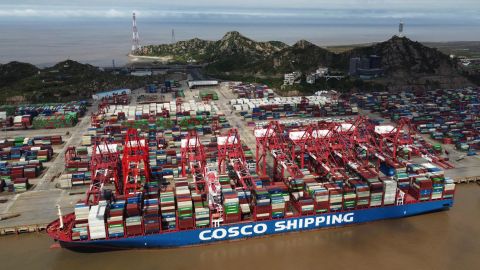
A Cosco Shipping container ship is seen at the Yangshan Deep Water Port amid the coronavirus disease (COVID-19) outbreak in Shanghai, China April 24, 2022.

By the end of April, ships from China to Seattle were taking four days longer than expected to arrive, up from about one day the previous month.

The time it takes ships to leave China and arrive at major ports around the world increased steadily over the past year, but there had been some signs of relief since December with transit times between Shanghai and Long Beach, for example, dropping in January and February.

Since March, however, there’s been a sharp increase again in transit times on that route.

To add to the problem, many truck drivers have struggled to reach ports in China to pick up containers because of travel restrictions and Covid testing requirements. Shipping giant Maersk warned in an advisory last month that trucking services in Shanghai would be “severely” impacted by these restrictions.

“With the manufacturing industry being shuttered [in Shanghai] and truckers unable to travel quickly, exports have been reduced, and shipment delays have increased,” said Josh Brazil, director of Supply Chain Data Insights at Project44.

Delays will “continue into the summer months,” as factories struggle to return to normal operations in Shanghai, he added.

Although authorities have allowed some businesses to restart production, many workers are still stuck in quarantine at home. Factories that do reopen are facing component shortages and difficulty in securing trucks to carry goods into or out of the port.

“The ripples in shipment delays are only beginning to become visible and are expected to extend well into the next few months,” said Brazil.

Shanghai — China’s leading financial center and most populous city — has been under a strict lockdown since late March. More than 8 million residents are still banned from leaving their residential compounds. The Covid restrictions have spread to other cities, including Beijing — the nation’s capital.

Shanghai port remained open throughout the lockdown, but data from various shipping firms show an increasing backlog of ships and containers.

US supply chain companies have expressed concerns about fresh chaos heading towards American ports, which are still recovering from the severe congestion and delays they suffered last year.

Shelley Simpson, chief commercial officer for JB Hunt Transport Services, said late last month that while there has been “a temporary relief” at US ports, things may get a lot “a lot worse” this summer because of what’s happening in China.

It “just takes a little bit of disruption to really change the environment all over again,” she added.

Shipping queues are getting worse in China — and other parts of the world.

Nearly 20{cfdf3f5372635aeb15fd3e2aecc7cb5d7150695e02bd72e0a44f1581164ad809} of container vessels globally are currently waiting outside congested ports, according to a survey published last Thursday by Windward, an Israel-based global maritime data firm.

Almost a quarter of those unberthed ships are stuck outside Chinese ports. That’s 412 ships, up 58{cfdf3f5372635aeb15fd3e2aecc7cb5d7150695e02bd72e0a44f1581164ad809} since February, the survey added.

It’s clear that lockdowns in China have caused a bottleneck, the firm said.

Across China, at least 27 cities are under full or partial lockdown, which could be impacting up to 185 million residents across the country, according to latest CNN calculation on Wednesday. Beijing effectively shut down its largest district this week.

President Xi Jinping signaled this week that China would continue with its zero tolerance approach to Covid. On Thursday, Xi told all levels of government to “resolutely adhere to the zero-Covid policy.”

China is home to seven of the world’s top ten container ports, including Shanghai, Ningbo-Zhoushan, Shenzhen, and Hong Kong. In Shanghai — the epicenter of China’s current Covid outbreak, the situation remains severe.

The number of vessels waiting at the Port of Shanghai had increased to 384 by April 25, up 27{cfdf3f5372635aeb15fd3e2aecc7cb5d7150695e02bd72e0a44f1581164ad809} from a month earlier, according to most recent data from S&P Global Market Intelligence.

Pressure is also building on other Chinese ports, as vessels try to find alternative ports to berth. Ships have faced growing delays since late March outside Ningbo-Zhoushan port, the world’s third largest port, less than a hundred miles from Shanghai, according to Lloyd’s List Intelligence.

Containers are also piling up because of truck shortages.
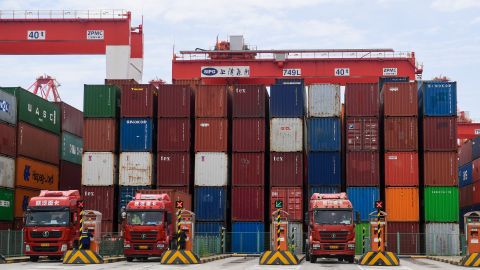
Trucks wait to load containers at Yangshan Deepwater Port on April 27, 2022 in Shanghai, China.

At the peak of the lockdown in Shanghai, containers were sitting for as many as 15 days at the port before being picked up by truckers, up from fewer than 5 days when the restrictions first took effect, Project 44 data showed. The average wait time has since come down but was still 10 days last Wednesday.

Zhang Wei, vice mayor of Shanghai, acknowledged last week that the city is seeing “reduced efficiency” in cargo transport and “poor logistics” since the lockdown.

The turmoil at the ports has already hit China’s factories and foreign trade, as manufacturers have to wait longer to get raw materials.

It is also harder for them to ship their products to customers. Inventories of finished goods have surged to the highest level in about a decade, as products pile up in warehouses due to weak demand and the difficulty of finding trucks to move them.
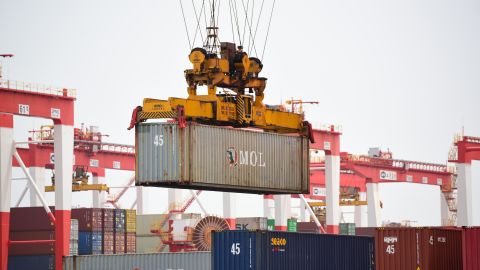
Cranes lift containers at Yangshan Deepwater Port on April 27, 2022 in Shanghai, China.

Latest PMI surveys — released on Saturday — showed that factory activity slumped to the worst level since February 2020, when China was battling the initial Covid outbreak. New export orders that manufacturers received in April fell at a much faster pace than in March.

The decline in export orders showed that the chaos at some major ports, including Shanghai, have hit China’s trade with the rest of the world, according to Goldman Sachs analysts.

“Worryingly, there was plenty of evidence of worsening supply pressures, with supplier delivery times collapsing, input prices surging and inventories of finished good rising to their highest since June 2012,” wrote Mitul Kotecha, head of emerging markets strategy at TD Securities, in a report.

“Such supply pressures will have ramifications across supply chains globally, as already evidenced in some recent US Q1 earnings reports in the tech sector,” he added.

The situation in Shanghai will push global inflation higher this year, said Daejin Lee, associate director at S&P Global Market Intelligence.

He pointed out that last year’s inflation was driven by two factors — supply shortages of key parts owing to supply chain bottlenecks, and record high container freight rates.

Both problems continue this year, even as Russia’s invasion of Ukraine has fueled global inflation by driving up prices for energy and other key commodities.

“Another lengthy delay” in seaborne supply of key parts because of China’s port congestion could increase consumer prices “much faster than previously expected,” Lee said.

Maersk said Wednesday that freight rates will stay elevated as supply chain pressures persist. According to the company, congestion in sectors such as trucking and warehousing in mainland China, have created “bottlenecks, resulting in challenged supply chain management services and elevated rates.”

The company’s average freight rate jumped 71{cfdf3f5372635aeb15fd3e2aecc7cb5d7150695e02bd72e0a44f1581164ad809} in the first quarter from a year earlier.

China’s Covid Lockdowns Stir Memories of a Planned Economy

China’s Covid Lockdowns Stir Memories of a Planned Economy

Yang Wenhui really should be a happy instance of China’s increase from financial rubble to global powerhouse.

Expanding up lousy, he ate so a great deal cabbage that he didn’t touch it again for lots of several years. He labored as a farmer and a construction worker ahead of becoming a member of the country’s nascent logistics business. In 2003, he commenced his own freight logistics enterprise, hanging gold as online buying took off in the 2010s and goods moved quickly among provinces.

Then the Omicron variant started out spreading in China. In the government’s zealous pursuit of its “zero Covid” policy, dozens of towns along the 1,300 miles of highway involving the cash, Beijing, and the southern province of Guangdong, his primary freight route, imposed vacation constraints and lockdowns. Many truckers had been grounded. Cargo selling prices rose by 20 {cfdf3f5372635aeb15fd3e2aecc7cb5d7150695e02bd72e0a44f1581164ad809} in a matter of months.

“I’ve been in the logistics business enterprise for 28 many years,” Mr. Yang, 47, claimed in an interview. “But I’ve hardly ever witnessed a mess like this. There have been numerous emergencies to offer with.” He estimates that he shed tens of 1000’s of dollars in March.

China’s economic system is a huge, innovative machine that needs a lot of pieces to work together. Powering its 1.4 billion buyers are 150 million registered corporations that offer work, food items and anything that retains the device humming.

Now, in the title of pandemic regulate, the Chinese govt is meddling with the financial state in means that the country has not seen for a long time, wreaking havoc on organization.

Businesspeople be concerned that the place is heading back to a planned economic climate, and the fantastic Covid disruptions could past right up until just after a Communist Get together congress late this year when China’s best chief, Xi Jinping, is anticipated to safe a third expression. A surge in instances in Beijing is amplifying worldwide fears as effectively, prompting a offer-off in shares on problems that China’s financial state could choose another strike.

In the previous two yrs, lots of governments about the globe have sought a equilibrium between controlling the pandemic and retaining organizations open up. China was mostly thriving until finally a short while ago when Omicron, a milder, if more infectious, variant, brought on a serious outbreak. As considerably of the environment is opening up, the state is doubling down on its zero Covid plan, creating very low dying and an infection premiums central to its legitimacy.

Since March, China has claimed about fifty percent a million Covid infections and 48 fatalities through April 22.

Close to 344 million persons, or a quarter of the country’s inhabitants, are beneath some type of lockdown, in accordance to the expense lender Nomura. The lockdowns have left China’s most significant city, Shanghai, a metropolis of 25 million persons, a ghost town farmers in the northeastern granary cooped up in the spring planting year and many factories, outlets and restaurants throughout the country suspending their operations.

The stringent actions are exacting a major toll on the economic system. Nationwide usage fell by 3.5 percent in March, even though paying out on restaurants plummeted by 16 {cfdf3f5372635aeb15fd3e2aecc7cb5d7150695e02bd72e0a44f1581164ad809}, according to official info.

“This is not only producing it unachievable for many non-public enterprises to endure, but also accelerating outbound immigration and promptly dampening willingness to invest,” reported Zhiwu Chen, an economist at University of Hong Kong. “Once people today lose self-assurance in the country’s future, it will be really hard for the economic climate to recuperate from the zero Covid policy’s impact.”

Business proprietors and administrators are complaining that the existing disruptions are worse and a lot more prevalent than those of early 2020 when logistics, commerce and industrial manufacturing in a lot of the state quickly returned to standard. Back then, the government’s digital surveillance techniques to limit the movements of autos and persons were being less substantial.

The business local community is waiting around nervously to see if the authorities will implement the Shanghai lockdown model to other metropolitan areas. The technique has a strong aspect of a planned financial system, in which the govt controls business actions, somewhat than allowing the current market regulate offer and demand.

Throughout the outbreak, the Shanghai federal government upended the business units and tried out to provide for 25 million men and women on its personal. The final results are familiar to Chinese of a certain age: shortage of materials and mushrooming of black marketplaces.

Simply because of Covid limitations, commercial trucks have a difficult time delivering foodstuff and house merchandise to Shanghai. Inside the metropolis, only cars with passes are allowed on the street.

On the black industry, some operators are ready to pay $2,000 for a working day pass. The value is then priced into the groceries they sell to the people.

Some community committees let only authorities-arranged grocery distributions some others never allow their citizens to order diapers, infant components and bathroom paper mainly because they are not viewed as necessities. In other places, fruit, beer and espresso are thought of frivolous things.

Beginning in the 1980s, China moved away from its planned economy, for the reason that it still left absolutely everyone very poor. It didn’t get the job done in the former Soviet Union nor is it working in North Korea.

Moreover the troubling ghost of a planned financial state, the business enterprise community is also dealing with conflicting messages from the govt. Premier Li Keqiang and ministers in Beijing have been urging authorities to equilibrium pandemic-handle steps with a require to motivate development. The Ministry of Marketplace and Facts Engineering sent a functioning group to Shanghai to be certain that critical companies and offer chains could resume operations.

But Mr. Xi has not budged from his zero Covid posture. “Perseverance is victory,” he reported on April 13. The point out media, provincial social gathering secretaries and lower-degree governing administration officials all know who is in cost and are eager to display their loyalty. Quite a few local officials are escalating pandemic-regulate actions so they really do not chance an outbreak that could put their positions in hazard.

Some factories in Shanghai, these types of as Tesla and some of its suppliers, have resumed creation. But they should adhere to a established of sophisticated and pricey pandemic-control actions, such as producing what’s known as a closed-loop administration procedure in which workers live on-internet site and check frequently for the virus.

Not lots of companies are ready or able to do this. 1 senior govt of a significant logistics company explained to me that they have only a few thousand shipping staff back again on the job in Shanghai for the reason that they deficiency the potential to give lodging for so several staff. That’s significantly lessen than the extra than 60,000 shipping and delivery workers the organization had in peak seasons in the past handful of a long time.

The disruptions are especially complicated for smaller sized corporations.

A truck driver who requested me to use only his surname, Zhao, has been trapped in his automobile, not able to work, in a Shanghai suburb due to the fact March 28 when the district was locked down. He, alongside with practically 60 other truckers, have been consuming from fireplace hoses, struggling to protected food and without the need of a lavatory to wash up in.

He’s getting rid of sleep, asking yourself how he will protect his loans: about $2,000 month-to-month for his truck and about $500 for mortgages, while continuing to assistance his spouse and their two children.

He told me that he borrowed income from kin and pals to pay out the financial loans this thirty day period. If he just can’t start off doing the job shortly, he claimed, up coming month he will have to sell his truck.

The main executive of a high-traveling client brand name is also thinking how very long her company’s funds can final. The firm raised $100 million previous year and experienced formidable expansion ideas, she claimed in an interview. But approximately a 3rd of her company’s 150 retail suppliers experienced to shut their doorways in locked-down towns. Their on-line product sales, which weren’t damage in 2020, are struggling now for the reason that quite a few metropolitan areas shut the highway exits, halting e-commerce deliveries.

If the lockdowns haven’t eased by May well 1, a general public holiday in China, she will have to consider allowing go some of her 1,000 employees.

She and most men and women I interviewed for this column requested for anonymity, simply because private enterprises are easy and susceptible targets for federal government retaliations.

John Ji, a authentic estate developer in Nanjing of Jiangsu Province, is anxiously watching the lockdowns in Shanghai and other towns. He thinks that several individuals will get rid of their positions and have problem paying out mortgages. When nobody can afford housing, he asked, who will obtain his residences?

Mr. Ji also grew up very poor. In advance of he turned 10, his staple was sweet potatos he ate meat only a couple of times a year.

“I’m apprehensive regardless of whether we’re going back again to a prepared overall economy,” he explained to me. “If the economic system keeps slumping, we may possibly grow to be bad once more.”

COVID-19 lockdowns ‘deepened social inequality’

COVID-19 lockdowns ‘deepened social inequality’
A COVID-19 vaccination centre sign stands at St Thomas' hospital opposite Westminster on September 13, 2021 in London, United KingdomShare on Pinterest
A COVID-19 vaccination center sign stands at St Thomas’ Hospital opposite Westminster on September 13, 2021, in London, United Kingdom. Dan Kitwood/Getty Images
  • Lockdown measures resulting from the COVID-19 pandemic have changed people’s lives.
  • Different social groups felt these changes disproportionately.
  • Future research is necessary to determine if, how, and why these social inequalities continue to persist.

The United Kingdom officially announced its first lockdown due to the COVID-19 pandemic on March 23, 2020. Two more national lockdowns occurred in the months that followed, Home Decoration.

The lockdowns resulted in unprecedented changes to people’s lives, but not all these changes ended when the lockdowns were over.

A recent study, which appears in the open-access journal PLOS ONE, explores the longer-term impacts of COVID-19 on various dimensions of different social groups.

Stay informed with live updates on the current COVID-19 outbreak and visit our coronavirus hub for more advice on prevention and treatment.

Researchers at the University of Oxford, U.K., used data from the first eight waves of the U.K. Household Longitudinal Survey on COVID-19 — from March 2020 to March 2021. They also used data from the main survey of two waves before the pandemic — from 2017 to 2019.

The panel survey covers a representative sample of 51,000 adults from approximately 40,000 households. The researchers reached out to individuals aged 20–65 years who participated in the main study to ask them to join the COVID-19 supplementary study. This required monthly online reporting from April 2020. In May 2020, the researchers added the option to report by telephone.

In total, nearly 16,000 individuals responded, representing a 42{cfdf3f5372635aeb15fd3e2aecc7cb5d7150695e02bd72e0a44f1581164ad809} response rate.

The authors reviewed the impact of COVID-19 and COVID-19-induced measures as the surveyed population reported.

The researchers were especially interested in how income, their use of time, and their well-being changed throughout different stages of the pandemic. In addition, they wanted to determine if these factors varied based on the sex, ethnicity, and education level of those surveyed.

Many of the measures officials implemented to contain the spread of COVID-19 involved reducing physical contact between people. As a result, the first wave of lockdowns impacted global social behavior immediately.

For example, business closures and remote work altered working patterns. Countries that introduced lockdown measures, such as the U.K., Australia, and the United States, immediately recorded reductions in work earnings.

Studies conducted following the first U.K. lockdown indicated that women and parents experienced a more negative influence on their subjective well-being than that of other social groups. Black, Asian, and minority ethnic immigrants were also more likely to have experienced economic hardship.

“So often, we focus just on cases and hospitalization, ICU usage, and mortality numbers, but it’s important to also look at the social impacts,” said Richard M. Carpiano, Ph.D., in an interview with Medical News Today.

Carpiano is a public and population health scientist and a medical sociologist. “A pandemic is very much a sociological phenomenon as much as it is the spread of a virus.”

As more lockdowns occurred, people’s health and overall feeling of well-being changed, not only because of the possibility or actuality of contracting SARS-CoV-2 but also because of related worry and stress.

The study showed that at the start of the pandemic, individuals who worked experienced a reduction in average earnings and the hours they worked per week. In addition, there was an increase in distress levels.

Data indicates that the mental health of most U.K. adults returned to pre-pandemic levels after the first lockdown, but that was not true for everyone.

Another study that appears in The Lancet supports this observation. It showed that 1 in 9 people did not experience an improvement in their mental health once the first lockdown lifted.

These lingering lockdown effects differed across the sexes, ethnicities, and between degree and nondegree holders. For example, during the first lockdown, the decline in pay was smaller for female than for male workers, possibly because of a higher proportion of women working in key sectors. Later, however, paid work time for men recovered faster than that for women.

Initially, the subjective well-being experienced by women suffered more than that of men. Then, as women’s subjective well-being began to recover, men’s distress levels began to rise.

Regarding earnings, Black, Asian, and marginalized ethnic people were more negatively affected than white individuals. This earnings gap persisted after easing lockdown restrictions.

The researchers conclude that the long-lasting pandemic and related restrictions have produced persistent negative consequences for earnings, work patterns, and subjective well-being.

Author Muzhi Zhou spoke with MNT about the study:

“Some changes in social inequality seem to disappear once lockdown measures are lifted, while other changes remain persistent throughout the whole year. It is worrying to see that the deepened social inequality could be long term for certain social groups.”

The study concludes by noting, “The negative impacts of the spread of COVID-19 and its related measures vary not only in their extent but also in their speed among different social groups.”

The authors suggest further research to understand the factors that have driven and exacerbated these social inequalities. To stress their point, they quote poet Damian Barr: “We are in the same storm, but we are not all in the same boat.”

Speaking about future research, Zhou told MNT: “I think that given the richness of this continuing dataset and the growing number of people contracting [SARS-CoV-2], it is time to examine whether positive and negative COVID-19 test results have different impacts on people of different social groups. Moreover, whether people respond and behave differently after they have taken the vaccine is another very interesting topic.”

For live updates on the latest developments regarding the novel coronavirus and COVID-19, click here.

Visit : https://accuracyathome.com/