An Opportunity For Greater Innovation

An Opportunity For Greater Innovation

Fashion and culture go hand in hand, but some believe that the retail and fashion industries aren’t always as up to speed technologically as they are at the forefront of culture, that is depending on the brand of course. As companies adapt to technological acceleration and see a need to explore new ways to connect with consumers, more of them will need to think in 3D. This presents fashion with a massive opportunity for more than just digital transformation, but rather, real innovation.

 Innovating In A New Era

3D is at the heart of so many of the technological advancements happening today. Think of 3D as one of the highest orders of content. From a high-quality 3D model companies can generate photos, videos, and even interactive experiences from one 3D model. Virtual reality, augmented reality, animation, and gaming all require 3D models. And now, social media platforms like Snapchat, Facebook, and Instagram all support 3D content. In order to capitalize on these new technologies and channels, fashion needs to make 3D a top priority.

The retail and fashion industry is known for its resistance to change but some insiders recognize how far behind the industry is lagging when it comes to 3D. Spatial Computing and by extension 3D are changing the way that we interact with the world around us in as big a way as mobile phones changed our world 15 years ago.

For example, VNTANA, a 3D eCommerce platform that started working in the world of retail before the pandemic, was prepared for change. When the current pandemic hit they saw an increase in demand from multi-category retailers, fashion, footwear and apparel brands as they shifted focus to ecommerce.

Retail and fashion (whether it be a luxury fashion company, fast-fashion retailer or sportswear brand) is mistaking “digital transformation” for real innovation. Digital transformation is thrown around a lot these days and it acts as a catch-all for almost any new piece of software that gets added into the mix for brands. For many, thi is a problem because digital transformation is too broad a term to be properly useful, let alone efficient or visionary. It allows people to add a few pieces of software into their organization and reductively check their digital transformation box.

Oftentimes, when people talk about digital transformation, they’re referring to digital product creation, which is generally defined as the move from 2D to 3D. Rather than working off of 2D patterns and files, digital product creation uses 3D programs like Browzwear and Style 3D to stitch together patterns and provide a production-ready 3D version of a garment.

The automotive industry has been creating 3D versions (instead of just 2D drawings) of cars for years, but it’s not until recently that we’re seeing how valuable that can be. There is enormous value in designing and manufacturing something with the help of 3D tools, but there is also value that can be unlocked in sales and marketing.

For instance, almost every image on an automaker’s website was generated from a 3D model of a car. The same goes for any configurator that customers interact with. The key is that the auto industry pushed what was possible in 3D and now 3D is core to all of their marketing and sales efforts. This time investment upfront has significantly reduced the time it takes to create all forms of digital content that provide a better customer experience with, Smart Business.

In Retail and Fashion, digital product creation is viewed as important because brands are able to replace physical samples with 3D virtual models to reduce cost and make design decisions faster. And while there are great programs like Vstitcher by Browzwear that make it easy for designers to create 3D versions of their garments, there is almost no understanding of what to do with that 3D model after it’s created other than generate a 2D render or pull it up in Vstitcher during a line review. In fact, after going through all of the effort of creating a product in 3D, in all likelihood, no consumer or internal stakeholder will ever interact with a 3D version of the product other than the original designer. This may be why many brands feel that change can wait and that digital product creation and its benefits are merely “nice to haves.” Brands are just seeing the tip of the iceberg when it comes to 3D capabilities.

Digital product creation and 3D are about so much more than meeting sustainability goals or speeding up time to market; they mark the beginning of a totally different way of doing business as well as a potential threat to the incumbents. The lack of awareness around how far 3D technology has progressed recently and how quickly it is accelerating is serious; so serious that for some brands, it could possibly result in their ultimate demise.

3D Technology Acceleration And Fashion’s Big Opportunity

In the last few years, technology has made leaps and bounds forward in real-time 3D rendering, 3D printing, 3D scanning, 3D game engines, and AI. In the retail and fashion technology space, we’ve also witnessed integrations between PLM systems such as PTC FlexPLM, and apparel 3D design tools such as CLO and Browzwear, enabling designers to tap into full PLM functionality from their existing 3D workspace. This facilitates a seamless and efficient digital workflow.

Every new iPhone comes equipped with LiDAR scanning capabilities which allow people to generate 3D models with their phone. Technology companies like Unity have launched products like Forma which allow brands to create incredibly rich and realistic interactive experiences.  Forma can also generate ultra-high quality 2D renders very easily using 3D versions of products. This completely gets rid of the need for photoshoots. Apple is going to launch AR glasses which will allow consumers to overlay the digital over the real world with ease. Facebook, Snap, Google, Apple, and Microsoft have invested billions of dollars into consumer-facing 3D. Why do some in the fashion industry think they won’t need to take advantage of these new technologies and distribution channels to stay competitive?

There is an enormous opportunity to create a completely different type of fashion brand by leveraging these technologies in conjunction with digital versions of their products. Imagine a brand that is able to put out digital designs and take orders before ever producing a single sample, who can create virtual try-on experiences and leverage the power of AI to make highly personalized recommendations based on style and fit, and who allows consumers to take 3D versions of clothing they buy and dress up avatars in their favorite games. The pace of technological advancement is only accelerating, and the brands that don’t invest heavily in digital product creation today will be left behind.

While it’s understandable that the focus for many is decreasing the pain of product development and reducing inventory risk via a shortened product life cycle, this shouldn’t prevent brands from taking advantage of the opportunities that are available today. By showing ROI in sales and marketing, Retail and Fashion companies will be more likely to possibly get the executive buy-in needed to create real change.

So what are some things Retail and Fashion can do to start taking advantage of the opportunities that 3D can provide?  First, they need to let go of the idea of the perfect digital product; not because they shouldn’t always be striving to improve, but because opportunities are being missed today in the pursuit of perfection. Retail and Fashion need to stop asking themselves the question, “Does this digital version of my product look identical to the real thing?” and start asking, “How can I make the most of my 3D assets with the tools available today?” and “Are there ways to test consumers’ response to a fully digital version of my product?”

There are opportunities right now for multiple stakeholders (including sales and marketing) to review products in 3D, to replace 2D images with 3D for wholesale buyers, and even sell on e-commerce. Today, the 3D version of products on a website probably won’t look identical to the real thing, but check back in 6 to 12 months. It’s important to try new things because the technology is advancing rapidly and brands who already have 3D versions of their product today will be in a far better position to take advantage of it in the future.

The furniture industry has proven this point. The furniture industry has excelled in using 3D and is reaping the rewards. Their digital products aren’t perfect but relatively young companies like Houzz and Wayfair have been able to leverage the power of 3D and AR in e-commerce to scale extremely quickly and make a massive impact on the industry. In fact, Houzz reports that customers who use AR are 11x more likely to make a purchase. There is no reason why a company like Ikea can allow consumers to place almost every item of furniture they offer in their rooms using AR, but footwear brands still aren’t utilizing AR shoe try-on at scale. The technology exists and the devices to power it are in almost every consumer’s pocket; it’s just a matter of investing the time and resources to execute.

Next, executive leadership needs to start looking at the bigger picture. How can the 3D products their teams create today be used 12, 18, and 36 months from now? While products are seasonal, the processes, skills, and technology to produce digital versions of those products are not. In order to take advantage of the new technologies that are coming online they will need robust processes, software, and a well-educated workforce who understands things like technical 3D, real-time rendering, and game engines. They need to be willing to make investments today with the understanding that ROI will grow over time with the technology, but not evolving is not an option.

To help with the planning and adoption of this new technology, brands should be looking to add fashion outsiders to their innovation and digital product creation teams. We’ve seen some of the most forward-looking brands like Adidas do this very successfully. More brands should be following suit. Ideally, these people should come from the gaming or 3D industry and understand the complexity as well as the opportunity of using 3D in e-Commerce and AR. In addition to strategists, technical 3D artists from the gaming space should be working side by side with garment designers. Part of the reason that 3D adoption isn’t happening quickly enough in industries such as fashion is that designers understand garment making but they don’t understand technical 3D. It takes them much longer to troubleshoot issues and overcome roadblocks when trying to use those 3D designs across web, game engines and social media. Adding just one or two technical 3D artists will act as a force multiplier for these teams.

Finally, companies should be looking to participate in Industry consortiums like the Khronos Group who are putting together standards for 3D and AR which will be hugely beneficial to the fashion industry. Today, the furniture industry is well represented and as a result, they are able to push for standards that make the distribution of their 3D assets easier. Fashion, both brands and software developers across the industry, should be participating in these types of groups as well as they have their own specific needs.

Rising Up To The Challenge

Fashion has always been at the forefront of culture, influencing trends through experimentation and radical approaches to dress. Designers haven’t succeeded through doing things safely, but rather, pushing the bounds of what we as humans believe we can be. These new 3D mediums are calling for that spirit of experimentation and boundary-pushing.

Thankfully, we are starting to see accelerated innovation in Fashion with creative technology leaders like Adobe integrating their Adobe Substance offering into digital design programs like Browzwear and Clo, giving fashion designers access to new and more realistic 3D materials. Brands and venture capital are forming more fashion accelerators and innovation groups with the express purpose of accelerating digital transformation, but this alone will not be enough for larger slower moving brands.

Fashion needs to think bigger and invite outsiders to join them in true digital transformation. It’s not too late for some of them to make a change. Let’s see who rises to the challenge.

This article was written in collaboration and with insight from Ben Conway, Co-founder, and COO of VNTANA

Visit : https://www.charityjoybell.com/

Stocks in news: HCL Tech, HDFC Bank, PNB Housing Finance, Coal India and more

Indian benchmark indices are most likely to open increased amid mixed worldwide cues.

Equity markets closed at history highs on October 14, tracking gains in ITC, HDFC Financial institution and PowerGrid shares amid mixed cues in world-wide markets. Sensex finished previously mentioned 61,000 for the 1st time and Nifty shut previously mentioned the 18k mark for the next consecutive session.

The 30-inventory index shut 568 factors greater at a new peak of 61,305 and Nifty rallied 176 factors to 18,338. Sensex and Nifty logged record highs of 61,353 and 18,350 for the duration of the session.

Listed here are the shares that are probable to keep on being in concentration now.

HCL Tech: HCL Technologies claimed a internet financial gain of Rs 3,265 crore for the July-September quarter, recording a progress of 1.6 per cent on quarter-on-quarter (QoQ) and 3.9 for each cent progress on a yr-on-12 months (YoY) basis.

The company’s income grew 2.9 per cent QoQ and 11.1 per cent YoY to Rs 20,655 crore. The profits in frequent currency conditions grew 3.5 for every cent QoQ and 10.5 for each cent YoY. The EBITDA margin for the mentioned quarter stood at 23.4 for each cent, while the EBIT margin was recorded at 19 for each cent.

HDFC Bank: The lender noted a 18.1 for each cent jump in consolidated web profit at Rs 9,096 crore in the July-September quarter of the current fiscal year. The bank experienced registered a internet financial gain of Rs 7,703 crore through the very same quarter previous fiscal.

On a standalone basis, after delivering Rs 3,048.3 crore for taxation, HDFC Lender gained a web profit of Rs 8,834.3 crore, an maximize of 17.6 for every cent over the Rs 7,513.1 crore standalone internet profit noted in the quarter finished September 30, 2020.

The lender’s standalone web revenue increased 14.7 for each cent to Rs 25,085.2 crore for the duration of the quarter ended September 30, 2021 from Rs 21,868.8 crore in the quarter ended September 30, 2020.

PNB Housing Finance: Punjab Countrywide Financial institution Housing Finance Ltd, a subsidiary of state-owned Punjab Nationwide Lender, in a inventory trade submitting said its board has terminated a Rs 4,000 crore deal with US-based mostly Carlyle team-led team of buyers.

“At a meeting held these days, the board resolved not to commence with the preferential challenge and the share subscription  agreements executed with the Proposed Allottees have been terminated in accordance with their respective terms,” PNB said in a stock trade filing.

The PNB Housing Finance mentioned its board has been knowledgeable that consequently Pluto Investments, which is a Carlyle entity, will be initiating the procedure to withdraw the open supply designed by them  (at Rs 403.22 for each share).

Coal India: Coal India Constrained lessened source to the non-ability sector, but did not prevent it entirely as alleged by some quarters, to fulfil emergency prerequisites for electrical energy vegetation amid shortage of the dry gasoline, a senior formal explained to PTI.

Cyient: The company posted a 44.57 for each cent leap in consolidated web earnings to Rs 121.3 crore for the quarter finished on September 30, 2021, in contrast to Rs 83.9 crore in the exact same time period a calendar year ago.

Consolidated earnings from operations elevated by 10.79 for each cent to Rs 1,111.6 crore during the described quarter in comparison to Rs 1,003.3 crore in the corresponding quarter of 2020-21, in accordance to a regulatory submitting by the organization.

Avenue Supermarts: The enterprise reported a twofold boost in its consolidated web earnings to Rs 418 crore for the quarter finished September. Revenue from functions jumped 46.79{cfdf3f5372635aeb15fd3e2aecc7cb5d7150695e02bd72e0a44f1581164ad809} to Rs 7,789 crore through the quarter.


What channel is Chargers vs. Ravens on today? Time, TV schedule for NFL Week 6 game

The Chargers and Ravens will meet on Sunday as they remain two of the three 4-1 teams left in the AFC through five weeks.

Both teams are coming off of comeback Week 5 games. The Chargers beat the Browns 47-42 after trailing by as much as 14, while the Ravens beat the Colts 31-25 in overtime after trailing 22-3 in the third quarter. 

It will be a battle between the two MVP-candidate quarterbacks, the Chargers’ Justin Herbert and the Ravens’ Lamar Jackson. Although Jackson is known for his rushing yards (341 this season so far), he ranks fifth for the most passing yards by a quarterback this season so far (1519). The quarterback in the fourth spot is no other than Herbert with 1576 passing yards. 

The last time these two teams met was during their 2019 wildcard playoff game, which the Chargers won 23-17 to advance. 

According to DraftKings, the Ravens have a 3.5 point advantage, with the over/under being 51 points.

Here’s everything you need to know to watch the Chargers vs. Ravens game on Sunday, including kickoff time, TV channels and a full Week 6 NFL schedule.

MORE: Watch Chargers vs. Ravens live with fuboTV (7-day free trial)

What channel is Chargers vs. Ravens on today?

  • TV channel (national): CBS
  • TV channel (Los Angeles): KCBS-TV
  • TV channel (Baltimore): WJZ
  • Live streams: CBS All Access, fuboTV

The Chargers vs. Ravens game will be broadcast on Fox in select markets. Greg Gumbel and Adam Archuleta will call the game from the booth.

For those looking for radio information, the Chargers broadcast can be heard on SiriusXM channel 387, or the Ravens broadcast can be heard on SiriusXM channel 229.

In Canada, viewers can watch Chargers vs. Ravens on DAZN, which has rights to every NFL game.

Chargers vs. Ravens start time

  • Date: Sunday, Oct. 17
  • Time: 1:00 p.m. ET

Chargers vs. Ravens is scheduled to start at 1:00 p.m. ET. The broadcast will be shown in the west coast and Baltimore regions, while the Chiefs vs. WFT game will be shown in the majority of the country.

NFL Week 6 schedule

Sunday, Oct. 17

Game Time (ET) Channel
Dolphins vs. Jaguars 9:30 a.m. CBS
Packers at Bears 1:00 p.m. Fox
Bengals at Lions 1:00 p.m. Fox
Texans at Colts 1:00 p.m. CBS
Rams at Giants 1:00 p.m. Fox
Chiefs at WFT 1:00 p.m. CBS
Vikings at Panthers 1:00 p.m. Fox
Chargers at Ravens 1:00 p.m. CBS
Cardinals at Browns 4:05 p.m. Fox
Raiders at Broncos 4:25 p.m. CBS
Cowboys at Patriots 4:25 p.m. CBS
Seahawks at Steelers 8:20 p.m. NBC

Monday, Oct. 18

Game Time (ET) Channel
Bills at Titans 8:15 p.m. ESPN

Chargers 2021 schedule

Week Date Opponent Time (ET) TV
6 Oct. 17 @Ravens 1:00 p.m. CBS
7 BYE
8 Oct. 31 Patriots 4:05 p.m. CBS
9 Nov. 7 @Eagles 4:05 p.m. CBS
10 Nov. 14 Vikings 4:05 p.m. Fox
11 Nov. 21 Steelers 8:20 p.m. NBC
12 Nov. 28 @Broncos 4:05 p.m. CBS
13 Dec. 5 @Bengals 1:00 p.m. Fox
14 Dec. 12 Giants 4:05 p.m. Fox
15 Dec. 16 Chiefs 8:20 p.m. Fox, NFL Network
16 Dec. 26 @Texans 1:00 p.m. CBS
17 Jan. 2 Broncos 4:05 p.m. CBS
18 Jan. 9 @Raiders 4:25 p.m. CBS

Ravens 2021 schedule

Week Date Opponent Time (ET) TV
6 Oct. 17 Chargers 1:00 p.m. CBS
7 Oct. 24 Bengals 1:00 p.m. CBS
8 BYE
9 Nov. 7 Vikings 1:00 p.m. Fox
10 Nov. 11 @Dolphins 8:20 p.m. Fox, NFL Network
11 Nov. 21 @Bears 1:00 p.m. CBS
12 Nov. 28 Browns 8:20 p.m. NBC
13 Dec. 5 @Steelers 4:25 p.m. CBS
14 Dec. 12 @Browns 1:00 p.m. CBS
15 Dec. 19 Packers 1:00 p.m. Fox
16 Dec. 26 @Bengals 1:00 p.m. CBS
17 Jan. 2 Rams 4:25 p.m. Fox
18 Jan. 9 Steelers 1:00 p.m. CBS

Stellantis will turn Turin factory into hub for EVs, Maserati cars

MILAN — Stellantis programs to retool its manufacturing unit in Turin, Italy, into an electric powered-auto hub, transferring production of two Maserati styles to the Mirafiori plant.

The move is meant to improve performance and safeguard jobs as the automaker shifts to providing a lot more electric powered autos.

Stellantis will assign Mirafiori a new electrified platform to build Maserati sedans involving 2022 and 2024, producing the manufacturing unit, wherever the automaker currently produces the Fiat New 500 battery-electrical minicar, the group’s centre for electrification in Italy.

The Mirafiori manufacturing unit is the historic heart of Fiat, employing some 50,000 personnel in its heyday in the 1970s when it made use of to produce extra than 600,000 autos a year.

The plant at this time builds the Maserati Levante SUV as properly as the Fiat New 500.

Italian newspaper La Repubblica on Saturday described that Stellantis could enhance creation of the combustion-motor Fiat 500 at Mirafiori by going some volumes there from Tychy, Poland.

At Mirafiori, Stellantis will have 1 producing system to make combustion engines, hybrids, and electric powered powertrains.

Maserati EV platform

Stellantis, which was fashioned from the merger of Fiat Chrysler Automobiles and PSA Group earlier this calendar year, will create the Maserati Ghibli and Quattroporte sedans at Mirafiori, shifting from the close by web-site of Grugliasco.

A person of the initial steps will be to create a new electrified system precise for Maserati, Stellantis explained.

“Stellantis is doing the job with willpower and alacrity to foresee and put together for the vitality changeover of all its Italian industrial sites,” the company stated in a assertion Monday.

The objective is to increase effectiveness at the crops “to give this region a strategic purpose among the group’s major domestic European markets,” Stellantis mentioned.

Future generation of the New 500 is also verified in Turin, the automaker explained, after presenting its approach in Rome to the field and labor ministers and unions.

No job losses

All 1,100 employees and capabilities in Grugliasco will move to Mirafiori by 2024 with no in general effects on positions in the region, Stellantis explained without offering information about what comes about to the Grugliasco web-site following that date. Assembly functions will go right away.

Grugliasco is 4 km (2.5 miles) from Mirafiori. Its workers have usually moved in between the two internet sites dependent on creation requirements.

The conclusion marks the conclusion of complete auto producing at the Grugliasco plant considerably less than a ten years following it began creation of Maserati vehicles.

Stellantis claimed it will allocate much more electrification-linked activities to Mirafiori.

Italy overhaul

Stellantis’ generation in Italy has been underneath scrutiny for costing more than somewhere else in Europe.

Stellantis CEO Carlos Tavares informed Italian unions in February that production expenditures at Fiat’s factories in Italy were being up to four times extra than at PSA’s crops in France or Spain for a equivalent product, generally since of lower-than-anticipated product sales relatively than significant labor prices.

In June, the automaker made the decision to reorganize output at the Melfi plant in southern Italy, its premier facility in the region, on a single improved line that will merge two current types with unchanged capability. It will build 4 medium-phase electrical motor vehicles, for distinct brands, beginning in 2024.

The corporation claimed in July it would develop one of its 3 European battery factories in Italy, at the Termoli site, 300 km east of Rome. The plant at this time tends to make internal combustion engines.

Italy’s Marketplace Minister Giancarlo Giorgetti said in a assertion that there was an ongoing “large effort” to help the Termoli gigafactory initiative with general public funds.

Italy’s govt has sought assurances from Stellantis that Italy will stay 1 of the primary international locations where by it builds vehicles as the EV shift jeopardizes thousands of manufacturing jobs.

Stellantis very last month finalized options for Daimler to be part of its European battery enterprise.

Bloomberg and Reuters contributed to this report

Coronavirus daily news updates, Oct. 16: What to know today about COVID-19 in the Seattle area, Washington state and the world

Editor’s note: This is a live account of COVID-19 updates from Saturday October 16, as the day unfolded. It is no longer being updated. Click here to see all the most recent news about the pandemic, and click here to find additional resources.

Federal and state health officials are laying the groundwork to offer Pfizer vaccines to children ages 5 to 11, within a few weeks.

The massive expansion of public-health efforts could add as many as 28 million kids to the ranks of the vaccinated.

And in another sign of progress, Harborview Medical Center will allow visitors to return Tuesday, if they show proof of vaccination or a negative COVID test.

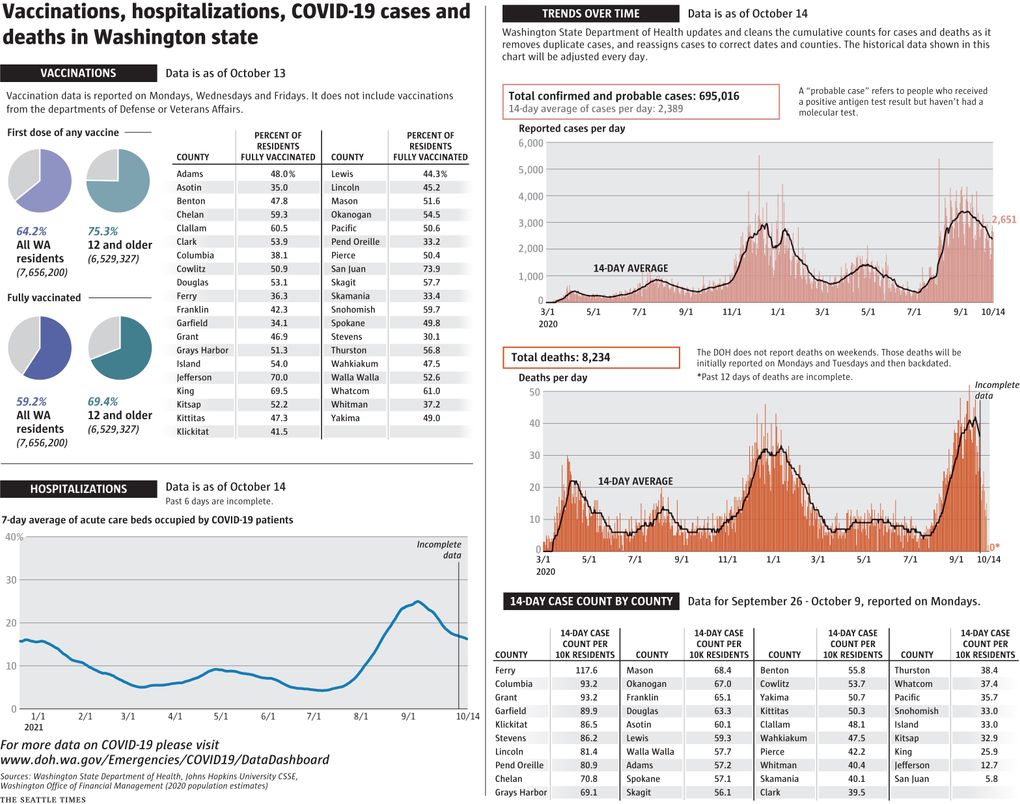
Washington state reported 36 coronavirus-related deaths Friday, bringing the total to 8,234 deaths. Providers are giving an average 18,507 vaccine shots per day.

Major cities, including Seattle, Chicago and Los Angeles, are facing showdowns with large numbers of police who oppose vaccine mandates.

Hundreds of Boeing workers protested the company’s vaccine mandate in Everett on Friday.

Gov. Jay Inslee’s deadline of Monday is fast approaching for state workers to provide proof of vaccinations, or seek religious or medical exemptions.

Over at Washington State Ferries, already short of crew to operate all 10 routes, about 200 workers have yet to supply proof of vaccination, out of 1,900 total employees, spokesperson Ian Sterling said Friday afternoon. It’s unknown how many will be suspended, retire, or seek other work. Service is cut by half on several lines effective Saturday.

We’re updating this page with the latest news about the COVID-19 pandemic and its effects on the Seattle area, the U.S. and the world. Click here to see previous days’ live updates and all our other coronavirus coverage, and here to see how we track the daily spread across Washington.


Deworming drug now at center of COVID lawsuits

Mask rules, vaccination mandates and business shutdowns have all landed in the courts during the COVID-19 outbreak, confronting judges with questions of science and government authority. Now they are increasingly being asked to weigh in on the deworming drug ivermectin.

At least two dozen lawsuits have been filed around the U.S., many in recent weeks, by people seeking to force hospitals to give their COVID-stricken loved ones ivermectin, a drug for parasites that has been promoted by conservative commentators as a treatment despite a lack of conclusive evidence that it helps people with the virus.

Interest in the drug started rising toward the end of last year and the beginning of this one, when studies — some later withdrawn, in other countries — seemed to suggest ivermectin had some potential and it became a hot topic of conversation among conservatives on social media.

Read the full story from the Associated Press here.


Lawsuits demand unproven ivermectin for COVID patients

Mask rules, vaccination mandates and business shutdowns have all landed in the courts during the COVID-19 outbreak, confronting judges with questions of science and government authority. Now they are increasingly being asked to weigh in on the deworming drug ivermectin.

At least two dozen lawsuits have been filed around the U.S., many in recent weeks, by people seeking to force hospitals to give their COVID-stricken loved ones ivermectin, a drug for parasites that has been promoted by conservative commentators as a treatment despite a lack of conclusive evidence that it helps people with the virus.

Interest in the drug started rising toward the end of last year and the beginning of this one, when studies — some later withdrawn, in other countries — seemed to suggest ivermectin had some potential and it became a hot topic of conversation among conservatives on social media.

The lawsuits, several of them filed by the same western New York lawyer, cover similar ground. The families have gotten prescriptions for ivermectin, but hospitals have refused to use it on their loved ones, who are often on ventilators and facing death.

Read the full story here.

—The Associated Press


Why vaccine resisters changed their minds

NEW YORK — In the Bronx, a youth counselor closed his eyes and steeled himself for the shot. In Queens, a nurse calmed herself by humming gospel music. In Manhattan, a graduate student asked one last question about fertility while reviewing the consent form.

With a mixture of nervousness, resentment and, sometimes, relief, hundreds of thousands of New Yorkers finally got a dose of coronavirus vaccine in recent weeks. In some cases, it was because they had a change of heart; perhaps, more commonly, it was to keep their jobs.

The uptick in vaccinations has contributed, experts say, to a flattening of the virus curve in the city, where the numbers of new infections and hospitalizations have been falling — a trend across the United States as well.

Read the full story here, from the New York Times.


What Oregon’s vaccine deadline means for State Police and juvenile corrections

Oregon State Police employees who have not complied with Monday’s vaccine deadline will be placed on administrative leave the following day, the agency said.

As of Friday, 73{cfdf3f5372635aeb15fd3e2aecc7cb5d7150695e02bd72e0a44f1581164ad809} of the agency’s 1,270 employees had been fully vaccinated and 12{cfdf3f5372635aeb15fd3e2aecc7cb5d7150695e02bd72e0a44f1581164ad809} had obtained exceptions to the mandate, with most of the exemptions citing religious grounds.

That leaves 15{cfdf3f5372635aeb15fd3e2aecc7cb5d7150695e02bd72e0a44f1581164ad809} – about 200 workers – who have not taken any steps to comply, according to the Oregon Department of Administrative Services.

State police Capt. Stephanie Bigman said the agency doesn’t anticipate “any impact to public safety” despite the possibility of placing dozens of patrol troopers on leave.

Senior Trooper Joshua Wetzel, president of the union that represents about 750 troopers, sergeants and other workers in the agency, said that’s an unrealistic expectation.

Read the full story here.

—oregonlive.com


Vaccine mandates stoked fears of labor shortages. But hospitals say they’re working.

At Houston Methodist – one of the first American health-care institutions to require workers to get vaccinated against the coronavirus – the backlash was short-lived.

More than 150 employees were fired. There were legal battles and protests. But President and CEO Marc Boom has no regrets: 98{cfdf3f5372635aeb15fd3e2aecc7cb5d7150695e02bd72e0a44f1581164ad809} of staff have been vaccinated, and they and patients are safer as a result, he said.

“I can unequivocally say [it was] the best decision we ever made,” Boom said in an interview.

Houston Methodist is not alone in requiring its employees to be vaccinated. About 41{cfdf3f5372635aeb15fd3e2aecc7cb5d7150695e02bd72e0a44f1581164ad809} of hospitals nationwide – roughly 2,570 facilities – have some sort of vaccine mandate, according to data collected by the American Hospital Association, a trade group. Others are expected to follow after President Biden announced last month that he would require most health-care facilities that accept Medicaid or Medicare funding – many of which also treat immunocompromised people who are at high risk of getting severely ill from covid – to vaccinate their employees.

Most health-care systems that require vaccination have touted widespread compliance. In interviews, administrators at some of the nation’s largest hospital systems said the mandates worked: Officials said that they have very high vaccination rates they attributed to the requirement and that they have seen coronavirus infections – and sick leaves – noticeably drop.

Read the full story here.

—The Washington Post


Russia’s daily COVID-19 deaths top 1,000 for first time

Russia’s daily death toll from COVID-19 has exceeded 1,000 for the first time as the country faces a sustained wave of rising infections.

The national coronavirus task force on Saturday reported 1,002 deaths in the previous day, up from 999 on Friday, along with 33,208 new confirmed COVID-19 cases, more than 1,000 higher than the day before.

Russian authorities have tried to speed up the pace of vaccinations with lotteries, bonuses and other incentives, but widespread vaccine skepticism and conflicting signals from officials stymied the efforts. The government said this week that about 43 million Russians, or about 29{cfdf3f5372635aeb15fd3e2aecc7cb5d7150695e02bd72e0a44f1581164ad809} of the country’s nearly 146 million people, are fully vaccinated.

Despite the mounting toll, the Kremlin has ruled out a new nationwide lockdown like the one early on in the pandemic that badly hurt the economy, eroding President Vladimir Putin’s popularity. Instead, it has delegated the power to enforce coronavirus restrictions to regional authorities.

Read the full story here.

—The Associated Press


Washington physician assistant’s license suspended over COVID actions

The Washington Medical Commission has suspended the license of a pediatric health care provider in southwestern Washington.

The suspension came this week after an investigation into more than a dozen complaints against physician assistant Scott C. Miller, who runs Miller Family Pediatrics in Washougal, The Columbian reported.

The complaints say he interfered with the care of hospitalized COVID-19 patients, engaged in a threatening public campaign against hospitals and doctors, and also prescribed medications without seeing patients.

The commission’s findings say Miller also “began a public campaign touting the use of ivermectin in treating coronavirus disease,” despite no reliable clinical evidence showing the drug is effective in treating COVID-19.

Read the full story here.

—The Associated Press


New Zealand dispenses record number of jabs at ‘Vaxathon’

New Zealand health care workers administered a record number of vaccine jabs Saturday as the nation held a festival aimed at getting more people inoculated against the coronavirus.

Musicians, sports stars and celebrities pitched in for the “Vaxathon” event which was broadcast on television and online for eight hours straight. By late afternoon, more than 120,000 people had gotten shots, eclipsing the daily record of 93,000 set in August. The event stretched into the evening.

A throwback to TV fundraising “telethon” events that were popular from the 1970s through the 1990s, it comes as New Zealand faces its biggest threat since the pandemic began, with an outbreak of the delta variant spreading through the largest city of Auckland and beyond.

Prime Minister Jacinda Ardern, who chatted with motorists at a drive-through vaccination center in Wellington, initially set a target of 100,000 jabs for the day but upped that to 150,000 after the first target was met.

She also set a target of 25,000 shots for Indigenous Maori, whose vaccination numbers have been lagging and who have been hit hard by the latest outbreak.

Read the full story here.

—The Associated Press


In New Hampshire, vaccine fights and misinformation roil GOP

Republican Rep. Ken Weyler was known around the New Hampshire Statehouse for dismissing the benefits of COVID-19 vaccines and opposing tens of millions of dollars in federal funds to promote vaccinations.

But when the 79-year-old Weyler, a retired commercial pilot and Massachusetts Institute of Technology graduate who chaired the legislature’s powerful fiscal committee, sent a 52-page report likening vaccines to “organized mass murder,” Republican leaders were compelled to act.

“I don’t know of anyone who agrees with it. It’s absolute craziness,” said Republican House Speaker Sherman Packard, who quickly accepted Weyler’s resignation from his committee post.

The episode was especially piercing in New Hampshire, where the previous House speaker died of COVID-19 last year. It has also exposed Republicans’ persistent struggle to root out the misinformation that has taken hold in its ranks across the country.

A year and a half into the pandemic, surveys show Republicans are less worried about the threat from COVID-19 or its variants, less confident in science, less likely to be vaccinated than Democrats and independents and more opposed to vaccine mandates.

Read the full story here.

—The Associated Press


Workers protest angrily near Boeing’s Everett plant against vaccination mandate

Several hundred anti-vaccination protesters, most of them Boeing blue-collar workers, voiced loud and angry opposition to the company’s newly announced vaccine mandate Friday outside the Machinists union hall in Everett.

Lining Airport Way on both sides and undeterred by pouring rain, the crowd waved signs and U.S. flags while chanting anti-vax and anti-government slogans.

The loud scene was made deafening at times as most cars and trucks driving by showed their support with gestures and honking of horns. Several supersized pickups deliberately spun tires and slid sideways across the roadway, burning rubber and slowing the traffic behind them but delighting the protest crowd.

One big pickup flew a U.S. flag and two “Thin Blue Line” flags from the truck bed. A sprinkling of MAGA hats and Donald Trump signs lent a distinctly political edge to the protest as chants broke out directing an obscenity at President Joe Biden.

Workers interviewed at the protest said they are determined to resist Boeing’s mandate, even ready to lose their jobs.

Read the full story here.

—Dominic Gates


With state’s vaccine mandate looming, will Nick Rolovich still be WSU’s football coach next week?

Will Nick Rolovich be Washington State’s football coach after Monday?  

After weeks of speculation, commentary, debate and Rolovich’s refusal to answer questions about his vaccination status, we should know soon. 

That’s because if Rolovich, the state’s highest paid employee ($3.2 million annual salary), is not in compliance with the state’s COVID-19 vaccination mandate that takes effect Monday, he can no longer work as WSU’s football coach. 

To continue coaching, Rolovich needs three things to happen: have his exemption request decided upon (which is no sure thing); have it approved; and if that happens, have his supervisor, WSU Athletic Director Pat Chun, determine that Rolovich can effectively do his job while keeping the public safe. 

WSU employees were encouraged to make exemption requests by Oct. 4, but there is no guarantee that all requests will be processed by Monday. WSU employees still waiting for their exemption request to be ruled upon when the mandate takes effect will be unable to work until it is decided upon — and approved. 

Read the full story here.

—Scott Hanson


Seattle Schools cuts more than 100 bus routes

Beginning Monday, Seattle Public Schools is suspending 142 school bus routes, a move made necessary because of a national bus driver shortage and because some drivers are declining the state-mandated coronavirus vaccine for public employees, district officials say.

Out of the 18,000 students who are eligible for bus rides, about 6,740 could be affected by the bus route cuts, but the actual number could be lower, district spokesperson Tim Robinson said.

The 142 bus routes that are being cut will not affect students in special education classes, students with Individualized Education Programs, students whose disabilities make them eligible for public transportation services, students experiencing homelessness or foster students. Schools at interim sites or those that serve “high proportions of historically underserved students” won’t be affected either, according to an email to parents sent Friday afternoon.  

Seattle Schools does not know how many students will be affected by route shortages because the number of students who ride the bus fluctuates every day, Robinson said. Of the 18,000 students in the district who are eligible for transportation services, it’s estimated about half ride the bus.

Read the full story here.

—Monica Velez


Washington state trooper who died of COVID hadn’t been vaccinated yet, family says

Washington State Patrol Trooper Eric Gunderson, who died from COVID-19 at age 38 last month, was unvaccinated but likely would have gotten a vaccine this fall, family members said in a statement Friday.

Gunderson was best known for leading the State Patrol’s part of the Amtrak 501 investigation, when a speeding passenger train flew off a curve at DuPont, killing three people and injuring dozens in late 2017. A detective specializing in accident reconstruction, Gunderson mapped the scene using drone footage, and was a pioneer in the use of unmanned aircraft to reduce the length of road closures after crashes, the WSP has said.

He died Sept. 26, and is the 32nd trooper to die in the line of duty, according to Chief John Batiste.

Gunderson contracted the coronavirus while traveling for work, said the family’s statement, which was issued Friday by WSP Communications Director Chris Loftis. Though State Patrol officials earlier had said Gunderson caught the virus that causes COVID-19 while on the job, they did not disclose Gunderson’s vaccination status, which prompted questions from news organizations.

Read the full story here.

—Mike Lindblom


The pandemic pushed some students out of Washington’s schools. New data tells us who left.

When the coronavirus pandemic first emerged in the U.S. in early 2020 and forced shutdowns in schools across the nation, most experts assumed that in-person learning would be paused for only a few weeks. Instead, it took many months before children returned to the classroom — and in the Seattle area, it took more than a year. Teachers and districts scrambled to put together online learning, often with little or no training on what works best.

What happened to children during that year of virtual schooling? Educators still don’t have a good measure of how they fared academically, because standardized testing and even simple screening tools to measure specific skills, like reading comprehension, were put on hold. But evidence suggests that students lagged academic expectations by several months or more, and that there were sharp increases in the number of students who failed courses, especially among students from low-income households and students of color.

Many students, especially those from low-income households, struggled with internet access, making it difficult for them to attend virtual school. Children whose parents had to report to work in person were left with a patchwork of caregiving arrangements. Thousands of homeless children in Washington disappeared from school enrollment counts, even as homelessness grew around the Puget Sound area. The pandemic was especially hard on children with learning disabilities, and some districts — like Seattle — were called out by the state superintendent’s office for doing a poor job of supporting those students.

Click here to read the full story.

—Seattle Times staff


What to know about Monday’s COVID vaccine deadline in Washington state

The deadline for most state government, health care and school workers in Washington to get their COVID-19 vaccination is days away. When Gov. Jay Inslee issued the sweeping order this summer, his announcement was clear: Show proof of vaccination on or before Oct. 18 or lose your job.

Since then, however, labor unions have worked on ironing out conditions of employment, thousands of workers have requested exemptions and the state has granted new extensions for certain employees.

In the past few months, more and more questions have emerged.

We rounded up some of the most pressing ones and answered them. Click here to find out what you need to know.

—Elise Takahama


Harborview to allow visitors again Tuesday

Harborview Medical Center will soon reopen its doors to visitors, with a new requirement that they must show proof of vaccination or a negative coronavirus test to be allowed inside, the Seattle hospital announced Friday.

Most visits were banned during the COVID-19 pandemic.

Visitors are expected to wear a medical-grade mask, or put on a free multi-layer surgical mask available at the entrances. Similar policies are expected eventually at all UW Medicine hospitals and clinics.

Read the full story here.


After months in lockdown, a weary world is ready to dance

Even in the depths of the pandemic — even when the world locked down, leaving billions isolated and desolated — there were those who danced.

“I did not stop dancing for a second,” says Federico Carrizo, who competed in the Tango World Championship in Buenos Aires last month. “In the kitchen, on the street, on the balcony …”

Some danced alone. Some danced alone and yet together, swaying and twirling across the internet. Some danced to be freed of the shackles of the coronavirus, if only for a moment.

“It was very hard to be for a year and a half without being able to go out to the recreation center to dance,” says Joaquin Bruzon. “Sometimes during the quarantine at home we would dance to try to improve our spirits.”

Now, once again, the Failde Orchestra of Matanzas, Cuba, can perform danzóns like “El Naranjero” and “Cuba Libre,” “A La Habana me Voy” and “Nievecita.” And once again, Bruzon and his wife, Milagros Cousett, can glide across the dance floor.

Maybe it’s because of the advent of COVID-19 vaccines. Maybe it is because feet can be repressed for just so long. But it seems that everywhere, dancers are letting loose.

Read the full story here.

—The Associated Press

Lifting COVID-19 restrictions could lead to a large flu outbreak

black and white photo of bedsheets and crumpled tissuesShare on Pinterest
COVID-19 restrictions might have weakened inhabitants immunity, so lifting the limitations could induce a flu outbreak. nito100/Getty Illustrations or photos
  • Flu infections dropped by 60{cfdf3f5372635aeb15fd3e2aecc7cb5d7150695e02bd72e0a44f1581164ad809} following the introduction of COVID-19 constraints.
  • This diminished exposure to influenza may possibly mean lessened populace immunity.
  • The lifting of COVID-19 controls could guide to a large flu outbreak.
  • Anybody provided a flu vaccination should choose it to reduce the hazard.

A examine in the Journal of Infectious Ailments has predicted a extreme influenza outbreak as soon as COVID-19 regulate actions are lifted, with elevated levels of flu in the pursuing many years.

The researchers from Columbia University Mailman Faculty of Wellbeing used computer modeling to quantify the reduction in transmission and incidence of flu just after the implementation of control steps. They utilised these knowledge with each other with information from the Centers for Condition Command and Avoidance (CDC) FluView web-site to venture influenza transmission over the up coming 5 years.

Non-pharmaceutical interventions (NPIs), these types of as mask-sporting, physical distancing, journey limitations, and university closures, led to a 60{cfdf3f5372635aeb15fd3e2aecc7cb5d7150695e02bd72e0a44f1581164ad809} fall in flu bacterial infections throughout the 10 weeks after their introduction final 12 months. The review suggests that the lessened publicity to flu all through the handle actions will have led to reduced immunity.

Keep knowledgeable with are living updates on the present COVID-19 outbreak and visit our coronavirus hub for far more assistance on avoidance and treatment method.

Dr. Jonathan Stoye, head of virology at the Francis Crick Institute in London, United Kingdom, told Healthcare News These days: “This modeling research […] suggests that the minimized quantities of bacterial infections in 2020 will lead to waning inhabitants immunity and that this may well, in transform, lead to a surge in flu infections for numerous several years.”

The scientists forecast that comforting steps could direct to a massive-scale flu outbreak, significantly in pieces of the United States where by there had been significant stages of COVID-19 control compliance. They also anticipate that the small concentrations of flu in the course of the pandemic may perhaps make it tough to predict which circulating flu strains they will need to use to inform the future vaccines. This could decrease the efficiency of influenza vaccines.

On a more optimistic note, the authors concede that the predicted bad flu time is not unavoidable. Because of the focus on COVID-19, flu may perhaps have been underreported last yr, so extra men and women may well have been uncovered to the virus than their modeling acknowledges.

Alternatively, since of lessened flu transmission, the virus will have experienced much less prospect to mutate and produce new variants. People might consequently have immunity from previously flu infections, which would guide to a less severe outbreak.

Prof. William Schaffner, Professor of Preventive Medication at Vanderbilt College College of Drugs, TN, is not certain by the suggestion of underreporting: “Last 12 months had the most affordable incidence of flu any of us can keep in mind thanks to the restraints for COVID-19. I do not imagine there was underreporting of influenza. We did not detect a important drop in testing, but minimal flu was detected. I imagine the small flu price was authentic.”

But Dr. Stoye agrees that the severity of an outbreak depends on the variety of variants: “It will be appealing to see regardless of whether such an raise does, in actuality, manifest as charges of viral an infection are driven by various variables, this sort of as adjustments in the rate of physical appearance of new viral variants.”

Prof. Schaffner factors out that other respiratory bacterial infections have greater as daily life starts to return to regular, which would propose that we require to take the warning of a undesirable flu period critically. This summer season, with fewer limits and the return of youngsters to faculty, there has been a surge in instances of respiratory syncytial virus, an infection generally seen only in the winter months. “This could be a harbinger of factors to come,” he pointed out.

“This 12 months, it’s much more essential than at any time to get your flu shot. Although we’re rightly targeted on safeguarding ourselves in opposition to COVID-19, we shouldn’t forget about about the flu, which can be fatal.”

– Senior writer Dr. Sen Pei, Ph.D, Assistant Professor of Environmental Wellness Sciences, Mailman Faculty of Community Well being, Columbia.

“Predicting flu is a hazardous profession,” Prof. Schaffner states. “Because we have had these types of a very low earlier flu time, has our immunity waned in such a way that we are vulnerable to additional transmission and more severe ailment? Flu is fickle — we’ll just have to hold out and see.”

His suggestions is unequivocal: “Take the jab.”

For reside updates on the most recent developments pertaining to the novel coronavirus and COVID-19, simply click in this article.