LONDON — Omicron is “the most significant threat” to public health in the U.K., authorities warned Wednesday, as the World Health Organization cautioned that the highly contagious Covid-19 variant was spreading at an unprecedented rate.
The number of Covid-19 infections over the coming days will be “quite staggering” compared to previous variants, said Jenny Harries, the head of the U.K. Health Security Agency.
Hours after her warning, government data showed that 78,610 new cases had been recorded in the U.K. as of 9 a.m. local (5 a.m. ET) on Wednesday morning — the highest daily number of laboratory confirmed cases since the pandemic began.
Despite the advisories from domestic and international experts, there has been growing resistance to the British government’s new Covid-19 measures — notably from members of Prime Minister Boris Johnson’s Conservative Party.
New regulations intended to help slow the spread of omicron, including masks in public places and the use of Covid-19 passes for some venues, passed in Parliament on Tuesday evening. However, scores of Conservative lawmakers refused to back the new measures.
People wait for a booster vaccine in London on Tuesday. Hannah McKay / Reuters
Some called the new measures too severe and questioned the introduction of a certificate of vaccination or proof of a negative Covid test to enter some venues.
“We are not a ‘papers, please’ society. This is not Nazi Germany,” Conservative lawmaker Marcus Fysh told BBC radio on Monday.
The comment led to pushback both in Parliament and on social media, where the term Nazi Germany trended, and Fysh later apologized for the comparison in a piece he wrote for London’s Jewish Chronicle newspaper.
Omicron’s quick spread
Just over two weeks after the first cases were detected in the U.K., omicron is now the dominant variant in London, the city’s public health chief Kevin Fenton said in a tweet Tuesday.
Since the start of the pandemic, more than 170,000 people have died in the U.K. with Covid-19, one of the highest death tolls in Europe. However, it was the first country to roll out a clinically approved Covid vaccine, and more than 68 percent of the population has been fully vaccinated. That’s ahead of the U.S., where just over 60 percent have been fully vaccinated, according to Our World in Data.
Omicron’s quick spread in Britain, with cases doubling in less than two days in most regions, came as the head of the WHO warned that measures, including masks, social distancing and ventilation, were needed alongside vaccines.
“Omicron is spreading at a rate we have not seen with any previous variant,” Director-General Tedros Adhanom Ghebreyesus wrote Tuesday on Twitter. “I need to be very clear: Vaccines alone will not get any country out of this crisis.”
In the U.S., rising cases and the fear that omicron could spark a new wave of infections led California to reimpose its indoor mask mandate for at least a month.
Europe, meanwhile, is facing a “double challenge,” with high numbers of Covid-19 infections, hospitalizations and deaths driven by the delta variant, as well as the spread of omicron, European Commission President Ursula von der Leyen said in the European Parliament. By mid-January, omicron is expected to be the dominant variant in Europe, she said.
More than 5,300 cases of omicron have been recorded in the U.K., with 10 people hospitalized. One person died after contracting the variant.
British Prime Minister Boris Johnson visits the Health at the Stowe vaccination center in London on Monday.Jeremy Selwyn / AFP – Getty Images
Johnson, who warned Sunday that “there is a tidal wave of omicron coming,” ramped up the country’s booster program, saying that he wants to offer all residents 18 and older a third dose to by the end of the month.
His push for boosters led to long lines at walk-in vaccination centers, with people reporting on social media that vaccines had run out before their turn came. The health service, which provides U.K. residents with free rapid Covid-19 test kits, has faced shortages on its website since Johnson’s televised address Sunday.
The U.K. administered more than 513,000 booster vaccines on Monday, its third highest rate since October.
The push for the third doses also came as the first real-world study of the variant in South Africa showed that two doses of the Pfizer-BioNTech vaccine offered reduced protection against omicron. However, the variant also appeared to cause less severe illness in South Africa, where it was first discovered last month.
The analysis, released Tuesday by South Africa’s largest health care administrator, found that on average 29 percent fewer people were being admitted to a hospital than previously with the delta variant. However, the study also found that two Pfizer jabs gave 70 percent protection against hospitalization from the new variant, compared with 90 percent seen in the delta wave.
Share on PinterestNew research examines trends in blood pressure during the pandemic. Aleks_G/Getty Images
Governments enacted emergency measures in response to the COVID-19 pandemic.
These measures significantly altered people’s behavior.
In a new study, researchers wanted to see if there was a link between these changes in behavior and effects on people’s blood pressure.
The researchers found blood pressure increased during the pandemic compared with previous, non-pandemic years.
In a new study, researchers have found that blood pressure increased in adults in the United States during the pandemic compared with previous, non-pandemic years.
The research, published in the journal Circulation, makes clear that the health effects of the pandemic include not just the COVID-19 disease but also other, indirect health issues.
Doctors measure blood pressure at two points: when a person’s heart is pumping, known as systolic blood pressure, and when a person’s heart is resting between beats, known as diastolic blood pressure.
If a person has high blood pressure, also known as hypertension, they are at a greater risk of stroke or heart disease. Hypertension can also damage a person’s liver, eyes, and brain.
The CDC state that 47{cfdf3f5372635aeb15fd3e2aecc7cb5d7150695e02bd72e0a44f1581164ad809} of U.S. adults have hypertension, and in 2019 hypertension was the primary or contributing cause of more than 500,000 deaths.
A person can help maintain healthy blood pressure levels by eating a diet low in salt and high in fruit and vegetables, exercising regularly, avoiding smoking, and limiting alcohol intake.
However, the COVID-19 pandemic significantly disrupted people’s behavior and access to regular medical care.
Researchers are interested to see if this disruption had an effect on people’s blood pressure levels.
To look at blood pressure levels during the pandemic relative to previous years, a group of scientists studied data from an employee wellness program in the U.S covering 2018–2020.
This involved 464,585 participants, 53.5{cfdf3f5372635aeb15fd3e2aecc7cb5d7150695e02bd72e0a44f1581164ad809} of whom were women, with an average age of 45.7 years in 2018. The paper offered no information regarding the racial or ethnic makeup of the participants.
The scientists compared blood pressure levels before the pandemic in 2018, 2019, and until March of 2020, when most U.S. states gave stay-at-home orders. They then compared these levels with those recorded from April–December 2020 during the pandemic.
The researchers found that before the pandemic, there was no significant change in blood pressure between years.
However, each month during the pandemic, blood pressure increased by an average of 1.1 to 2.5 millimeters of mercury (mmHg) for systolic blood pressure and 0.14 to 0.53 mmHg for diastolic blood pressure. This was the case for both women and men of different ages.
Women, on average, had greater increases for both systolic and diastolic blood pressure. Older participants had greater systolic blood pressure increases, whereas younger participants had greater diastolic blood pressure increases.
Speaking to Medical News Today, Dr. Luke Laffin, co-director of the Center for Blood Pressure Disorders at the Cleveland Clinic in Ohio and the study’s lead author, said that “[d]ietary indiscretion, lack of exercise, central obesity, excessive alcohol consumption, and not taking prescribed blood pressure medications can all drive high blood pressure.”
“Other research demonstrates that lifestyle habits like excessive alcohol intake worsened during the pandemic, so it is not surprising that a blood pressure elevation followed.”
“We also know that patients hesitated to see their doctor, particularly in the early part of the pandemic, and that may have contributed to increased blood pressures,” said Dr. Laffin.
Prof. Matthew Bailey, who leads hypertension and renal research at the Centre for Cardiovascular Science at the University of Edinburgh, Scotland, and was not involved in the study, told MNT that the findings were significant and had global implications.
“This paper has examined almost half a million people and clearly shows that the societal changes [and] restrictions imposed in response to the pandemic have increased blood pressure. The effect is particularly large in women, and there is also an unanticipated increase in young people.”
“A rise in blood pressure of this size increases the risk of debilitating heart attack or stroke. For individuals and their families, cardiovascular disease can be devastating. [F]or governments, these conditions are costly to treat and manage. Health budgets are already overstretched.”
“This study is based in the U.S. but is relevant globally. It provides an early warning signal that poor cardiovascular health might be a big problem a few years down the line,” said Prof. Bailey.
Dr. Tarek Antonios, a senior lecturer in physiological medicine at St George’s, University of London in the United Kingdom, and not involved in the study, told MNT the findings were not unexpected.
“I was not surprised when I saw this article. I am concerned about hypertension and the epidemic. If you put the two together — the COVID-19 epidemic and hypertension — there are certain different avenues [that connect] them.”
“The first one is the increased anxiety levels among the population. Lots of people lost their jobs, they became redundant, lost their businesses, and they lost income — all of this created a lot of stress and anxiety, and that can increase blood pressure. So this is one possible explanation.”
“The second is during the lockdown, there were no open gyms, no one was going out for running or sports, and many people — including some of my patients — put on a significant amount of weight. And once you put on weight, your blood pressure goes up as well.”
“The third point is that people are sitting at home most of the time, they order takeaways, and takeaways are full of salt, and therefore people have increased their salt intake. So there is a lot of stuff that may not be directly related to COVID-19, but [was] indirectly affected by this epidemic.”
“Some patients also found it very difficult to get in touch with their GPs and get a refill of their prescriptions. Some stopped taking their medications, and that also increased their blood pressure levels. [T]his is something we need to give information about to patients — that it is very important that they don’t stop the tablets.”
“Many of my patients have bought blood pressure machines so that they can monitor their own blood pressure and make sure that their blood pressure is well-controlled. This is my advice to most patients: get their own blood pressure machines and start measuring their blood pressure at home.”
Prof. Bailey said that he thought low-level stress and low quality sleep might be key factors in the increase in blood pressure.
“High blood pressure is caused by […] lifestyle [and] environmental factors that were difficult to avoid during pandemic restrictions. Many of us ate too much comfort food — high in salt, fat, and sugar — had limited capacity to exercise, and may have indulged in other […] habits such as drinking too much alcohol or smoking. Of these, the study was only able to discount weight gain itself.”
“I think a major factor is chronic low-level stress and poor sleep patterns. I think this will emerge as a big factor once more studies are done,” said Prof. Bailey.
Speaking to MNT, Dr. Helen Flaherty, head of health promotion and education at Heart Research UK and not involved in the study, also agreed that a range of factors may be at play when accounting for the increase in blood pressure.
“As a result of the pandemic, many people have seen a change to their usual lifestyle habits which, in many cases, can impact negatively on their blood pressure and cardiovascular health.”
“People working from home may be less physically active as they miss out on their usual walk to work or a trip to the gym. Physical activity may also be restricted where people are isolated at home due to the pandemic. In addition, changes to dietary habits, such as buying more takeaway foods, which may be higher in salt, can also contribute to raised blood pressure.”
“Many people have found the pandemic to be stressful and long-term stress is also associated with an increase in blood pressure, as well as behaviors that can increase blood pressure, such as smoking and alcohol consumption,” explained Dr. Flaherty.
As well as possible indirect factors that might account for the rise in blood pressure, Dr. Antonios highlighted that there could be more direct causes.
“The disease itself may cause high blood pressure because of the interaction with certain molecules like the angiotensin-converting enzyme receptors. Moreover, many of my patients called to tell me that once they got the vaccines — especially the first dose — their blood pressure went very high, and they ended up in A&E and casualty with systolic blood pressure exceeding 200 in some of them.”
“What is also interesting is that for many of [my patients], the blood pressure did not settle down and remained high — not as high as 200, but higher than it was before. I am doing some research now to look at the effects of vaccination on blood pressure. And I have at least nine patients who had the same reaction: [their] blood pressure went up, and they ended up in casualty at St George’s [hospital].”
“Since then, there have been two publications — one from Lausanne in Switzerland and the second from Italy — that describe exactly this. Especially with the BioNTech vaccine, the blood pressure goes very high. What we don’t know is why this happens and why it does not settle down,” said Dr. Antonios.
Dr. Antonios also said there could be a connection between long COVID and hypertension. However, this required more research.
“What we don’t know so far is if hypertension is part of the long COVID syndrome. Most papers and reviews have not included hypertension [as part of long COVID]. They have included, for example, chest problems, myocarditis, thromboembolic phenomena, or even diabetes, but hypertension is not yet part of this long COVID syndrome, which we don’t know much about.”
Dr. Laffin said researchers should continue monitoring blood pressure levels:
“It is going to be very important to identify if blood pressure elevations persisted throughout 2021, given that vaccination became more widespread and individuals started returning to see their medical provider. I think it is unlikely that we’ll see a decline to pre-pandemic levels until the current pandemic ends.”
Crucially, there are limitations to the generalizability of the study’s findings. In the U.S., Black adults consistently exhibit significantly higher rates of hypertension, for example, compared with their white counterparts. However, the present study did not characterize blood pressure based on race or ethnicity. This is an important point that researchers should further evaluate during the pandemic.
Fortunately, there are many things a person can do to try and maintain healthy blood pressure levels.
Prof. Bailey said: “I try to make sure I eat well and sleep well and have goals for regular exercise. Using mindfulness or breathing apps can be a really good way to unplug for a few minutes in the day. It’s a great idea to get your blood pressure measured — know your numbers — and to remember to keep taking the medicine if you have high blood pressure.”
“High blood pressure increases your risk of having a heart attack or stroke. However, many people are unaware that they have high blood pressure as there are usually no symptoms. It is important to have your blood pressure checked regularly. Ideal blood pressure is below 120/80 mmHg,” Dr. Flaherty told us.
“To maintain healthy blood pressure, it is important to maintain a healthy weight by eating a healthy diet and getting plenty of physical activity. Eating a diet that is not too high in salt also helps to avoid raised blood pressure. Keep an eye on food labels and avoid foods that have a high salt content, such as salted nuts and potato chips.”
“Limit your alcohol intake to no more than the recommended amounts — in the U.K. this is no more than 14 units of alcohol a week, spread out over 3 or more days.”
“Physical activity can help to reduce your blood pressure, and adults should aim to do 150 minutes of moderate-intensity activity — for example, brisk walking — or 75 minutes of vigorous-intensity activity — for example, running — each week.”
About fifty percent of this year’s profitable dealerships stated they supply telecommuting as a typical follow. And more than 50 percent of the suppliers on the listing stated their telecommuting fees elevated soon after the start off of the pandemic in early 2020, with some reporting that half or much more of workers were being doing work from household, in accordance to a study by Most effective Organizations Team, which compiled the Best Dealerships To Do the job For listing. Individuals premiums have given that moderated, nevertheless almost a quarter of the successful dealerships documented that staffers are continue to telecommuting at levels bigger than ahead of the pandemic commenced.
At Faulkner Subaru, BDC reaction time to customers’ queries is now 5 to 10 minutes, down from up to 30 minutes pre-pandemic, Jones mentioned, citing knowledge from the store’s customer connection management program.
The top secret sauce? Utilizing the Slack communication platform allows staff members to promptly ship messages even when they are active. In advance of, BDC brokers had been pressured to wait for, say, a sales supervisor to get off a phone contact or complete a assembly right before having issues answered, Jones explained.
Outside of the BDC, two place of work staff stored doing work remotely, this means about 10 percent of the store’s 4 dozen employees now telecommute, up from zero right before the pandemic, Jones said.
Also, the remote staff feel to communicate more than standard to compensate for not getting in a position to speak experience-to-encounter with colleagues.
Kim Stanley, an region human resources manager for Penske, reported telecommuting can aid catch the attention of and keep staff members.
“We consider we will have to go on to look for these sorts of options in purchase to attract and keep group members shifting forward,” Stanley wrote in response to a survey of winners executed by Automotive News.
Diana Kennedy, standard manager of Volvo Cars Marin in San Rafael, Calif., owned by Price Simms Relatives Dealerships, mentioned, “I can unquestionably see us performing much more of this as we mature, but there are boundaries.”
Two of the Volvo store’s staff members — a marketing manager and a BDC agent — now operate from household. Those careers are suited for remote do the job mainly because they you should not involve continual face-to-deal with interaction with fellow employees, consumers or vendors, Kennedy explained.
“Our internet marketing manager is just as productive as just before, if not additional,” she stated. “She enjoys getting the flexibility to composition her day as necessary and suggests it assists a good deal when she can prevent and get a walk to mentally regroup. Which is tough to do in the shop, where by you are often getting interrupted by curveballs.”
Share on PinterestThe pandemic increased mortality rates in people with mental health issues compared with people without. JGI/Tom Grill/Getty Images
A study finds that people with mental health issues or intellectual disabilities have been far more likely to die during the pandemic than others.
More people in these groups have died of COVID-19 and other causes.
There are likely several reasons for this disparity.
According to a new study, people in the U.K. with mental health issues and intellectual disabilities were at about twice the risk of dying than people without those conditions before the COVID-19 pandemic.
The study suggests this difference has increased dramatically during the pandemic, with people with mental health conditions and intellectual disabilities experiencing much higher death rates.
The current study considered “excess deaths,” a general category of deaths during a particular period compared with historical levels.
Says the study’s lead author, Dr. Jayati Das-Munshi of King’s College London in the United Kingdom:
“The results from our study paint a stark picture of how the existing vulnerability of those with mental health conditions and intellectual disabilities has worsened during the COVID-19 pandemic. The higher death rates compared [with] the general population were associated with more deaths from [SARS-CoV-2] infection itself, as well as deaths from other causes.”
Dr. Thomas F. Betzler, executive clinical director of the Montefiore Behavioral Health Center in New York, who was not involved in the study, confirmed for Medical News Today that “many of our patients have similar issues.”
Dr. Das-Munshi says the study’s findings warrant a reappraisal of the groups understood to be at high risk of dying from COVID-19:
“People living with severe mental health conditions and intellectual disabilities should be considered a vulnerable group at risk of COVID-19 mortality — as well as deaths from other causes — throughout the pandemic. We suggest a need to prioritize vaccination and optimize physical healthcare and suicide risk reduction before, during, and after peaks of [SARS-CoV-2] infection in people living with mental health conditions.”
The study’s analysis found an increased likelihood of dying among people with mental health issues and intellectual disabilities in the U.K. during the first COVID-19 lockdown compared with the general population.
Specifically, they found that:
People with intellectual disabilities were 9.24 times more likely to die of COVID-19.
People with eating disorders were 4.81 times more likely to die of COVID-19.
People with dementia were 3.82 times more likely to die of COVID-19.
People with personality disorders were 4.58 times more likely to die of COVID-19.
People with schizophrenia spectrum disorders were 3.26 times more likely to die of COVID-19.
These groups experienced a brief respite, relatively speaking, from July to September 2020 during a temporary drop in COVID-19 cases. During these months, their risk returned to the pre-pandemic, already doubled, chances of mortality.
MNT asked Holly Kathryn Tabor, Ph.D., an associate professor of medicine at Stanford University, California — who was not involved in the study — why this disparity occurs. She replied that there are likely several reasons.
“It’s very hard for adults with intellectual disabilities to get access to basic healthcare and to other things that are social determinants of health, and they have much poorer health overall,” said Dr. Tabor.
Dr. Tabor also explained that the conditions cited by the study:
“All require you to be able to have a care provider and go get help from them, and also have a safety net. Your care provider isn’t going to do everything for you. You have to have people taking care of you and looking in on you. Health is more than just getting a prescription. Health is more than going to the doctor when you have a heart attack. Health is a lot of other things, and […] because of those conditions, all those people need help getting to a doctor.”
Dr. Betzler pointed out that these groups often experience “medical comorbidities, delayed or poor access to healthcare, living in a group or congregate care setting, and psychiatric hospitalizations.”
Joseph A. Stramondo, Ph.D., another expert not involved in the study, focuses on the intersection of the philosophy of disability and bioethics at San Diego State University.
Dr. Stramondo told MNT about the often damaging effect of institutionalization on some people in these groups. He recalled the 1972 TV exposé of the Willowbrook State School on New York’s Staten Island.
In that coverage, he said, “you just saw horrifying living conditions, and so it’s no wonder that there’s going to be increased mortality for disabled people living in these places.”
An additional factor may be triage decisions regarding who doctors treat. Early in the pandemic, hospitals in the United States had to devise “crisis standards of care.”
A number of these policies contained language that either overtly or indirectly excluded people with mental health issues or intellectual disabilities, leaving disability advocates “completely justifiably” angry, said Dr. Tabor.
Dr. Stramondo told MNT that the attitudes embodied in discriminatory policies “are fundamentally about disvaluing disabled lives.”
He explained: ”There is this presumption that they have a lower quality of life – that there ought to be less effort put into preserving their lives. And I think that we see that over and over again in various contexts.”
However, according to Dr. Tabor, “The advocacy groups and the attorneys generally succeeded in getting most crisis standards of care policies to have at least the explicit and very often the implicit discriminatory language taken out.”
“But,” she cautioned, “a policy is only as good as the people who are implementing it and hopefully doing it right.” So far, only a few states have officially implemented their crisis standards of care policies.
The disparities before and during the pandemic are “a judgment on our society,” Dr. Tabor said. “And the fact that the people who are the least well-off in our society also have the poorest health [is] just magnified with COVID-19.”
Dr. Tabor noted that “the ways in which our society is ableist and discriminatory against people with disabilities — that those [biases] existed in the first place pre-pandemic — is a sign and symptom of what already exists in society. And it’s appalling and needs to change, absolutely.”
Your sweatpant size is not the only point ballooning in this pandemic — the variety of suppliers promoting trend-ahead comfort clothing is growing like an elasticated waistband.
When thousands and thousands of business-dwellers moved en masse to function from home in the early times of the pandemic, it sparked a change in trend developments, too, considering the fact that men and women no for a longer time wanted the exact outfits for the exact activities they were being applied to.
Adult men who generally wore the vintage suit and tie to the business office observed by themselves placing those Oxford shirts and a few-parts to the back again of the closet, and grabbing one thing considerably less staid for their phalanx of Zoom conferences.
And girls who’d commonly costume to impress with a shirt and slacks or pencil skirt were now donning something more cozy although on the job.
That compelled clothes vendors to improve what they do, way too.
Apparel income overall fell in Canada in 2020, but have come roaring back by 20 per cent so significantly this yr, according to Tamara Szames, an sector adviser to vogue and retail with the research agency NPD Group.
View | Why do the job-from-home apparel could be below to stay:
Stores consider staples of function-from-household wardrobes are right here to continue to be
The shift of millions of men and women to work from their properties sparked a improve in vogue toward consolation — especially sweatpants and ‘athleisure’ put on. But even as Canadians return to the place of work, merchants are acquiring these pandemic staples are sticking around. 2:04
“It really is athleisure and individuals ease and comfort classes that are major the way,” she mentioned in an job interview, utilizing the field portmanteau for clothing built for the two athletic activity and every day daily life.
Two a long time back, these types of “energetic” apparel designed up about 25 per cent of the apparel that Canadians ended up buying. Now it can be far more than one-third — and profits are increasing two times as fast as other kinds of apparel, claimed Szames.
No wonder merchants are attempting to income in on the craze. Denim pioneer Levi Strauss declared earlier this thirty day period that it willinvest in the Over and above Yoga brand name for an undisclosed sum, citing the want to “diversify its business enterprise” further than their legendary jeans.
The Gap, together with its flanker manufacturers Old Navy and Banana Republic, is also reinventing alone on the fly, closing shops and beefing up its on the web operation.
That is a unpleasant transition that has noticed the ubiquitous retail chain shut down more than 200 Hole suppliers in North The usa since 2019. But it also now has virtually that lots of physical outlets of its athleisure brand name, Athleta.
Retail analyst Tamara Szames states product sales growth in the athleisure group is outpacing just about each and every other variety of clothes. (Jacqueline Hansen/CBC)
Athleta is opening two new flagship Canadian stores — in Toronto and Vancouver — due to the fact they are self-assured that the athleisure pattern has being electrical power.
“We know the Canadian client is super active … she’s hiking, she’s swimming, and our effectiveness life style merchandise provides the skill for her to do all of all those activities in genuinely comfy activewear with general performance traits,” said Jennifer Steichen, the chain’s North The united states vice-president for stores and operations.
With 199 outlets now, Steicher said the business expects the athleisure group to double by 2023.
Athleta is focusing on men and women wanting to be classy and at ease even though remaining active — not automatically people sitting down in their household offices all day.
And though the corporation is banking on the fact the sweatpant pattern is listed here to keep, that will not indicate schlubby is in.
Far from it.
Michelle Watson is the founder and imaginative director of Michi, an ethically designed apparel label that describes by itself as a maker of “energetic life style garments that combines significant overall performance and large vogue.”
She dreamed up the thought for relaxed, nicely-produced and stylish exercise session gear while living in New York a lot more than a ten years ago. Soon after some beneficial early evaluations for her handmade prototypes, she took the organization again to her homeland of Canada in 2012 to check out to develop.
Now, her dresses are offered in retailers about the planet, including major section stores like The Bay, Holt Renfrew and Selfridges.
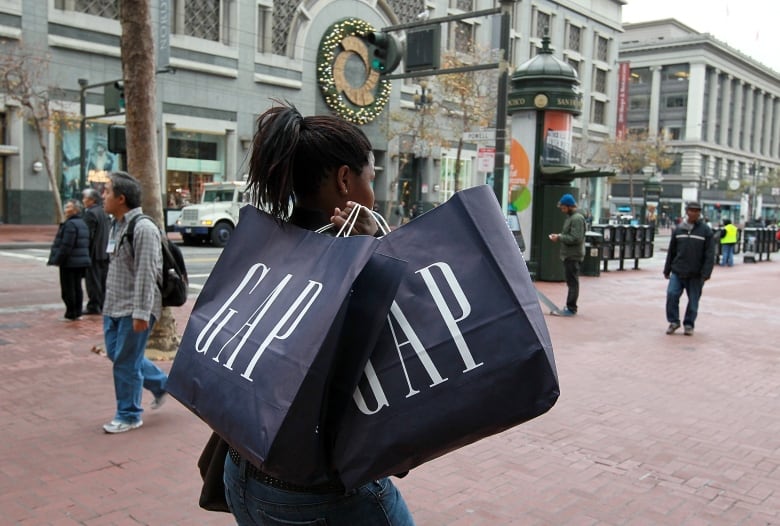
The iconic Hole purchasing bag may perhaps be on the decrease, but the company’s yoga-concentrated model Athleta is quickly growing, like into Canada, with two flagship shops opening this fall in Toronto and Vancouver. (Justin Sullivan/Getty Illustrations or photos)
While the pandemic built matters tougher in lots of approaches, Watson reported it served in other methods by fuelling present developments toward far more online procuring, and a need for extra adaptable and comfortable clothing.
“I constantly believed in producing goods that can be worn in the fitness center for your most extreme routines, but also included into your typical wardrobe,” she said. “I have been sporting the products to get the job done each single day, operating definitely extensive hours, and I cannot go back to just about anything else.”
She’s not by yourself.
At Yorkdale Mall in Toronto, the place Athleta is poised to open up coming thirty day period, shopper Sarah Mohavir reported relaxed dresses have turn out to be her “go to” while functioning from property in the pandemic.
“I never even know if I could go again to wearing gown trousers,” she joked.
Style is normally reinventing itself, and Szames said the new buyer force to need convenience and design in business wear is just an extension of what arrived earlier.
“We observed the pattern commence with folks carrying Lululemons to the grocery retail store or on the weekend — and that seriously progressed and trickled into our day to day wardrobe,” she reported.
“Now we’re seeing more athleisure go into a different segment of the market place and we are starting off to see it move into going out and even do the job wear,” she stated.
Wherever the drive for trendy ease and comfort goes up coming, Watson calls it an concept whose time has arrive.
“Ease and comfort is a motion … not a pattern,” she quips. “It is really below to stay.”