The latest coronavirus news from Canada and around the world Saturday. This file will be updated throughout the day. Web links to longer stories if available.
5:45 p.m.: In a gathering with more than 20,000 people from nearly every country in the world, one of the biggest major international summits since the pandemic began, a COVID-19 outbreak was always going to be a danger. So far, organizers have not revealed the number of positive COVID-19 …
GLASGOW, Scotland — In a gathering with more than 20,000 people from nearly every country in the world, one of the biggest major international summits since the pandemic began, a COVID-19 outbreak was always going to be a danger.
So far, organizers have not revealed the number of positive COVID-19 test results. But on Saturday, the State Department confirmed that a member of the U.S. delegation had tested positive. Earlier, Mayor Eric Garcetti of Los Angeles tested positive days after arriving in Scotland.
The State Department statement Saturday declined to identify the person but said the official had been fully vaccinated and was quarantining. The statement also said John Kerry, the U.S. presidential envoy for climate change who is leading the negotiations at the summit, had received several negative COVID-19 results, including daily lateral flow tests and a PCR test, since the delegate tested positive.
Asked this week about the number of positive tests at the conference, Alok Sharma, the British president of the talks, said the numbers were lower than in the rest of Scotland. “At this point, we’re comfortable where we are,” he said.
5:23 p.m.: Winter is coming, COVID-19 is accelerating at an alarming pace in Colorado and the state’s 43 rural hospitals continue to struggle through debilitating staff shortages.
Employees have left small-town health care facilities complaining of burnout, and now that vaccine mandates are in place, some have quit over being forced to receive the shot.
In one rural hospital, a pharmacist and a business office employee died of COVID-19 within a week of one another, leaving co-workers at Holyoke’s Melissa Memorial Hospital grief stricken and overworked as those positions remain unfilled.
“They died very tragically,” said MMH CEO Cathy Harshbarger. “Both required a lot of support and medical care. We had to ship them out to other hospitals for care. We’re stretched to the max.”
Holyoke, about three hours northeast of Denver, has a population of 2,200 people.
MMH has run a help wanted ad in the Holyoke Enterprise for 10 openings including a dietary cook, a paramedic and an EMT. The hospital has a separate ad for an executive director to lead its hospital foundation.
“More and more my employees are asking, ‘Why am I in health care?’ ” said Harshbarger.
5:20 p.m.: A month ago the coronavirus seemed headed for a long winter’s nap in masked and well-vaccinated California. Gov. Gavin Newsom boasted that the Golden State “continues to lead the nation” as the only state to reach the Centers for Disease Control and Prevention’s yellow “moderate” tier of community virus transmission.
But COVID-19 cases aren’t falling in California anymore. They have climbed back up to the CDC’s blood-red “high” level of virus transmission as the highly contagious delta variant continues to wreak havoc.
Meanwhile, the virus has gone quiet in Deep South states that abandoned mask orders, opposed vaccine mandates, posted lower vaccination rates and saw larger outbreaks over the summer. California’s case rate is now well above Texas’ and double Florida’s, which along with the rest of the Gulf Coast are down to the CDC’s orange “substantial” transmission level.
“There are early indications that the decline in the delta surge at the national level in the U.S. has ended,” said Ali H. Mokdad, professor of health metrics sciences at the University of Washington, which runs a widely followed model projecting the course of the pandemic. Currently, 19 states have increasing transmission, including several like California “that had previously appeared to have been declining.”
And while much of the Golden State’s current coronavirus woes are driven by virus spread in the less-vaccinated and restricted inland counties, the Bay Area hasn’t been immune. Most Bay Area counties that hoped to reach the yellow moderate level by now remain stubbornly stuck in orange. Marin and Santa Cruz counties, which had reached the yellow level, are back up to orange. San Francisco is the only county in yellow.
4:20 p.m.: A federal appeals panel in Louisiana has temporarily blocked the Biden administration’s new safety regulations directing businesses with more than 100 workers to require their employees to get vaccinations against the coronavirus by early January.
The three-judge panel from the U.S. Court of Appeals for the 5th Circuit granted a temporary stay to a group of businesses, religious groups, advocacy organizations and several Republican-led states that had filed a joint petition in court, arguing the administration had overstepped its authority.
Numerous Republican-led states have filed legal challenges against the new rule, among them Texas, Mississippi, South Carolina and Utah.
4:04 p.m.: A Rhode Island man who federal prosecutors said used stolen identities to obtain more than $450,000 in pandemic-related unemployment assistance was arrested in Michigan, authorities said.
Dquintz Alexander, 34, of Cranston, Rhode Island, was indicted and charged in federal court in Boston on five counts of wire fraud, one count of conspiracy to commit wire fraud and one count of aggravated identity theft, according to the U.S. attorney for the District of Massachusetts.
As the coronavirus pandemic devastated the economy in March 2020, Congress passed the Coronavirus Aid, Relief, and Economic Security Act, which among other things created a temporary federal unemployment insurance program called Pandemic Unemployment Assistance. The program granted unemployment insurance benefits to people who lost their jobs or were unable to work because of the coronavirus.
The pandemic unemployment program, which is administered by each state, lowered the barriers to collecting benefits, and the usual security methods intended to prevent fraud were not able to keep up with security breaches. Last year in California, an underground internet bazaar that specialized in selling stolen accounts and data had for-sale ads for filched unemployment insurance claims in the state that had been approved and offered benefits worth $17,550.
2:31 p.m.: New Brunswick is reporting 50 new cases of COVID-19 and 51 recoveries.
The active confirmed case count now sits at 476 across the province.
Health officials say 13 people are currently in hospital, with eight in intensive care.
Twenty-two of the new cases were identified in the Moncton region.
Sixty per cent of the new cases are in people who are unvaccinated against the disease.
Officials also say nearly 86 per cent of eligible New Brunswickers are fully vaccinated against COVID-19, while 92.8 per cent have received their first dose of a vaccine.
1:30 p.m.: Quebec is reporting 688 new cases of COVID-19 today and four deaths attributed to the virus.
Health officials say COVID-19-related hospitalizations dropped by 11 to 229, while the number of people in intensive care declined by six to 51.
The seven-day average for new cases stands at 561.
Of the latest reported infections, 409 were among people who were either unvaccinated or who had only received a first dose within the past two weeks.
Quebec says another 6,869 vaccine doses have been administered, most of which were given in the past 24 hours.
The province’s public health institute says about 91 per cent of Quebecers aged 12 and older have received at least one dose, while 87 per cent are considered fully vaccinated with two shots.
12 p.m.: Ukraine’s health ministry on Saturday reported a one-day record of 793 deaths from COVID-19.
Ukraine has been inundated by coronavirus infections in recent weeks, putting the country’s underfunded medical system under severe strain.
The ministry said 25,063 new infections had been tallied over the past day; a record 27,377 were reported on Thursday.
Although four different coronavirus vaccines are available in Ukraine, only 17.9 per cent of the country’s 41 million people have been fully vaccinated, the second-lowest rate in Europe after Armenia.
11:25 a.m.: Nearly two years of being caged in Canada during the COVID-19 pandemic has some snowbirds anxiously waiting in their motorhomes and trailers in southern Alberta.
The Eight Flags Campground in the small windswept town of Milk River, 18 kilometres from the Canada-United States border crossing at Coutts, is full of shiny, large RVs.
It’s in anticipation of land and sea border crossings reopening Monday for fully vaccinated Canadians. Such crossings were closed to non-essential travel at the beginning of the pandemic in March 2020.
10:45 a.m.: An Independent member of Ontario’s legislature has apologized for a post in which he used names and photos of people who had died to suggest without evidence that they had died due to COVID-19 vaccination.
Randy Hillier, who represents Lanark-Frontenac-Kingston, has frequently posted COVID-19 misinformation and conspiracy theories throughout the pandemic.
In one recent social media post, he used an array of photos from news articles about what he believed to be the sudden and unexplained deaths of young people and called on police to investigate links to vaccines.
Family members of some of those people told various media outlets that they were angered by Hillier’s post and denied his allegations, while the legislature unanimously passed a motion last month condemning him.
Hillier shared an apology Friday night saying he has removed that post and offering sincere regrets for further distress his actions caused the grieving families.
Public Health Ontario says all deaths following vaccination that are reported to public health units are thoroughly investigated, and it has so far determined in one case that vaccine-induced immune thrombotic thrombocytopenia was a cause of death in someone who received the AstraZeneca vaccine.
There are seven other reports of death after COVID-19 vaccination that meet the provincial surveillance definition. In four, the adverse events were found to have possibly contributed to the death but were not the underlying cause, and in the remaining three the vaccine was not a cause of death.
Public Health Ontario says another 30 deaths following COVID-19 vaccination that have been reported to public health units are “persons under investigation.” They don’t meet the provincial surveillance definition, but investigations are underway.
“Preliminary information suggests that these events occurred in individuals with multiple co-morbidities which may be related to the cause of death,” a recent Public Health Ontario report said. “There has been no association with the vaccine identified at this time.”
Health officials say the approved vaccines are effective and safe.
10:20 a.m. (updated): Ontario is reporting 508 new COVID-19 cases and three additional deaths in the province in its latest daily count.
In Ontario, 203 people are hospitalized with COVID-19 — 151 are not fully vaccinated or have an unknown vaccination status and 52 are fully vaccinated.
The province also says due to data cleanup, three deaths were removed from the overall count.
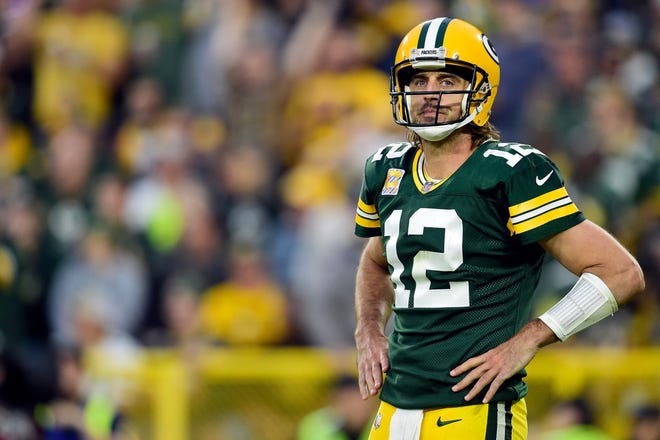
10 a.m.: Green Bay Packers quarterback Aaron Rodgers will miss Sunday’s game at Kansas City after being placed in the NFL’s COVID-19 protocol. Because he is considered unvaccinated, he must stay isolated for at least 10 days.
Here’s an explanation of the NFL’s protocols and a breakdown of Rodgers’ case.
9:20 a.m.: I live in a world where Mike McCarthy kept his job as my boss for 13 years. I don’t trust authority.
If Aaron Rodgers had just said that, maybe the rest would have been an easier ride. But then again, he may be the greatest quarterback in the biggest pro sports league of a country where at least 775,000 people have died during the pandemic, and Friday he spent 45 minutes pumping out the kind of misinformation that can get people killed. You know what that means? Rodgers could be president, one day.
All grim, tight-faced jokes aside, the Green Bay Packers great has had himself a week. Rodgers contracted COVID, it turned out he wasn’t vaccinated, and Friday he went on former punter and current shouty bro Pat McAfee’s Sirius XM show and delivered almost every anti-vaccine talking point you can imagine.
Read the column from the Star’s Bruce Arthur.
8:40 a.m. Unvaccinated people in Austria who also haven’t had COVID-19 will no longer be allowed to enter restaurants, hotels and hair salons or attend public events larger than 25 people under new rules that take effect Monday, the government said.
Austrian Chancellor Alexander Schallenberg outlined the rules Friday night after a meeting with state-level leaders to discuss the country’s response to rapidly rising coronavirus cases.
“It is simply our responsibility to protect the people in our country,” Schallenberg told reporters, noting the case numbers and increasingly full hospital intensive care units.
7:30 a.m.: You can almost forget about the ongoing collective nightmare of the pandemic when you’re sipping a mojito in the pink twilight on the edge of the undulating Atlantic, and a long arc of surf foams over the distant reef, and a soft breeze rustles the palm fronds and laps against your sun-tender skin.
But you can’t.
For despite having to navigate a whole bureaucracy of attestations and electronic paperwork to embark abroad these days, there’s no guarantee the people around you are COVID-free. You hope everyone is vaccinated. But you can’t be sure. And even then, it’s still possible to get infected.
Yet after almost two years living with the coronavirus, we are experiencing a cautious re-emergence. And the door is open to vacation again.
Travel is back, but is pandemic tourism fun? Read the story by the Star’s Alex Ballingall.
7:15 a.m. Russia’s COVID-19 cases hit another one-day record as the country struggles to contain a wave of infections that has persisted for more than a month.
The national coronavirus task force on Saturday reported 41,335 new cases since the previous day, exceeding the previous daily record of 40,993 from Oct. 31. The task force said 1,188 people with COVID-19 died, just seven fewer than the daily death record reported Thursday.
Officials cite Russia’s low vaccination rate as a major factor in the sharp rise in cases that began in mid-September. The task force reported about 57.2 million full-course vaccinations, or less than 40{cfdf3f5372635aeb15fd3e2aecc7cb5d7150695e02bd72e0a44f1581164ad809} of the country’s 146 million people.
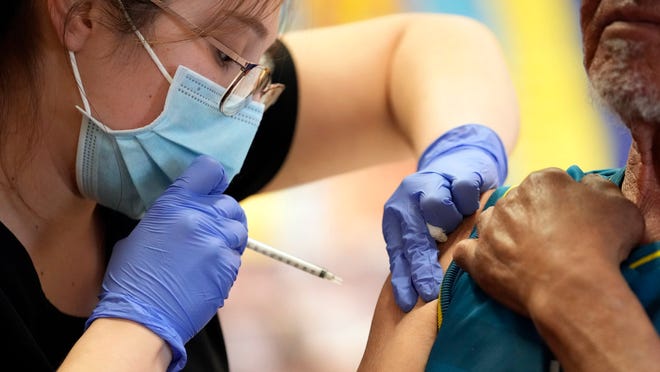
7 a.m. Several groups of high-risk Ontarians will be eligible to book COVID-19 booster shots starting this morning at 8 a.m.
An additional 2.75 million people become eligible for boosters today, following the quarter of a million people already eligible who include certain immunocompromised individuals and residents of long-term care and retirement homes.
Starting today, people can book an appointment for a booster dose if they are aged 70 and older, health-care workers or essential caregivers in congregate settings, people who received two doses of the AstraZeneca vaccine or one dose of Janssen, and First Nations, Inuit and Metis adults and their non-Indigenous household members.
They can make appointments that are at least six months after their second dose. Ontario’s chief medical officer of health says evidence suggests that’s when immunity starts to wane.
Dr. Kieran Moore says those groups of people are at an increased risk of waning immunity and greater risk of exposure and serious illness.
Ontario officials say the protection from two doses is still very high for the general population after six months, especially against severe illness and death, so a booster dose would provide additional protection against more mild illness.
The province is planning to eventually offer booster doses to everyone, and is eyeing early 2022 to start the broader rollout.
6:45 a.m.: The United States is steadily chipping away at vaccine hesitancy and driving down COVID-19 cases and hospitalizations to the point that schools, governments and corporations are lifting mask restrictions yet again.
Nearly 200 million Americans are fully vaccinated and the nation’s over-65 population, which bore the brunt of the pandemic when it started nearly two years ago, is enthusiastically embracing vaccines.
Nearly 98{cfdf3f5372635aeb15fd3e2aecc7cb5d7150695e02bd72e0a44f1581164ad809} of the over-65 population has received at least one COVID-19 shot and more than 25{cfdf3f5372635aeb15fd3e2aecc7cb5d7150695e02bd72e0a44f1581164ad809} of them have gotten boosters, just weeks after they were authorized. The improving metrics could get a boost from President Joe Biden’s workplace mandate unveiled Thursday and the launch of COVID-19 shots in elementary-age students.
6:30 a.m. Green Bay Packers quarterback Aaron Rodgers said Friday he sought alternative treatments instead of the NFL-endorsed COVID-19 vaccinations because he is allergic to an ingredient in two of the FDA-approved shots.
Speaking on SiriusXM’s “Pat McAfee Show,” Rodgers said: “I’m not an anti-vax, flat-earther. I have an allergy to an ingredient that’s in the mRNA vaccines. I found a long-term immunization protocol to protect myself and I’m very proud of the research that went into that.”
Rodgers, who turns 38 on Dec. 2, did not say what ingredient he was allergic to, or how he knows he is allergic.
Rodgers, who has been tested daily as part of NFL protocols for the unvaccinated, found out he contracted COVID-19 on Wednesday. The reigning NFL MVP said he didn’t feel well on Thursday but was much better on Friday.
6 a.m. Monday’s reopening of the Canada-U.S. land border is sparking a mixed reaction among Canadian business leaders: They’re excited that people and not just goods will be crossing the border again but are wary of remaining red tape.
The Canadian Chamber of Commerce and the Business Council of Canada say the Canadian requirement for returning travellers to provide a recent, negative molecular test is an unnecessary obstacle to kick-starting business travel and tourism.
They say proof of vaccination is all that should be needed and the test requirement should be scrapped.
They argue that the continued testing requirement is too cumbersome for Canadian business travellers wanting a quick visit to an American destination, and too expensive for families who want a vacation or reunion with loved ones.
“If we believe, as we should, that being fully vaccinated is the best way of minimizing risk, we should be trusting the vaccination systems. We should be monitoring what’s taking place in terms of outbreaks in the two countries,” chamber president Perrin Beatty said in an interview.
5:45 a.m. As Ontario slowly creeps toward the goal of having 90 per cent of the eligible population vaccinated against COVID-19, new data shows vaccine rates are stubbornly lagging in some neighbourhoods and among groups of people across the province.
The latest numbers from non-profit research group ICES, formerly known as the Institute for Clinical Evaluative Sciences, out Friday, show there are still stark differences hiding behind the overall vaccination rate.
“There is a huge range, with some areas hovering around 50 per cent of the population fully vaccinated and some areas as high as 90 per cent,” said Dr. Jeff Kwong, lead of the Populations and Public Health Research Program at ICES.
“The risk of outbreaks in these areas with low vaccination coverage is worrisome. It means there is a lot of fuel for a fire to burn.”
Read the full story from the Star’s Megan Ogilvie and May Warren here.
5:30 a.m. Eleven patients died Saturday after a fire broke out in a hospital’s COVID-19 ward in the western Indian state of Maharashtra, police said.
An official told New Delhi Television that around 17 patients were in the ward when the fire broke out. The remaining patients have been moved to a COVID-19 ward in another hospital, district collector Rajendra Bhosle said.
While the fire has since been brought under control, the cause was not immediately clear, he added, saying officials will carry out an investigation.
The former chief minister of the state, Devendra Fadnavis, took to Twitter to express his condolences and called for “strict action” against those responsible.
Such incidents are not uncommon in India. In May, when the country was battling a devastating surge in coronavirus cases, a fire in a COVID-19 ward in western India killed at least 18 patients.
Poor maintenance and lack of proper firefighting equipment often cause deaths in India.




/https://www.thestar.com/content/dam/thestar/news/canada/2021/11/06/covid-19-coronavirus-updates-toronto-canada-november-6/afw_newsfeatures01.jpg?w=1200&resize=1200&ssl=1 "Today’s coronavirus news: Ontario reports 508 new cases, three more deaths; expands eligibility for booster shots; U.S. COP26 delegate tests positive")