Hong Kong says it’s back open for business. Will the world buy it?

Hong Kong says it’s back open for business. Will the world buy it?


Hong Kong
CNN
 — 

At a glitzy finance summit in Hong Kong this week, the city’s leader triumphantly told a room packed with top Wall Street executives that the Asian hub was back in business. “The worst is behind us,” he declared.

Two days later, tens of thousands of rugby fans descended on the city’s largest stadium for the Hong Kong Sevens, its biggest (and usually booziest) annual sporting event, which had been suspended since 2019 due to political unrest, and, later, Covid-19.

The two high-profile international events sent a clear message: After almost three years of border closures, mandatory quarantines, and restrictions on businesses and social gatherings, Hong Kong was finally reopening.

For much of the pandemic, the semi-autonomous Chinese city maintained some of the region’s most stringent restrictions, including one of the world’s longest mandatory quarantines for international arrivals. With the economy tanking and concerns mounting that Hong Kong was being left behind as the world moved on, the government finally threw open the city’s doors in September and ended formal quarantine to the relief of millions of people.

“We were, we are and we will remain one of the world’s leading financial centers,” vowed Hong Kong leader John Lee at Wednesday’s summit, attended by more than 200 investors from 20 countries. “You can take that to the bank.”
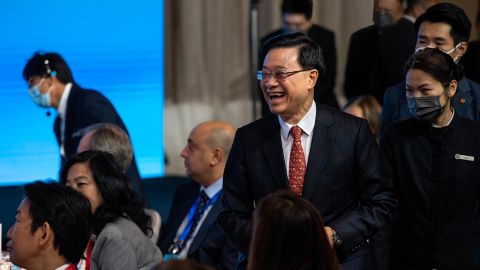
Hong Kong leader John Lee during the Global Financial Leaders Investment Summit on November 2.

Speaking on Friday ahead of the kickoff of the Sevens, Hong Kong Rugby Union CEO Robbie McRobbie hailed the return of the tournament as a “catalyst, watershed,” a symbol that “Hong Kong is still a vibrant, resilient city.”

But experts warn the push to revive Hong Kong, while welcome and long overdue, faces many challenges ahead.

The past few years of isolation, which coincided with an ongoing political crackdown, have taken their toll, they said. Despite what Lee and other leaders insist, the Hong Kong that’s reopening is not the same city the world knew before the pandemic – and the true impact of that change remains to be seen.

Last year, as many destinations reopened to travelers and relaxed restrictions, Hong Kong appeared to be stuck in a different reality.

Restaurants, bars and gyms were frequently forced to shutter or limit their hours. Residential buildings were placed under lockdown for days. At one point, public gatherings were capped at two people. And most residents didn’t leave the city for years, unable or unwilling to spend up to three weeks in hotel quarantine at their own cost upon return.

Businesses were hit hard. The Sevens tournament makes up 95{cfdf3f5372635aeb15fd3e2aecc7cb5d7150695e02bd72e0a44f1581164ad809} of the Hong Kong Rugby Union’s revenue, so “we’ve had three years of redundancies and cutbacks,” said McRobbie.

Many disillusioned residents chose to leave permanently; this past year, the city recorded its steepest drop in population since records began in 1961. Companies, too, began eyeing other locations – most notably Singapore, Hong Kong’s longtime regional rival.

But Hong Kong authorities, eager to reopen the border with mainland China – which still shows no sign of easing its strict zero-Covid policy that aims to stamp out infections – remained reluctant to loosen restrictions for fear cases would spike and close that door.

Then, a severe outbreak fueled by the highly contagious Omicron variant at the start of the year put an end to Hong Kong’s hope of maintaining zero daily cases.

Under mounting public pressure, the government lifted flight bans with certain countries and shortened hotel quarantine in March – but these small concessions did little to lure people back.

According to media reports in August, some Wall Street banks warned their executives would only attend Wednesday’s finance summit if there was quarantine-free travel – a widely-speculated factor behind the government’s ultimate decision to scrap quarantine.

Finance leaders in the city breathed a sigh of relief at the news.

“We’ve been closed for too long,” said Sebastian Paredes, CEO of Singaporean bank DBS’ Hong Kong operations. “We are beginning to open up following the other parts of the world that have already opened up. And this is a tangible demonstration that Hong Kong is back.”
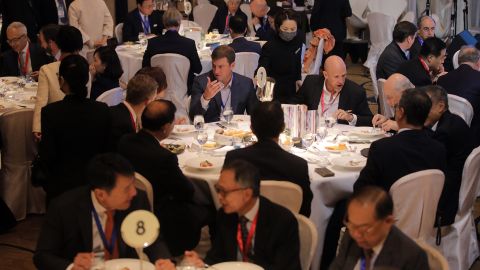
Attendees at the Global Financial Leaders' Investment Summit in Hong Kong on November 2.

Alicia Garcia-Herrero, chief Asia Pacific Economist of French investment bank Natixis, agreed the week’s dual big events were “a big sign of Hong Kong moving away from Covid restrictions to a new world.”

However, the remaining restrictions pose a competitive disadvantage.

International visitors must take Covid tests for seven straight days after arrival in Hong Kong, and for the first three days are barred from restaurants, bars and gyms. But the testing doesn’t stop there – bars and clubs that don’t serve food require proof of a negative rapid antigen test from all patrons.

A mask mandate – indoors and outdoors – is also in effect, though photos of the finance summit show attendees sitting at tables without face coverings. They included the city’s Financial Secretary Paul Chan, who was declared a “recovered case” by health authorities after testing positive for Covid upon arrival from a trip abroad on Tuesday.
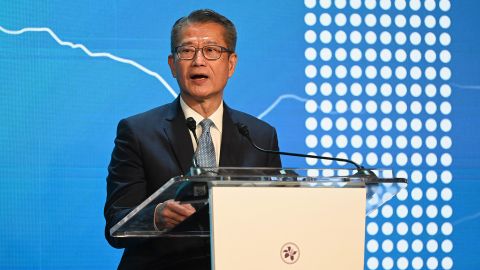
Hong Kong's Financial Secretary Paul Chan makes a speech at the Global Financial Leaders Investment Summit in Hong Kong on November 2, 2022.

These rules are “still largely prohibiting the overseas travel market,” said McRobbie, the Hong Kong rugby chief. Before the pandemic, roughly half the fans at the Sevens came from abroad; this year, that number is “negligible,” he said.

The long stretch of isolation and financial hardship has also created challenges for companies hoping for a comeback. Many people have left the sports and events sectors in the past few years in favor of more stable jobs, leaving the industry short staffed, McRobbie added.

This partial reopening has left the city in an awkward Covid limbo, said Vera Yuen, an economics lecturer at the University of Hong Kong.

“If we want to open up our border with the Mainland China, our restriction is too lenient … so it’s not allowed,” she said. “But then if we want to open ourselves up to the world, we are still too stringent. We are now stuck in between, hoping to see better policies in the future.”

Others also warn of growing political challenges. “Clouds are certainly coming to Hong Kong from different angles,” said banker Garcia-Herrero, pointing to the West’s response to the sweeping national security law Beijing imposed on Hong Kong in 2020.

Under this law, pro-democracy activists have been jailed or exiled, independent newsrooms shut down, and former lawmakers targeted. Meanwhile, authorities have changed school curricula to emphasize Chinese history and culture, and pushed greater economic cooperation in the Greater Bay Area, a national scheme to link China’s southern Guangdong province closer with Hong Kong and Macao.

The law has been widely criticized by foreign governments and human rights organizations, with the United States sanctioning Lee and other top Hong Kong officials over their role in the crackdown. Hong Kong authorities have repeatedly claimed the law has restored order and stability after the city’s 2019 anti-government, pro-democracy protests.

For the US and the European Union, the national security law and crackdown represent “a change in the rules of the game in what was agreed upon,” said Garcia-Herrero.

These rising tensions could spell trouble for Hong Kong’s trade and diplomatic relationships with other countries. Hong Kong is afforded more freedoms than other Chinese cities, thus has long been seen as a gateway between the mainland and the West – a position that looks increasingly precarious as its civil liberties erode.

“The West would now understand that Hong Kong is not only part of China, but it’s closer to China than before,” said Yuen, the economics lecturer. “The worst scenario is that the West would treat Hong Kong as the same as the mainland China, and then Hong Kong would suffer the kind of sanctions.”

And this drawing closer together is likely to continue. In an effort to stem the brain drain, the government is spending 30 billion Hong Kong dollars ($3.8 billion) to draw in global businesses and fresh talent – which Yuen said is expected to “attract a lot of mainland workers” who may be eager to escape an even more dire job market across the border.

Despite these geopolitical frictions, some argue Hong Kong’s innate advantages will allow a revival – even if the city is heading in a different direction than before.

Asia doesn’t have many other financial centers that can match Hong Kong’s open regulatory environment, low salaries tax and existing financial infrastructure – “therefore, even if the image may be tarnished a little bit, there are not many other places to go,” said Garcia-Herrero.

Yuen echoed this point, saying the city’s proximity to China remains appealing to businesses and investors hoping to tap into the vast and lucrative mainland market.
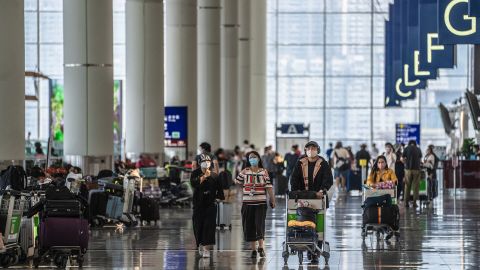
Travelers in the departure hall at Hong Kong International Airport following the government's scrapping of hotel quarantine, on September 26.

“We can plug into China and sort of maintain the status as having a little bit of autonomy, and (being) different from them, given different Covid policies and (systems of) governance,” she said.

But, both experts acknowledged, the path forward is now fraught with new risks. International businesses may come to Hong Kong, but be warier in how much they invest in the city, keeping in mind the threat of US sanctions and regional conflict.

Today’s Hong Kong is increasingly under Beijing’s control, with China growing more assertive on the world stage as leader Xi Jinping enters a third term in power surrounded by loyalists. Those rising tensions between China and its rivals have caused growing divides “as the world deglobalizes,” said Garcia-Herrero – effects that inevitably spill over into Hong Kong, caught in the middle.

“It will never be, in my opinion, what it used to be in terms of the openness of Hong Kong to both the West and the East,” she said.

Is Today’s World a More Dangerous Place for Journalists?

Is Today’s World a More Dangerous Place for Journalists?

On May possibly 11, Palestinian-American journalist Shireen Abu Akleh was shot and killed by an Israeli soldier even though reporting for Al Jazeera in the West Bank, in accordance to the information network.

Only times just before, nearly 8,000 miles away in Mexico, a few journalists were killed in the span of three times, marking 11 reporters killed there given that the commence of the year. Just a working day immediately after Abu Akleh’s slaying, Chilean journalist Francisca Sandoval died from wounds she endured just after remaining shot in the head although masking a protest.

The the latest spate of killings of reporters begs an vital dilemma, industry experts in the field say: Is today’s planet a extra unsafe area for the push?

Jody Santos, a human legal rights filmmaker and traveling to assistant educating professor of journalism at Northeastern College, argues yes, noting that the rise in authoritarianism around the world is building the occupation of journalists extra perilous. She points out that earth leaders — like previous U.S. President Donald Trump, Mexican President Andrés Manuel López Obrador, and some others — vilify the push. Via their polarizing rhetoric, they normalize intense behavior towards those people reporting the information, she states.

woman waering blue floral shirt and brown jacket

Jody Santos, a human legal rights filmmaker and traveling to assistant instructing professor of journalism. Image by Alyssa Stone/Northeastern University

“When you say ‘fake news, faux news’ or ‘journalists are the enemy,’ it produces this extra permissive environment for physical assaults on the media,” Santos claims. “It produces an ambiance exactly where it’s permitted to dedicate violence towards journalists.”

Marcus Howard, an award-winning reporter and associate educating professor of journalism at Northeastern, agrees that journalists are viewed far more negatively

now in the United States and all over the earth. Politicians in Brazil, Mexico, Russia, Venezuela, the U.S. and other nations proceed to denounce customers of the press as “fake news” and take care of them with hostility, he notes.

“That unquestionably has had a detrimental impact on how journalists are considered and contributed to threats to journalists,” Howard suggests. 

Howard notes that increased accessibility to news by way of the web has compounded the threats journalists experience by making authoritarian leaders come to feel like their energy is in jeopardy, earning it much more likely that they would take care of journalists as enemies.

“The world-wide-web has exposed a ton of folks to other parts of the entire world. When you have details at people’s fingertips, that’s a risk to places with leaders who want to limit people’s legal rights and freedoms,” Howard states. “The press should really be keeping leaders accountable for their steps. We want a vibrant press that … exposes wrongdoing in governments and firms. All of that is significant for a modern society to operate.”

Also, when a journalist is assaulted or killed in a nation with a federal government that is hostile towards push freedoms, the individual dependable is not generally prosecuted, Santos says. She provides the absence of effects has a ripple influence, sending a perilous concept that almost nothing will take place if a journalist is attacked.

Relatively, she details out, entire world leaders should to attempt to deliver a unique concept, “that a crime against a journalist is a criminal offense in opposition to the nation, and the liberty of the press is incredibly essential for democracy.” 

Supporting the strategy that the globe has turn out to be a much more unsafe spot for journalists, a variety of push liberty trackers have downgraded many countries’ ranks in relation to their journalistic protections, Howard notes.

This year’s ​​Globe Press Flexibility Index, which assesses the point out of journalism in almost 200 nations, rated the United States 42nd in press freedoms, offering it only a “satisfactory” ranking. The index gave only eight international locations the highest “good” rating, in comparison to 25 in 2013.

Marcus Howard, associate training professor in the School of Journalism. Photo by Matthew Modoono/Northeastern College

“Journalism is less than menace,” Howard suggests. “A good deal of folks assume we in the United States have a cost-free surroundings for the push to operate in, but these push liberty trackers have downgraded the United States in some circumstances. That’s a problem.”

Howard and Santos stage out that the dangers journalists confront consider unique sorts. Further than getting assaulted or killed, they could have their equipment or paperwork taken away they could be surveilled and tracked by the federal government or they could even be arrested and detained.

They say quite a few racial justice demonstrations structured in the United States in 2020. In the course of these protests, journalists were attacked for executing their position and even questioned and arrested by regulation enforcement.

A documentary filmmaker who has traveled to dozens of nations around the world, reporting on all the things from refugee crises in Kenya to the human trafficking of gals and women in Nepal, Santos has confronted some of the extremely threats she discusses. She typically has armed protection with her on assignments and, if not, employs basic safety protocols with fellow journalists if they perception hazard. 

“Just pulling out the digicam and tripod quickly can deliver off alerts and make you a goal,” Santos claims. “But as a journalist, as a filmmaker, you just never know exactly where the threat is likely to appear from. One particular time, we had been stopped in Honduras by the police, which are notoriously corrupt, and that was possibly the time we were most in danger, with the law enforcement.”

Santos is also the govt director of a media group known as the Disability Justice Job, which trains people with disabilities in the International South on electronic storytelling. A lot of its curriculum facilities on teaching journalists about the array of threats they could deal with as perfectly as the protection protocols they need to use, which includes turning off locale solutions so they can’t be tracked, backing up their individual documents in case they get missing or confiscated, and not putting up on social media about where they are going so they will not be specific. 

Journalists are not just enduring physical dangers however, Santos says. There are also emotional chance variables that reporters experience in the discipline that the Incapacity Justice Task talks with taking part fellows about, mostly posttraumatic pressure.

“Probably in the previous ten years, we’ve been hearing a great deal additional communicate about posttraumatic anxiety amid journalists. That term was a little something that was used for a ton of to start with responders, like law enforcement officers and firefighters,” Santos says, “but journalists are also encountering trauma on a extremely deep and own stage.”

In courses she teaches at Northeastern, Santos notes, she talks with college students about their actual physical and emotional safety. If they are reporting on an situation that could be triggering for them, she can make guaranteed to discuss to them about working by it, or regardless of whether they want to swap to a different assignment.

“Now, the discussions are starting up to open up a small little bit, and it’s a lot more acceptable to chat about the psychological risks alongside with the physical threats,” Santos suggests.

For media inquiries, make sure you call media@northeastern.edu.

The world may be careening toward a 1970s-style energy crisis — or worse

The world may be careening toward a 1970s-style energy crisis — or worse

Contrary to these infamous episodes, this a person is not contained to oil.

“Now we have an oil crisis, a gasoline disaster and an electrical power disaster at the similar time,” Fatih Birol, head of the Global Electricity Agency watchdog group, explained to Der Spiegel in an job interview released this week. “This electrical power crisis is significantly bigger than the oil crises of the 1970s and 1980s. And it will most likely final extended.”

The world economic climate has mostly been in a position to withstand surging vitality costs so much. But charges could continue on to rise to unsustainable degrees as Europe tries to wean itself off Russian oil and, likely, gas. Supply shortages could direct to some tricky selections in Europe, such as rationing.

Joe McMonigle, secretary general of the Global Strength Discussion board, explained he agrees with this depressing forecast from the IEA.

“We have a really serious difficulty all over the globe that I consider policymakers are just waking up to. It truly is variety of a ideal storm,” McMonigle, whose group serves as a go-involving for power creating and consuming nations, informed CNN in a mobile phone interview.

'I wouldn't trust them.' Energy Secretary blasts Russia for 'weaponizing' energy
The extent of that best storm — underinvestment, powerful demand from customers and provide disruptions from the war — will have large-achieving effects, potentially threatening the economic recovery from Covid-19, exacerbating inflation, fueling social unrest and undermining initiatives to preserve the planet from global warming.

Birol warned of offer bottlenecks of gasoline and diesel, especially in Europe, as effectively as rationing of organic fuel future winter in Europe.

“It is a disaster for which the world is woefully unprepared,” reported Robert McNally, who served as a top rated electrical power adviser to previous US President George W. Bush.

Not only are strength selling prices extremely higher, but the dependability of the electricity grid is currently being challenged by intense temperatures and severe drought. A US electrical power grid regulator warned last month that parts of the place could experience energy shortages and even blackouts this summer months.

‘Our fears have borne out’

Former Obama power adviser Jason Bordoff and Harvard College professor Meghan O’Sullivan wrote a piece in the Economist in late March warning that the entire world was on the cusp of “what may perhaps turn into the worst electricity crisis considering that the 1970s.”

“Due to the fact we wrote that, our fears have borne out,” Bordoff, co-founding dean of the Columbia Climate Faculty, advised CNN.

Of class, there are important variances among nowadays and the 1970s. Selling prices have not spiked nearly as a lot as they did then and policymakers have not resorted to excessive measures like value controls.

“Were we to vacation resort to price tag controls and selling price caps, then we could have shortages,” McNally stated.

When the war started off, the West sought to keep away from focusing on Russia’s energy provides instantly for the reason that it was simply way too crucial to world wide markets. Russia is not just the world’s largest oil exporter, but it is the most significant normal gas exporter and a key supplier of coal.

But as the brutality of the war grew to become distinct to the globe, that arms-off tactic did not past, with the United States and other international locations banning Russian strength imports.

Russia retaliated from Western sanctions by proscribing or even halting its cargo of pure fuel to multiple European countries.

The European Union declared designs this week to section out 90{cfdf3f5372635aeb15fd3e2aecc7cb5d7150695e02bd72e0a44f1581164ad809} of Russian oil imports by the conclusion of the yr. That go has lifted the specter of even further retaliation from Russia.

Energy experts sound alarm about US electric grid: 'Not designed to withstand the impacts of climate change'

This tit-for-tat scenario has only worsened the offer shortfall in energy markets that were previously limited.

“We have not however viewed how lousy this electricity disaster is heading to get,” Bordoff mentioned.

Already, US gasoline rates have surged by 52{cfdf3f5372635aeb15fd3e2aecc7cb5d7150695e02bd72e0a44f1581164ad809} over the past year to document highs, angering the general public and contributing to the nation’s inflation disaster.

Rates for all-natural gas, a very important gasoline for heating properties and powering the electrical grid, have practically tripled more than the previous year in the United States. All-natural gas costs have skyrocketed even more in Europe, while they are very well off their worst amounts.

‘Putin just introduced us there faster’

Present-day electrical power turmoil is not simply just the final result of the war in Ukraine. It is also the byproduct of cratering financial investment in oil and pure gas, which are depleting means that involve enormous sums of funds just to preserve their generation, enable by yourself raise it.

Upstream expenditure in the oil and gas sector stood at just $341 billion in 2021, 23{cfdf3f5372635aeb15fd3e2aecc7cb5d7150695e02bd72e0a44f1581164ad809} beneath the pre-Covid amount of $525 billion and nicely down below the modern peak in 2014 of $700 billion, according to the IEF.

This expenditure shortfall has been introduced on by a series of elements, which include a press between traders and governments to wager on clean up strength, the uncertain long run of fossil fuels and many years of weak and unstable oil rates.

California drought could cut state's hydropower in half this summer

“Mainly because of the want to bring down carbon emissions, we have a lot significantly less urge for food to devote in hydrocarbons. And that exacerbates the cost volatility and will make it much more tough to resolve the source side,” claimed Francisco Blanch, head of worldwide commodities at Lender of The united states.

Europe was now grappling with an electricity disaster previous yr and prices for pure gasoline, coal and oil had been high prolonged ahead of the initially Russian tanks commenced rolling into Ukraine.

“We had been heading to a crisis in any case. Putin just introduced us there speedier and sharper,” explained McNally, who is now the president of consulting firm Rapidan Electrical power Group.

Shortages and fuel lines?

The 1973 oil crisis was marked by hrs-lengthy lines at gas stations, fuel shortages and worry.

Gurus reported they fear about gas shortages yet again now, although they watch that as a bigger danger in Europe than in the United States.

“Gasoline shortages are a world wide problem. You are going to see that incredibly quickly, while it’s possible not in the US,” said Lender of America’s Blanch.

'I wouldn't trust them.' Energy Secretary blasts Russia for 'weaponizing' energy

Blanch mentioned he thinks this possibility is lower in the United States simply because the state stays a single of the largest oil producers on the world and is a main exporter of strength. Europe, on the other hand, is far more reliant on international oil and organic gasoline — specifically from Russia.

The IEA chief warned of purely natural gasoline rationing in Europe, which is greatly dependent on Russia for gasoline.

Blanch famous that sky-significant natural gasoline selling prices have currently shut down factories in Europe.

“Europe is by now in organic gasoline rationing method,” he said.

‘We have to be careful here’

Electrical power experts informed CNN they worry international policymakers are mismanaging the weather disaster, focusing as well a lot on lessening provide and not more than enough on cutting the world’s urge for food for fossil fuels.

“We are not undertaking approximately plenty of to lessen hydrocarbon need steady with our climate goals,” stated Bordoff.

Concentrating on just one facet of the equation threats not only price spikes but social unrest and turning the public off to climate motion.

“We have to be cautious here because if we permit the general public to equate large strength price ranges with the electricity changeover, we are doomed,” stated McMonigle. “You will effectively drop public guidance, probably forever.”

McMonigle urged governments to send indicators to traders that not only is it alright to continue to spend in fossil fuels, but it can be “vital” for the planet financial system and development in the vitality changeover.

But even if policymakers influence buyers to ramp up expense, that would consider appreciable time to final result in a lot more offer.

What could conclusion the electrical power crisis

Of class, no just one can say with certainty particularly how all of this will enjoy out. And there could be surprises that simplicity the supply crunch.

For instance, a diplomatic breakthrough that finishes the war in Ukraine and will allow sanctions to get lifted from Russia would be a gamechanger.

Birol reported other surprises that would simplicity the electricity crisis consist of an Iranian nuclear deal, a further economic slowdown in China or an settlement by Saudi Arabia and other OPEC producers to ramp up oil output.

Inflation worries are real but this isn't the 1970s

He also reiterated that governments stand ready to launch further crisis stockpiles of oil. However, even the record-setting release of US crisis stockpiles experienced just a modest and fleeting effect on gasoline rates.

In March, the IEA also urged governments all-around the globe to think about drastic steps to slash oil need, like lowering pace limits on highways, operating from house up to a few times a week wherever achievable and car or truck-no cost Sundays in cities.
And there is at least just one other growth that has been front-and-center lately and would relieve the electrical power crisis: An economic economic downturn, or at least one particular that is deep plenty of to cause desire to collapse.

Coronvirus news file for May 30: gta and world updates

Coronvirus news file for May 30: gta and world updates

The most current coronavirus information from Canada and about the earth Monday. This file will be up to date throughout the working day. Web inbound links to for a longer period stories if accessible.

1:55 p.m. The Earth Health and fitness Organization’s leading monkeypox expert stated she does not anticipate the hundreds of conditions reported to day to turn into one more pandemic, but acknowledged there are however several unknowns about the ailment, which includes how exactly it is spreading and whether the suspension of mass smallpox immunization a long time back may well in some way be speeding its transmission.

In a community session on Monday, WHO’s Dr. Rosamund Lewis explained it was crucial to emphasize that the huge greater part of cases being noticed in dozens of countries globally are in gay, bisexual or gentlemen who have intercourse with adult men, so that researchers can more review the difficulty. She urged all those at hazard to be very careful.

“It’s really vital to explain this for the reason that it seems to be an enhance in a mode of transmission that might have been beneath-acknowledged in the earlier,” stated Lewis.

10:45 a.m. From incorporating stability screening officers to rolling back again necessary random COVID-19 tests, the federal federal government is shifting swiftly to tackle the chaos at Canadian airports, which have been plagued with delays as air journey ramps up ahead of the summertime months.

The delays, which have been attributed by unions to preventable labour shortages, have brought about extended traces at safety checkpoints for departing travellers.

As effectively, industry reps have known as for COVID-19 screening steps to be rolled again, as they are contributing to delays for arriving international passengers.

Read the full tale from the Star’s Rosa Saba

10 a.m. Fewer than one in a few Individuals have obtained an additional shot of the COVID-19 vaccine and one patient protection team thinks which is a community overall health challenge.

The nonprofit ECRI stated in a posture paper that adopting a booster shot plan targeting emerging variants would produce certainty and convince more People to get boosted and support reduce COVID-19 spread in communities.

“This is the simply call to action,” stated Marcus Schabacker, president and CEO of ECRI, a patient basic safety nonprofit. “Only 30 per cent of individuals who are eligible to get vaccinated actually have a booster. It truly is not sufficient if we want to get this (pandemic) into an endemic state.”

Federal health and fitness agencies have cleared vaccine boosters for older people and teens, and final week, for young children ages 5 to 11. The Fda is reviewing Moderna’s vaccine for more youthful small children. Pfizer-BioNTech on Monday stated its COVID-19 vaccine appears to be secure and successful for kids below 5.

9:45 a.m. Some 8.9 million Canadians received the Canada Unexpected emergency Response Advantage (CERB) through the pandemic, and 1000’s of them are now obtaining out they did not qualify for some or all of it.

Now, of program, they have to fork out it again, with the Canada Profits Agency sending repayment notices to those people it has determined possibly weren’t qualified at all or gained also considerably.

If you can park how aggravated you are to discover out you have to fork out the income back again, you definitely have no preference but to try out to be strategic about how you’re likely to do it, in particular if you actually, genuinely simply cannot manage to do so.

Read through the column from Lesley-Anne Scorgie

9:15 a.m. Canada’s backlog of Nexus applications has ballooned into the hundreds of thousands, irrespective of a sharp downturn in candidates during the pandemic.

The Canada Border Expert services Agency (CBSA) suggests extra than 295,000 Nexus apps have nonetheless to be processed owing to ongoing business closures prompted by COVID-19.

Would-be cardholders in the plan, which makes it possible for pre-authorised Canadians to go by way of separate, speedy lines when travelling to the United States, will have to be possibility-assessed by equally the CBSA and U.S. Customs and Border Safety.

The American company reopened its Nexus enrollment centres for applicant interviews on April 19, but centres in Canada continue being shut just after shuttering in March 2020.

The ensuing backlog means some Nexus users are having difficulties to e-book sit-downs in advance of their cards expire, as Canadian citizens hoping to renew their standing can only program interviews in fewer than a dozen border community workplaces where by slots are couple of.

8 a.m. Morocco, which reopened to holidaymakers in February, has eased COVID-similar entry protocols ahead of summertime, no for a longer time necessitating vacationers with proof of comprehensive vaccination to make a adverse test end result.

“The Moroccan govt has decided to terminate the PCR take a look at problem for entry into Moroccan territory. This determination will occur into pressure on publication of this push launch,” officers verified on May perhaps 17.

As of proper now, travelers can visit Morocco with a wellness sort concluded in advance of boarding and possibly a valid vaccination passport or a damaging PCR examination end result much less than 72 hrs outdated. Kids below the age of 12 are exempt from all specifications.

7:20 a.m. Approval rankings of Indian Key Minister Narendra Modi’s authorities have risen to the greatest considering that the begin of the pandemic however there is lingering issues over the surging costs of important items and unemployment, the most current study confirmed on Monday.

Modi’s government has satisfied or exceed anticipations in the next expression, in accordance to 67 for every cent of 64,000 individuals polled by LocalCircles. That is a soar from 51 per cent very last yr when a brutal 2nd wave of Covid-19 infections overwhelmed hospitals and crematoriums and 62 per cent in 2020 when the pandemic started off.

The people today surveyed said the governing administration was improved organized to manage a third wave of COVID-19 bacterial infections and had efficiently managed the economy. Still there ended up issues above unemployment remaining about 7 per cent considering that the begin of the calendar year with 47 per cent of those people polled saying India has not been in a position to tackle the challenge.

6 a.m. Novavax hitched its wagon to the world wide coronavirus pandemic. Just before most Americans certainly grasped the scope of the risk, the smaller Maryland biotech startup experienced secured $1.6 billion in U.S. funding for its COVID-19 vaccine. Its moonshot purpose: offering 2 billion shots to the environment by mid-2021.

Even though the U.S. determination at some point expanded to $1.8 billion, rarely any Novavax photographs have located arms owing to producing troubles, and most of the world has moved on. Novavax stock has plummeted from $290 a share in February 2021 to all around $50 lately.

The Fda last but not least seems poised to authorize the company’s vaccine, however. If it does, Novavax would focus on the tens of millions of People who are not vaccinated in opposition to COVID-19 or would advantage from boosters but have averted mRNA vaccines due to the fact of overall health concerns or conspiracy theories about their risks.

In medical trials, Novavax’s two-dose vaccine has labored effectively and had couple protection difficulties. It appears to result in less disagreeable reactions — fever, chills, and exhaustion — connected with mRNA vaccines produced by Moderna and Pfizer-BioNTech.

5:45 a.m. With the Ontario election speedy approaching, some younger individuals in swing ridings say they keep on being doubtful on who to vote for. But concrete action on psychological wellbeing could be a selecting issue.

In focus teams held by the nonpartisan firm Long run Majority, which focuses on getting out the vote of millennials and Gen Zs in Canada, mental health has emerged as a vital ballot difficulty amongst younger Canadians, along with affordability and weather motion.

The Star spoke with 4 youthful undecided voters and volunteers with Future The vast majority from swing ridings in the Higher Toronto Space, who all in-depth why psychological overall health has been top of thoughts for them and their peers, in particular considering that the COVID-19 pandemic. They also spoke on what motion they hope to see from politicians.

Here’s what they experienced to say. Tale by the Star’s Nadine Yousif.

5:30 a.m. Hundreds of flights around the world were being cancelled by Sunday evening, including to the mounting quantity of scrubbed flights for the duration of the active Memorial Day holiday weekend in the U.S.

About 1,460 flights experienced been canceled as of 7 p.m. ET Sunday, according to flight tracking web page FlightAware. That adopted additional than 2,300 cancellations Friday and one more 1,500 on Saturday.

Just about 450 of Sunday’s cancellations included plane scheduled to fly to or from U.S. metropolitan areas.

Delta Air Traces canceled the most flights between main U.S. airways, with a lot more than 250 flights, or 9 per cent of its functions, eliminated Saturday. Just one hundred and sixty Delta flights have been canceled by Sunday night, in accordance to FlightAware.

“More than any time in our record, the many things now impacting our procedure — climate and air website traffic regulate, seller staffing, amplified COVID situation rates contributing to better-than-planned unscheduled absences in some get the job done groups — are ensuing in an procedure that is not consistently up to the benchmarks Delta has established for the marketplace in the latest yrs,” Delta’s Main Customer Experience Officer Allison Ausband stated in a article.

5:15 a.m. North Korean leader Kim Jong Un and other prime officials reviewed revising stringent anti-epidemic constraints through a conference Sunday, state media reported, as they preserved a widely disputed assert that the country’s to start with COVID-19 outbreak is slowing.

The discussion at the North’s Politburo conference suggests it will shortly rest a established of draconian curbs imposed right after its admission of the omicron outbreak this month out of worry about its meals and economic conditions.

Kim and other Politburo customers “made a optimistic evaluation of the pandemic condition remaining managed and improved across the nation,” the formal Korean Central News Company said.

5 a.m. Consumers returned to the malls of Beijing on Sunday as the Chinese cash comfortable pandemic constraints after declaring a smaller but persistent COVID-19 outbreak effectively beneath manage.

A partial reopening of outlets and workplaces in Beijing was welcomed by a weary populace and battling shopkeepers eager for lifestyle to return to ordinary. Coupled with a gradual easing of restrictions in Shanghai, it signaled that the worst is above in the twin outbreaks in China’s most outstanding metropolitan areas.

The lockdowns and other constraints less than China’s “zero-COVID” method have increasingly pissed off inhabitants as they see other international locations simplicity up and re-open their borders. Some have resisted and staged protests at condominium complexes and university dormitories, in an authoritarian nation where people today believe two times about talking out publicly due to the fact of possible repercussions.

Be part of THE Conversation

Conversations are thoughts of our visitors and are matter to the Code of Perform. The Star does not endorse these thoughts.

World Health Assembly agrees historic decision to sustainably finance WHO

World Health Assembly agrees historic decision to sustainably finance WHO

Currently, at the 75th Earth Wellbeing Assembly, Member States agreed to adopt a landmark decision to increase the Globe Overall health Organization’s financing product.

The conclusion adopted, in full, the recommendations of a Sustainable Funding Performing Team made up of WHO’s Member States, which was established up in January 2021 and chaired by Björn Kümmel, from Germany.

In one of the important suggestions in the Performing Group’s report to the Health and fitness Assembly, Member States target a gradual improve of their assessed contributions (membership dues) to represent 50{cfdf3f5372635aeb15fd3e2aecc7cb5d7150695e02bd72e0a44f1581164ad809} of WHO’s main finances by the 2030-2031 spending budget cycle, at the most up-to-date. In the last price range biennium, 2020-2021, assessed contributions represented only 16{cfdf3f5372635aeb15fd3e2aecc7cb5d7150695e02bd72e0a44f1581164ad809} of the approved programme price range.

The report incorporates other suggestions, this sort of as discovering the feasibility of a replenishment mechanism to broaden the funding foundation. It also asks the WHO Secretariat to perform with a Member States task team to strengthen WHO’s governance, which will make tips on transparency, efficiency, accountability and compliance. The activity group’s operate will help assure that boosts to Member States’ assessed contributions will be accompanied by even more reforms to the way the Corporation operates.

WHO’s present financing model has been recognized by many authorities as posing a chance to the integrity and independence of its get the job done. WHO’s over-reliance on voluntary contributions, with a big proportion earmarked for distinct spots of do the job, outcomes in an ongoing misalignment amongst organizational priorities and the ability to finance them. The suggestions today are designed to significantly handle these shortcomings.

It is supposed that the gradual raise to assessed contributions will get started with WHO’s 2024-25 finances, with a proposed 20{cfdf3f5372635aeb15fd3e2aecc7cb5d7150695e02bd72e0a44f1581164ad809} raise above the assessed contributions in the accredited 2022-23 base finances. The goal is to attain 50{cfdf3f5372635aeb15fd3e2aecc7cb5d7150695e02bd72e0a44f1581164ad809} of WHO’s finances by 2028-2029 if attainable, and by 2030-31 at the hottest, up from the present 16{cfdf3f5372635aeb15fd3e2aecc7cb5d7150695e02bd72e0a44f1581164ad809} in 2020-21. This would signify that by 2028-2029, WHO would see an increase of roughly US$ 600 million a yr in the element of its income that arrives from the most sustainable and predictable resources.

Much more predictable and sustainable funding for WHO would make economic perception for the Organization’s contributors, with its new investment decision case ‘A Nutritious Return exhibiting that just about every US greenback invested in WHO delivers a return on financial commitment of at the very least 35 US bucks. Sustainable financing will superior equip WHO to provide more properly for all its Member States and their populations, for example by for a longer time-expression programming in international locations and attracting and retaining experience.

WHO Director-Basic Dr Tedros Adhanom Ghebreyesus claimed, “This determination addresses head-on the many years-very long problem WHO has confronted on predictable, flexible and sustainable funding. Providing on the target they have agreed now will signify our Member States are empowering WHO to satisfy their expectations and really satisfy our mandate as the world’s foremost worldwide wellbeing authority.” “Coming on the working day I am re-elected, this final decision offers all of us at WHO renewed assurance as we deal with the potential,” he included.

Björn Kümmel, deputy head of the world-wide overall health division at Germany’s Federal Ministry of Wellness and chair of WHO’s Performing Team on Sustainable Funding, explained. “This choice is about nothing significantly less than the long run position of WHO in global health. Even past that, it is about what we envisage for the worldwide overall health architecture: a a lot less fragmented, improved coordinated, a lot more efficient and truly inclusive international well being governance with a essentially strengthened WHO at its centre as the enabled main and coordinating authority.”


“COVID-19 is not over”, Tedros warns World Health Assembly |

“COVID-19 is not over”, Tedros warns World Health Assembly |

Tedros Adhanom Gebreyesus sent his information for the duration of the kick-off of the yearly Earth Health Assembly–the choice-generating human body of WHO comprised of reps of 194 international locations.

Noting that it was the initial time considering that 2019 that the Assembly could get location in-man or woman, he asked Ministers in which the world stood two decades into the most serious overall health crisis in a century.

“So, is it COVID-19 around? No, it is most absolutely not over. I know that is not the message you want to listen to, and it’s certainly not the information I want to deliver”, he highlighted.

He added that although in many nations around the world all limitations have been lifted and lifestyle seems to be significantly like it did in advance of the pandemic, described conditions are rising in just about 70 nations in all locations.

“…And this in a world in which testing charges have plummeted”, he added.

Tedros warned that claimed deaths are also soaring in Africa, the continent with the cheapest vaccination coverage.

“This virus has amazed us at every turn – a storm that has torn through communities all over again and again, and we nevertheless just cannot forecast its path, or its intensity”, he emphasised.

World-wide gaps in the COVID-19 reaction

Whilst agreeing that there is progress with 60{cfdf3f5372635aeb15fd3e2aecc7cb5d7150695e02bd72e0a44f1581164ad809} of the world’s populace now vaccinated, Tedros reminded that pretty much just one billion persons in reduce-profits nations around the world continue to be unvaccinated.

It is not in excess of everywhere right until it is around just about everywhere… Only 57 countries have vaccinated 70{cfdf3f5372635aeb15fd3e2aecc7cb5d7150695e02bd72e0a44f1581164ad809} of their population – just about all of them substantial-profits countries”, he famous.

The WHO main also warned that expanding transmission suggests more deaths and far more chance of a new variant emerging, and the present-day decrease of testing and sequencing usually means “we are blinding ourselves to the evolution of the virus”.

He pointed out as effectively that in some countries there is even now inadequate political motivation to roll out vaccines, and there are still gaps in operational and economic capability.

“And in all, we see vaccine hesitancy pushed by misinformation and disinformation”, he additional.

It is possible to end the pandemic

Tedros mentioned that WHO’s major aim now is to support countries to turn vaccines into vaccinations as rapid as possible, but they are however looking at supply-aspect issues for checks and therapeutics with insufficient money and obtain.

The pandemic will not magically disappear. But we can end it. We have the information. We have the instruments. Science has provided us the upper hand”, he said, contacting on nations around the world to get the job done with each other to achieve 70{cfdf3f5372635aeb15fd3e2aecc7cb5d7150695e02bd72e0a44f1581164ad809} of vaccination coverage.


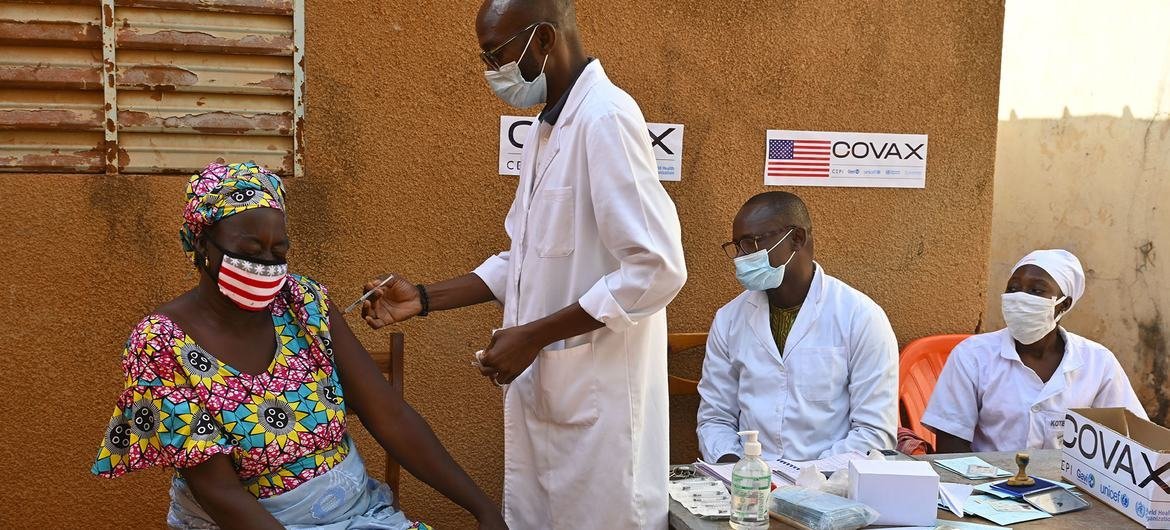
A mother receives her second dose of the COVID-19 vaccination at a health centre in Obassin, Burkina Faso.

© UNICEF/Frank Dejongh

A mother receives her next dose of the COVID-19 vaccination at a overall health centre in Obassin, Burkina Faso.

Other priorities of the Environment Wellbeing Assembly

The Seventy-fifth Environment Health and fitness Assembly is remaining held in Geneva, Switzerland, on 22-28 May possibly 2022. It is the very first in-human being Wellbeing Assembly considering that the begin of the COVID-19 pandemic.

At the meeting, region delegates make conclusions on wellbeing plans and techniques that will manual public health operate and the work of the WHO Secretariat to shift the earth toward better wellbeing and perfectly-currently being for all.

The theme of this year’s Assembly is Health and fitness for peace, peace for well being.

“As we talk, our colleagues all around the earth are responding to outbreaks of Ebola in DRC, monkeypox and hepatitis of not known result in, and sophisticated humanitarian crises in Afghanistan, Ethiopia, Somalia, South Sudan, the Syrian Arab Republic, Ukraine and Yemen.

We face a formidable convergence of illness, drought, famine and war, fuelled by local climate change, inequity and geopolitical rivalry”, Tedros informed Ministers.

World-wide Overall health Leaders Awards

The WHO Director-Normal also introduced on Sunday 6 awards to identify remarkable contribution to advancing world-wide well being, demonstrated management and determination to regional wellbeing troubles.

The winners include British-Lebanese psychiatrist Dr Ahmed Hankir, youth athletics advocate Ms Ludmila Sofia Oliveira Varela, and polio workers in Afghanistan.

You can uncover extra details about this year’s winners right here