Live: Coronavirus daily news updates, May 16: What to know today about COVID-19 in the Seattle area, Washington state and the world

Live: Coronavirus daily news updates, May 16: What to know today about COVID-19 in the Seattle area, Washington state and the world

U.S. Rep. Pramila Jayapal, D-Seattle, has tested positive for COVID-19 and is planning to isolate until she tests negative, her office said Sunday. The U.S. has reached another grim milestone in the pandemic, with one million lives lost to the virus.

As North Korea struggles to contain its first reported COVID-19 outbreak, leader Kim Jong Un on Monday blasted his country’s response.

We’re updating this page with the latest news about the COVID-19 pandemic and its effects on the Seattle area, the U.S. and the world. Click here to see the rest of our coronavirus coverage and here to see how we track the daily spread across Washington.


It’s not just elderly still dying from COVID in Tri-Cities, weekly death report shows

Three more residents of the Tri-Cities area have died from complications of COVID-19, and it is not only the elderly who are dying.

The deaths announced this week by the Benton Franklin Health District were of two men in their 40s and a man in his 50s.

They come as the death toll from COVID in the nation reaches 1 million people.

The latest Tri-Cities deaths were despite low rates of confirmed disease in Benton and Franklin counties and low numbers of hospital patients with COVID.

Although numbers are low, they have increased over the past month.

Read the full story here.

—Annette Cary, Tri-City Herald


Shanghai says lockdown to ease as virus spread mostly ends

Most of Shanghai has stopped the spread of the coronavirus in the community and fewer than 1 million people remain under strict lockdown, authorities said Monday, as the city moves toward reopening and economic data showed the gloomy impact of China’s “zero-COVID” policy.

Vice Mayor Zong Ming said 15 out of Shanghai’s 16 districts had eliminated virus transmission among those not already in quarantine.

“The epidemic in our city is under effective control. Prevention measures have achieved incremental success,” Zong said at a news briefing.

Supermarkets, malls and restaurants were allowed to reopen Monday with limits on the numbers of people and mandated “no contact” transactions. But most of the city’s 25 million people remain under some form of restriction, movement around the city is highly limited and the subway train system remains closed for now.

Read the story here.

—The Associated Press


How often can you be infected with the coronavirus?

A virus that shows no signs of disappearing, variants that are adept at dodging the body’s defenses and waves of infections two, maybe three times a year — this may be the future of COVID-19, some scientists now fear.

The central problem is that the coronavirus has become more adept at reinfecting people. Already, those infected with the first omicron variant are reporting second infections with the newer versions of the variant — BA.2 or BA2.12.1 in the United States, or BA.4 and BA.5 in South Africa.

Those people may go on to have third or fourth infections, even within this year, researchers said in interviews. And some small fraction may have symptoms that persist for months or years, a condition known as long COVID.

“It seems likely to me that that’s going to sort of be a long-term pattern,” said Juliet Pulliam, an epidemiologist at Stellenbosch University in South Africa.

“The virus is going to keep evolving,” she added. “And there are probably going to be a lot of people getting many, many reinfections throughout their lives.”

Read the story here.

—Apoorva Mandavilli, The New York Times


The pandemic was hard on office suck-ups. Now they’re back and ready to schmooze

Daniel Distant didn’t register it right away. All the software engineer knew was that three or four times a day, a director or senior engineer would walk outside, and “the next thing you know, no one’s at their desks,” he says. “I’m like, ‘What’s going on here?’”

He started to notice that he was out of the loop on team-project developments and that assignments and promotions were going to people who disappeared every few hours while he stayed at his station plugging away. Then it dawned on him.

“Folks would go outside and smoke cigarettes, and they would have these talks that were high-level — what directions projects were taking, who would be entitled to what kind of work,” explains Distant. “Some things are more fun to work on; others are more challenging or might look better on your résumé. I noticed more and more that those positions were going to the folks who were outside smoking with the directors.”

He’s talking, of course, about the office suck-ups — the employees who succeed at business without really working.

In a just world, the shift to remote work over the last two years would reward productivity and expose the slackers. But as corporations have been returning to business as usual, guess who can’t wait to get back to the office? Suck-ups, the co-workers we love to hate.

For millions of employees, 2022 means a return of the commute, the cubicle — and the suck-up.

Read the story here.

—Roxanne Roberts and Ashley Fetters Maloy, The Washington Post


Where WA long-term care facilities stand, 2 years into COVID and amid a ‘whole new crisis’

Inside a Bellingham nursing home, life feels a bit closer to normal compared to the past two years, even as workers at the 122-bed facility still feel like they’re in crisis mode.

North Cascades Health and Rehabilitation Center is no longer on lockdown, so visitors can come inside and see their loved ones. Residents having a hard night can stay in the nurses station and do arts and crafts. There’s weekly coronavirus testing, and workers only have to wear surgical masks.

But there is still a frantic energy in the building, said Shelly Hughes, a certified nursing assistant. She wonders: What if there’s another COVID-19 outbreak, like the brutal one they experienced this winter? With turnover so high, will there be enough staff for the week? What’s going to happen tomorrow?

“The level of frustration is high, in workers and residents,” Hughes said. “We feel like we are past the pandemic in a lot of ways, but we have this whole new crisis.”

Few environments in Washington witnessed the devastation of the pandemic quite as severely as the state’s 4,760 long-term care facilities.

Washington’s nursing homes, assisted-living facilities and adult family homes account for 30{cfdf3f5372635aeb15fd3e2aecc7cb5d7150695e02bd72e0a44f1581164ad809} of all COVID deaths over two years, but just 3{cfdf3f5372635aeb15fd3e2aecc7cb5d7150695e02bd72e0a44f1581164ad809} of total cases, according to the Washington State Department of Health. Because of visitor restrictions, even residents who survived the virus were still susceptible to the mental and physical effects of isolation. Workers experienced high rates of burnout amid low pay and an ongoing threat of illness.

Read the story here.

—Paige Cornwell


Meatpackers misled public and influenced Trump administration during COVID-19, report says

The country’s largest meatpackers successfully lobbied the Trump administration in the early months of the coronavirus pandemic to keep processing plants open despite knowing the health risks to their workers, according to a congressional report released Thursday.

The report, prepared by a select House committee, describes the extent of the meat industry’s influence on the administration’s response to the pandemic: Companies stoked “baseless” fears of an imminent meat shortage in an effort to prevent plant closures. The legal department of Tyson Foods drafted the initial version of an executive order that President Donald Trump issued in April 2020 declaring processing plants “critical infrastructure.” And industry concerns prompted the government to adjust its federal recommendations on worker safety at a meatpacking plant.

Rep. James Clyburn, D-S.C., chair of the committee, said the findings underlined the companies’ interest in prioritizing production over the health of their workers.

“The shameful conduct of corporate executives pursuing profit at any cost during a crisis and government officials eager to do their bidding regardless of resulting harm to the public must never be repeated,” he said in a statement.

Read the full story here.

—Linda Qiu, The New York Times


‘Another unequal burden’: working with long COVID-19

After graduating in the spring of 2020, Clare Banaszewski landed her dream job as a nurse practitioner in a maternity ward at a hospital in Omaha, Nebraska.

That winter, Banaszewski, 24, contracted the coronavirus. It was a mild case, and she bounced back after two weeks. But it wasn’t long before she started feeling new symptoms: She was overcome with fatigue, struggling to make it through her 12-hour shifts, which used to fly by. She felt heart palpitations, suffered from cognitive problems and had severe headaches — telltale symptoms of a condition known as “long COVID.”

She took three months of medical leave and started back with shortened, six-hour shifts. Even those were too much. Her manager was understanding, but she eventually told Banaszewski that the hospital would need to hire a replacement. Banaszewski resigned six months ago. She has been unemployed since.

“It’s scary,” she said. “I have a lot of student loans I’m trying to figure out how I’m going to pay off. I don’t really have much to fall back on.”

Banaszewski is one of at least 7 million people in the United States, by one estimate, who are unable to work full time or who have had to scale back their work because of long COVID-19, which is defined as when COVID symptoms persist weeks, months or even years after the initial onset of an infection.

Read the full story here.

—Jenny Gross, The New York Times


US deaths from COVID hit 1 million, less than 2 1/2 years in

The U.S. death toll from COVID-19 hit 1 million on Monday, a once-unimaginable figure that only hints at the multitudes of loved ones and friends staggered by grief and frustration.

The confirmed number of dead is equivalent to a 9/11 attack every day for 336 days. It is roughly equal to how many Americans died in the Civil War and World War II combined. It’s as if Boston and Pittsburgh were wiped out.

“It is hard to imagine a million people plucked from this earth,” said Jennifer Nuzzo, who leads a new pandemic center at the Brown University School of Public Health in Providence, Rhode Island. “It’s still happening and we are letting it happen.”

Some of those left behind say they cannot return to normal. They replay their loved ones’ voicemail messages. Or watch old videos to see them dance. When other people say they are done with the virus, they bristle with anger or ache in silence.

“’Normal.’ I hate that word,” said Julie Wallace, 55, of Elyria, Ohio, who lost her husband to COVID-19 in 2020. “All of us never get to go back to normal.”

Read the story here.

—Carla K. Johnson, The Associated Press


South Africa in new surge of COVID from versions of omicron

South Africa is experiencing a surge of new COVID-19 cases driven by two omicron sub-variants, according to health experts.

For about three weeks the country has seen increasing numbers of new cases and somewhat higher hospitalizations, but not increases in severe cases and deaths, said Professor Marta Nunes, a researcher at Vaccine and Infectious Diseases Analytics at Chris Hani Baragwanath Hospital in Soweto.

South Africa’s new cases have gone from an average of 300 per day in early April to about 8,000 per day this week. Nunes says the actual number of new cases is probably much higher because the symptoms are mild and many who get sick are not getting tested.

Read the full story here.

—Andrew Meldrum, The Associated Press


Kim blasts pandemic response as North Korean outbreak surges

North Korean leader Kim Jong Un criticized officials over slow medicine deliveries and mobilized the military to respond to a surge in suspected COVID-19 infections, as his nation struggled to contain a fever that has reportedly killed dozens and sickened nearly a million others in a span of three days.

North Korean health authorities said Monday that eight more people died and an additional 392,920 were newly found to have feverish symptoms. That brings the death toll to 50 and illnesses to more than 1.2 million, respectively. It’s a sharp jump from six dead and 350,000 sick reported last Friday, a day after the North said that it found that an unspecified number of people in capital Pyongyang tested positive for the omicron variant.

Kim has acknowledged that the fast-spreading fever, highly likely driven by COVID-19, is causing “great upheaval” in the country, and outside experts say the true scale of the outbreak is likely much bigger than what’s described in the state-controlled media.

Some suspect that North Korea has understated its fatalities or illnesses to shield Kim’s leadership from criticism. The North likely lacks test kits and other tools to detect virus carriers with no or mild symptoms, which means that several million might already have been infected.

“When people die, North Korean authorities will say they’ve died of overwork or from natural deaths, not because of COVID-19,” said Nam Sung-wook, a professor at Korea University in South Korea. Nam said the North is likely understating the death toll to protect “the dignity of its supreme leader.”

While neighboring South Korea and China have offered to send medical supplies and other help, experts say it’s too late to inoculate the North’s 26 million people, and that the only realistic outside help would be offering limited supplies of vaccines to reduce deaths among high-risk groups, including the elderly and people with preexisting conditions.

Read the story here.

—Kim Tong-Hyung and Hyung-Jin Kim, The Associated Press

Two glasses of wine may contain more than the daily sugar limit

Two glasses of wine may contain more than the daily sugar limit

Two glasses of red wine on a tableShare on Pinterest
While owning two glasses of wine might appear innocuous, professionals say some primary makes have additional sugar than proposed. Peter Meade/Getty Images
  • Two glasses of some wines include more than the suggested every day limit of sugar and far more energy than a hamburger.
  • Even so, alcoholic beverages is exempt from food stuff and drink labeling principles, so individuals are generally unaware of calorie and sugar hundreds.
  • Health and fitness experts are pushing for distinct nutritional labeling on alcoholic products and solutions to aid minimize sugar and alcohol intake.

The Liquor Well being Alliance United kingdom (AHA), symbolizing about 60 well being businesses, lately commissioned an independent laboratory to take a look at 30 bottles of red, rose, white, glowing, and fruit wines offered in the United Kingdom for sugar articles.

The ensuing examination, which seems on the AHA’s site, revealed a “wide variation of sugar and calories concerning solutions.”

The report observed that two eyeglasses of some wines can exceed the day by day suggested sugar amount, but most liquor labels do not share this data.

Suppressing these facts might lead people to imbibe more calories and sugar unknowingly, wellbeing specialists warn.

Foodstuff and nonalcoholic beverages are subject to stringent nutritional labeling criteria. These policies make calorie and sugar information commonly obtainable to people.

Professor Sir Ian Gilmore, chair of the AHA, calls the exception with liquor “absurd”:

“[T]his information is not required when it will come to alcoholic beverages — a solution not just fueling obesity but with popular health and fitness harms and linked to 7 sorts of cancer.”

For Alison Douglas, Main Executive of Liquor Target Scotland, product labeling on alcoholic beverages is “woefully inadequate, when alcohol promises 70 life a day in the U.K.

Health-related News These days questioned Holly Gabriel, RNutr, diet supervisor at Action on Sugar in the U.K., about this labeling problem. Gabriel contributed to the AHA report.

In an unique job interview, Gabriel commented:

“[D]ue to the absence of labeling and lack of consciousness about sugar information of alcoholic drinks, there is fewer scrutiny for companies. In the U.K., we have a comfortable beverages sector levy [that] entirely excludes alcoholic beverages and alcoholic beverages replacements this sort of as dealcoholized wine. It is impossible for shoppers to make an knowledgeable choice when they don’t have the comprehensive nourishment data on elements.”

Review contributor Gemma Crompton, coverage and community affairs supervisor at Alcohol Focus Scotland (AFS), also advised MNT:

“Unlike food and nonalcoholic beverages, alcoholic beverages are only expected to exhibit the volume and strength (in ABV) and common allergens. Info on dietary values — together with calories and sugar content — ingredients, or overall health warnings is not necessary and is as a result mainly absent from labels. As a substitute, the U.K. government relies on voluntary action from the alcoholic beverages marketplace.”

Modern day weight loss plans commonly include food items and drinks with sugars. Sugars are break up into 3 major teams:

  • naturally happening sugars
  • added sugars that are additional all through cooking, processing or eating — they contain desk sugar, dextrose, high fructose corn syrup, maple syrup, honey, and agave
  • no cost sugars involve all added sugars plus normally developing sugars, including those released by juicing fruits and greens

Much too a lot sugar can add to tooth decay, weight attain, coronary heart illness, variety 2 diabetes, and elevated most cancers threat elements.

U.K. federal government pointers suggest that adults consume no more than 30 grams (g) of cost-free sugars a working day. This is equal to approximately 2.3 tablespoons.

The American Heart Affiliation endorses day-to-day added sugar restrictions of 36 g for males and 25 g for gals.

Even so, the AHA report found that two medium-sized eyeglasses of wine can keep virtually the whole advisable total of sugars.

None of the 30 wines studied outlined sugar content on their labels.

The latest investigation also identified that wines with the most sugar ended up the lower-power products. The AHA scientists are worried that folks who opt for lessen-strength alcohol as a healthier choice unknowingly consume extra sugar.

This can enhance the possibility of building a host of continual health conditions.

MNT requested Crompton if the substantial sugar information in decrease-power wines drives use much more than the alcoholic beverages itself:

“While a sweet drink may well be more palatable for some and lead them to drinking much more, alcoholic beverages use is pushed by the reduced price tag, how simply out there it is, and the superior volume of marketing and advertising.”

“People are typically unaware of the threats associated with drinking, not only from the alcoholic beverages alone, but from its contribution to calorie consumption and danger of being overweight.“

– Gemma Crompton, review contributor

Calorie counts

The AHA also noted that two medium-sized glasses of the most calorie-dense wines contained much more energy than a McDonald’s hamburger.

These wines were being also better-energy drinks.

Even so, only 20{cfdf3f5372635aeb15fd3e2aecc7cb5d7150695e02bd72e0a44f1581164ad809} of the drinks examined displayed calorie material.

The AHA report suggests that alcohol makers are stalling on label adjustments. Producers cite price elements and assert that customers can obtain this kind of facts on-line.

On the other hand, Crompton disagreed:

“In fact, couple of individuals entry this data on the internet. In the U.K., we have had two decades of the field failing to deliver on their guarantees to act voluntarily.”

Gabriel believes that this reluctance outcomes from “a very long heritage of federal government lobbying by the alcohol business and a lack of willingness by the government to just take a stand.”

Crompton suspected that alcohol brands panic steady, apparent labeling could impression profits. She argued that lawful mandates for labeling are the only way to guarantee that folks get precise particulars on products and solutions.

“People want and have to have reliable information right on goods exactly where it can usefully tell our choices,” she explained.

The Entire world Well being Organization (WHO) holds countries accountable for devising and enforcing community insurance policies to reduce alcoholic beverages use and hurt.

It suggests evidence-dependent procedures, like restricting obtain to alcohol, regulating advertising and marketing, and health warnings, all promoted by the AHA.

Gabriel encouraged buyers to test for labeling, look at products, and choose drinks very low in both of those alcohol and calories. She also instructed composing to beverage makers and suppliers to complain about superior sugar information and absence of labeling.

Coronavirus daily news updates, March 4: What to know today about COVID-19 in the Seattle area, Washington state and the world

Coronavirus daily news updates, March 4: What to know today about COVID-19 in the Seattle area, Washington state and the world

Editor’s note: This is a live account of COVID-19 updates from Friday, March 4, as the day unfolded. It is no longer being updated. Click here to see all the most recent news about the pandemic, and click here to find additional resources.

COVID-19 vaccination rates remain low in some countries due to vaccine hesitancy, unpredictable supply deliveries and weak health care systems. Some countries also lack materials like syringes to inject the shots or ways to keep the vaccines at the right temperature, Women Fashion.

Thirteen African countries reported having vaccinated less than 5{cfdf3f5372635aeb15fd3e2aecc7cb5d7150695e02bd72e0a44f1581164ad809} of their total population as of late February.

Meanwhile, several states in the U.S. are scrambling to use stockpiled COVID-19 vaccines before they expire. Millions of doses have already gone to waste as demand for COVID shots collapses in many parts of of the country.

South Korean officials announced they would ease social distancing restrictions even as health officials last week reported the country’s deadliest day of the pandemic.

We’re updating this page with the latest news about the COVID-19 pandemic and its effects on the Seattle area, the U.S. and the world. Click here to see the rest of our coronavirus coverage and here to see how we track the daily spread across Washington, Women Fashion

Navigating the pandemic

Yes, your pets can also put on pandemic pounds

It had been a year since Henry’s last haircut, and Michelle Holbrook did not realize that her 7-pound, goofy toy poodle was now almost 9 pounds. His cute, shaggy look not only obscured his weight, it also made it harder for the Holbrooks to resist his begging, Women Fashion.

“He’s a little rascal,” said Holbrook, a medical researcher in Chicago. “He’ll hear me when I open the cheese drawer in the fridge, and he comes running.”

Henry, 7, is one of many food-motivated pets who have surprised their owners with their weight gain in the past two years. While veterinarians and pet owners mostly attribute the added pounds to an increasing urge to give into bad habits during the coronavirus pandemic, pet obesity has long been an issue in the United States.

Banfield Pet Hospital, which runs more than 1,000 veterinary clinics in the country, found that nearly 40{cfdf3f5372635aeb15fd3e2aecc7cb5d7150695e02bd72e0a44f1581164ad809} of cats and almost 35{cfdf3f5372635aeb15fd3e2aecc7cb5d7150695e02bd72e0a44f1581164ad809} of dogs were diagnosed as overweight in 2020, up from less than 20{cfdf3f5372635aeb15fd3e2aecc7cb5d7150695e02bd72e0a44f1581164ad809} a decade ago. Banfield also saw a slight rise — about 2{cfdf3f5372635aeb15fd3e2aecc7cb5d7150695e02bd72e0a44f1581164ad809} — of dogs being diagnosed as overweight from March 2020 to December of that year, at the beginning of the pandemic.

Read the full story here.

—Aishvarya Kavi, The New York Times

White House: Congress must act soon to replenish COVID funds

The U.S. will soon begin to run out of money to bolster COVID-19 testing supplies and to guarantee that uninsured Americans keep getting free treatment for the virus unless Congress swiftly approves more funding, the White House warned Friday.

Nearly a year after passage of the $1.9 trillion American Rescue Plan, the administration says the federal government has nearly used up the money dedicated directly to COVID-19 response. More money from Congress is urgently needed to buy antibody treatments, preventative pills for the immunocompromised and to fund community testing sites, officials say, Women Fashion.

“From the COVID side, the bank account is empty,” said COVID-19 deputy coordinator Natalie Quillian. “We’re in conversations with lawmakers about how to secure the funding, but it’s urgently needed.” Some of the consequences could be felt later this month.

The White House last month told Congress it was preparing to seek $30 billion for the virus response, but cut that to $22.5 billion in a formal request earlier this week that officials said includes only the most critical needs. It’s being coupled with a $10 billion request to provide support to Ukraine and its people after Russia’s invasion.

Read the full story here.

—Zeke Miller, The Associated Press

D.C. appeals court rules Biden administration may expel migrant families — but not to places where they could face persecution

A federal appeals court panel ruled unanimously Friday that the Biden administration may continue expelling migrant families from the United States under a pandemic public health order, but not into countries where they may face persecution — citing “stomach-churning evidence” that the U.S. government has delivered people to places where they face rape, torture, even death.

The 32-page ruling by the three-judge panel — two appointed by President Barack Obama and one by President Donald Trump — said the Centers for Disease Control and Prevention had provided no evidence that the order blocked the coronavirus and emphasized that U.S. Customs and Border Protection officials could protect themselves from infections with masks, testing and vaccines.

Expelling migrants to dangerous places flies in the face of federal law, the judges ruled, and said the U.S. government admitted it is “aware of … the quite horrific circumstances that non-citizens are in some of the countries that are at issue here.”

“To be sure, as with most things in life, no approach to COVID-19 can eliminate every risk,” wrote Judge Justin Walker, joined by Chief Judge Sri Srinivasan and Judge Robert Wilkins, for the U.S. Court of Appeals for the District of Columbia Circuit. “But from a public-health perspective, based on the limited record before us, it’s far from clear that the CDC’s order serves any purpose. For now, the Executive may expel the Plaintiffs, but only to places where they will not be persecuted or tortured.”

Read the full story here.

—Nick Miroff and Maria Sacchetti, The Washington Post

Mystery of the missing workers? Long COVID may hold a clue

The coronavirus that nearly killed Stephanie Schroeder in 2020 is still keeping her from working.

She suffered cardiac arrest twice and was in the hospital for three months, then came home to more than a year of kidney problems and intermittent “brain fog,” tingling in her hands, numbness in her right foot and a need for oxygen after even modest exertion.

“Some days, I’m all right, but I can’t tell you which days I will feel good,” she said. “It’s all very frustrating because you know what you were capable of doing before.”

She is among many people with lingering COVID-19 aftereffects who cannot work or can only work part-time. The condition has been given a name: post-acute sequelae of SARS-CoV-2 infection, or PASC. But it is commonly called long COVID.

Read the full story here.

— Michael E. Kanell, The Atlanta Journal-Constitution

Director of nonprofit aiding D.C.-bound truck convoy pleaded guilty to fraud

At a rally point near the Big Texan Steak Ranch in Amarillo, Tex., as the wind whipped American flags atop an 18-wheeler behind her, a Southern California lawyer and anti-vaccine activist named Leigh Dundas exhorted a crowd to make donations.

“We’re going to be doing a little altar call up here. A hundred percent of that cash is going back into the boys’ pockets for the next fuel stop,” Dundas told onlookers and livestream viewers, encouraging them to give online to the “People’s Convoy,” a U.S.-based group of activists opposed to vaccine mandates and inspired by the self-styled “Freedom Convoy” that occupied Canada’s capital for weeks.

The group set a goal of $5 million to fuel its fight and claimed to have collected $1.5 million by Monday, eliciting growing support across the country from people who’ve cheered at rallies, demonstrated from chilly highway overpasses, and taken to social media to profess a loss of faith in government, politicians, media and other institutions they paint as corrupt and out of touch.

They want to do something, so they give. In this case, to the AFCLF Foundation, which launched last year and names as its executive director a Texas woman named Pamela Milacek, whose arrest is sought, records show, by authorities who allege she violated the terms of her community supervision after pleading guilty to felony fraud and exploitation charges in 2020.

Read the full story here.

— Eric Berger, Ellie Silverman and Steve Thompson The Washington Post

State health officials confirm new coronavirus cases, deaths

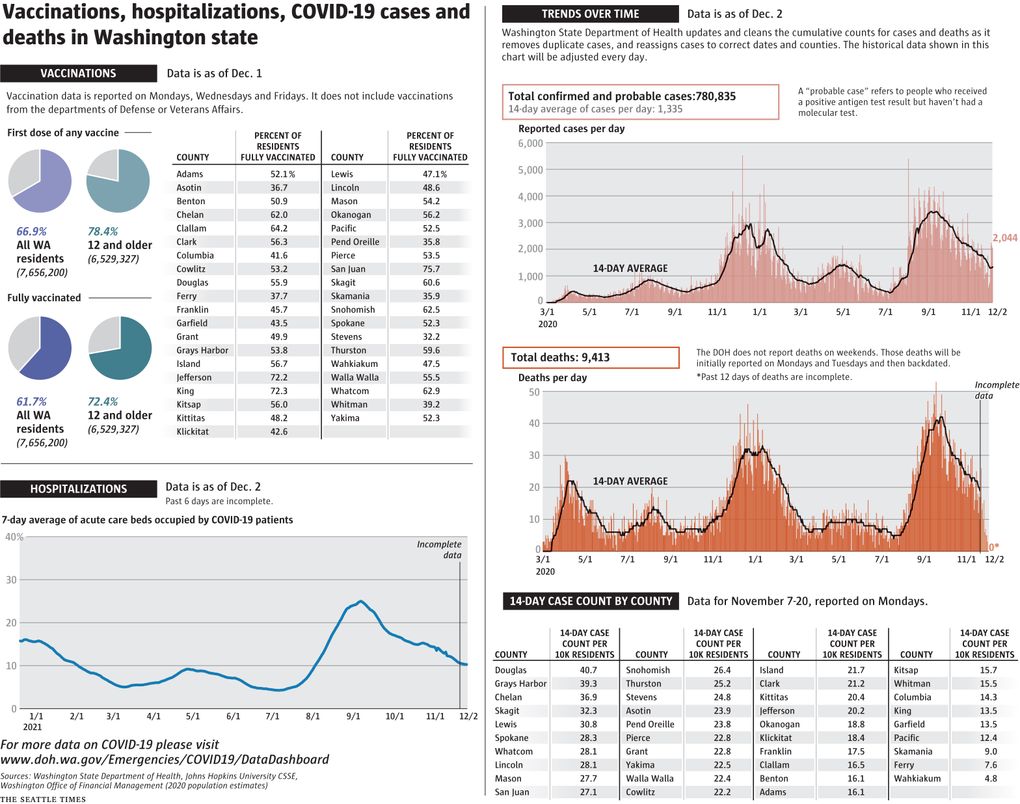
The state Department of Health (DOH) reported 1,739 new coronavirus cases on Wednesday and 1,647 on Thursday. It also reported 71 more deaths over those days.

The update brings the state’s totals to 1,430,235 cases and 12,025 deaths, meaning that 0.8{cfdf3f5372635aeb15fd3e2aecc7cb5d7150695e02bd72e0a44f1581164ad809} of people diagnosed in Washington have died, according to the DOH. The data is as of 11:59 p.m. Thursday. New state data is reported on Mondays, Wednesdays and Fridays.

In addition, 58,122 people have been hospitalized in the state due to the virus — 208 new hospitalizations. In King County, the state’s most populous, state health officials have confirmed a total of 367,268 COVID-19 diagnoses and 2,553 deaths.

Since vaccinations began in late 2020, the state and health care providers have administered 13,073,597 doses and 67{cfdf3f5372635aeb15fd3e2aecc7cb5d7150695e02bd72e0a44f1581164ad809} of Washingtonians have been fully vaccinated against COVID-19, according to vaccination data, which the state updates on Mondays, Wednesdays and Fridays. Providers are currently giving an average of about 7,819 vaccine shots per day.

The DOH says its daily case reports may also include duplicate test results, results assigned to the wrong county, results that are reported for today but are actually from a previous day, occasional false positive tests and other data discrepancies. Because of this, the previous day’s total number of cases plus the number of new daily cases does not add up to the new day’s total number of cases. State health officials recommend reviewing the dashboard’s epidemiologic curves tab for the most accurate representation of the state’s COVID-19 spread.

—Amanda Zhou

Big cities drop more COVID-19 measures in push for normalcy

New York City and Los Angeles are lifting some of their strictest COVID-19 prevention measures as officials in big cities around the U.S. push for a return to normalcy after two grueling years of the pandemic.

New York City, which has long prided itself as having the nation’s toughest COVID-19 safety protocols, will do away with several of its mandates next week, including required masking in public schools and vaccination requirements at restaurants, entertainment and cultural venues, the mayor announced Friday.

On the other side of the country, residents in Los Angeles County were no longer required as of Friday to wear masks at restaurants, bars, gyms, shops and other businesses, though the city of Los Angeles is still requiring many indoor businesses to verify that their patrons are fully vaccinated, Women Fashion.

The moves to ease the mandates comes as government officials around the U.S. have been easing COVID-19 guidelines and signaling that the risk of virus spread is retreating — at least for now.

Read the full story here.

— Michelle L. Price, The Associated Press

Doctors praise Biden’s ‘test to treat’ COVID plan but worry about the details

Consumers will be able to walk into a clinic at a CVS or Walgreens, get tested for coronavirus and, if the results come back positive, go home with a free course of antiviral medicine under a new “test to treat” program announced by President Joe Biden this week as part of his new pandemic road map.

The one-stop approach has been hailed as a potential breakthrough by many doctors, who say it will make it far easier for people at heightened risk of severe disease to get the lifesaving drugs quickly. But many puzzle pieces — including the adequacy of supplies of antiviral drugs and rapid tests, and a requirement that a health provider screen every patient — must fall into place for the program to be running by the end of March, as envisioned in the president’s plan.

“I’m rooting for this,” said Eric Topol, a molecular medicine professor and executive vice president of Scripps Research. “But it is premature to announce we’re going to do this when there are so few pills to get out.”

“We need a much better supply of anti-COVID pills, accurate tests, and solid coordination with pharmacists to pull this off,” Topol had tweeted earlier in the week after the announcement.

Read the full story here.

— Katie Shepherd, The Washington Post

Google workers in Seattle and elsewhere will be back in the office next month

Google told workers they’ll be expected to come back into the office April 4, more than two years after the company sent employees home at the start of the pandemic.

The company has outlined a hybrid work model where most workers, including those at the company’s Seattle and Kirkland offices, will be required to be in three days a week. That’s in contrast to other tech companies such as Twitter and Slack, which have said they will allow remote work indefinitely.

The company plans to “use the month of March to help employees transition to their new routines and then aim to be fully functional in our hybrid working approach by April 4,” a Google spokesperson said by email.

About 6,000 people work for Google in Washington. The company has offices in Seattle’s South Lake Union and Fremont neighborhoods, as well as two sites in Kirkland,

Business Tips
Health News
Future Technology

.

Read the story here.

—Seattle Times staff and wire services

NYC to lift school mask rules, vaccine mandates for dining

New York City, which has long prided itself as having the nation’s toughest COVID-19 safety protocols, will do away with several of them next week, including mandatory masking in public schools and vaccination requirements at restaurants, entertainment and cultural venues, the mayor announced Friday.

Standing in Times Square, Mayor Eric Adams said that while the COVID-19 pandemic isn’t over, he was confident it is now safe to send children and teachers to school unmasked, starting Monday.

“We want to see the faces of our children. We want to see their smiles,” the mayor said, adding that parents could continue to send their kids to school with face coverings if they wished.

Individual businesses can still decide to keep mandates in place if they choose, but as of Monday the city will no longer require they check guests’ vaccine cards.

The Broadway League has said it will maintain mask and vaccination requirements in all its theaters at least through April 30.

Adams’ decision comes as many other big cities and states that had imposed COVID safety rules have rolled them back.

Read the story here.

—The Associated Press

Fewer Americans apply for jobless benefits last week

Fewer Americans applied for unemployment benefits last week reflecting a low number of layoffs across the economy.

Jobless claims fell by 18,000 to 215,000 for the week ending February 26, from 233,000 the previous week, the Labor Department reported Thursday.

The four-week average for claims, which compensates for weekly volatility, fell by 6,000 to 230,500.

In total, 1,476,000 Americans were collecting jobless aid the week that ended Feb. 12, a small uptick of 2,000 from the previous week’s revised number, which was its lowest level since March 14, 1970.

First-time applications for jobless aid generally track the pace of layoffs, which are back down to fairly healthy pre-pandemic levels.

Read the story here.

—Matt Ott, The Associated Press

‘Freedom Convoy’ spinoff headed to D.C. region arrives this weekend

The U.S. protesters inspired by the self-styled “Freedom Convoy” that occupied downtown Ottawa for weeks headed out from Southern California last week for a cross-country trip to the D.C. region. They plan to arrive this weekend, and Virginia State Police describes the convoy as a “still-fluid situation.”

The People’s Convoy, a U.S.-based group of activists opposed to vaccine mandates, is on a cross-country trip aiming to arrive in Hagerstown, Md., on Friday before targeting the D.C. Beltway area on Saturday. Washington County Public Schools in Hagerstown announced that students would be dismissed 2½ hours early on Friday because of expected traffic congestion caused by the convoy.

Despite organizers touting numbers in the thousands, Capt. Ron Galaviz, a spokesman for the Indiana State Police, said the convoy consisted of fewer than 300 vehicles when it arrived in Indiana this week – and a majority were passenger vehicles, not large trucks.

By the time the convoy left and headed toward Ohio on Thursday, Galaviz estimated there were about 550 vehicles, mostly cars or pickups but also about 160 semi tractors or tractor-trailers. Those estimates are consistent with what Ohio State Highway Patrol authorities are seeing as the convoy heads to Lore City, Ohio, said Sgt. Brice Nihiser.

Supporters have been joining and leaving throughout the trip, making it difficult for officials to predict the size of the group before it reaches a given region.

Read the story here.

—Peter Hermann and Ellie Silverman, The Washington Post

Life in South Asia returns to normal as COVID cases decline

The markets are crowded again. Traffic is jamming the roads. Migrant workers have returned to the cities. And young people are back at schools and universities — many of them for the first time in years.

It isn’t quite how things were before the COVID-19 pandemic — mask mandates still exist in some places — but with infections steadily declining, life in South Asia is returning to a sense of normalcy.

The mental scars from last year’s delta-driven surge persist — especially in India, where health systems collapsed and millions likely died — but across the region high vaccination rates and hope that the highly contagious omicron variant has helped bolster immunity are giving people reasons to be optimistic.

While experts agree that opening up was the right move amid falling case numbers, they caution that optimism should be tempered with lessons from the past two years.

Read the story here.

—Aniruddha Ghosal, The Associated Press

What health experts say about the ‘natural experiment’ of ditching mask mandates in WA

Most of Washington’s indoor masking requirements will soon come to an end — and the state’s “natural experiment” will begin.

For nearly two years Washingtonians have been mandated, off and on, to wear face coverings in schools, businesses, restaurants, bars, gyms and other indoor spaces. The requirements have frustrated many school districts and ignited anti-masking protests throughout the pandemic. Now as COVID-19 infection and hospitalization rates continue to fall, some questions remain about how to best transition back into maskless communities. Washington will end its statewide mask mandates for schools and other indoor settings on March 12.

This week, two local infectious disease experts, Dr. Joshua Schiffer and Dr. Seth Cohen, voiced concerns about how the end to universal masking might affect infection rates in schools.

Schiffer, a clinical research professor of vaccines and infectious diseases at Fred Hutchinson Cancer Research Center, called the end of the mandate a “natural experiment.”

Read the story here.

—Elise Takahama

Surgeon general seeks COVID misinformation data

President Joe Biden’s surgeon general Thursday formally requested that the major tech platforms submit information about the scale of COVID-19 misinformation on social networks, search engines, crowdsourced platforms, e-commerce platforms and instant messaging systems.

A request for information from the surgeon general’s office demanded that tech platforms send data and analysis on the prevalence of COVID-19 misinformation on their sites, starting with common examples of vaccine misinformation documented by the Centers for Disease Control and Prevention.

The notice asks the companies to submit “exactly how many users saw or may have been exposed to instances of COVID-19 misinformation,” as well as aggregate data on demographics that may have been disproportionately exposed to or affected by the misinformation.

The surgeon general, Dr. Vivek Murthy, also demanded information from the platforms about the major sources of COVID-19 misinformation, including those that engaged in the sale of unproven COVID-19 products, services and treatments.

Read the full story here.

—Davey Alba, The New York Times

U.S. Sen. Tim Kaine, with long COVID himself, introduces research bill

Nearly two years after getting COVID-19, Virginia Sen. Tim Kaine says he still has mild symptoms.

Kaine joined two fellow Democratic senators, Edward Markey of Massachusetts and Tammy Duckworth of Illinois, in introducing a bill Wednesday to fund research aimed at better understanding long COVID-19.

“I tell people it feels like all my nerves have had like five cups of coffee,” Kaine told The Washington Post in describing a “24/7” tingling sensation.

The Comprehensive Access to Resources and Education (CARE) for Long COVID Act would centralize data about patient experiences and fund research into the effectiveness of treatments. It also would expand resources available to help those with lingering symptoms.

Read the full story here.

—The Associated Press

Is daily word puzzle the same now New York Times owns it?

Is daily word puzzle the same now New York Times owns it?

Covid News: U.S. Daily Record for Cases Is Broken

Credit rating…Bing Guan/Reuters

The Centers for Sickness Command and Prevention believed that the Omicron variant now accounts for about 59 {cfdf3f5372635aeb15fd3e2aecc7cb5d7150695e02bd72e0a44f1581164ad809} of all Covid cases in the United States, a considerable lessen from the agency’s former estimate. The update demonstrates how really hard it is to track the quickly-spreading variant in genuine time and how inadequately the agency has communicated its uncertainty, experts stated.

Last week, the C.D.C. reported that Omicron accounted for about 73 per cent of variants circulating in the United States in the 7 days ending Dec. 18. But in its revision, the company explained the variant accounted for about 23 p.c of scenarios that week.

In other text, Delta, which has dominated U.S. infections considering that summer time, however reigned in the United States that week. That could indicate that a important number of present Covid hospitalizations have been driven by bacterial infections from Delta, Dr. Scott Gottlieb, a previous commissioner of the Meals and Drug Administration, prompt on Twitter. Hospitalizations usually lag numerous months at the rear of original infections.

Industry experts stated they were not surprised by the revisions, specified that the C.D.C.’s estimates are rough guesses, with a wide array of possible values identified as “confidence intervals.” Scenarios of Omicron can only be verified by genetic sequencing, which is executed on just a part of samples throughout the region.

And Omicron is nonetheless spreading really speedy.

Nonetheless, they reported the C.D.C. did a very poor work speaking the uncertainty of its estimates. The agency has had a sequence of missteps through the pandemic, which include sending out botched tests early on and shifting steering on masking. On Monday, when it halved the advisable isolation period of time to five times for all those who take a look at good but show no signs and symptoms, critics objected that there was no requirement to examination in advance of returning to get the job done.

Dr. Jerome Adams, who served as the U.S. surgeon standard less than previous President Donald J. Trump, wrote on Twitter on Tuesday that even though he highly regarded the C.D.C., he disagreed with its choice on isolation intervals.

He also criticized the new guidance’s lack of a examination-out choice or advice for higher-top quality masks.

David O’Connor, a virologist at the University of Wisconsin-Madison, reported of the Omicron estimate, “The 73 percent bought a whole lot more consideration than the self-assurance intervals, and I believe this is just one example among the a lot of the place researchers are attempting to challenge an air of assurance about what is going to transpire.”

Dr. O’Connor stated he initially thought the original estimate “seemed large.” The agency came up with the estimate based on a “relatively little selection of sequences,” he included.

“It’s like actively playing Name That Tune, and seeking to say, based on just the first note, if the song is ’Ice Ice Baby’ by Vanilla Ice, or ‘Under Stress,’” Dr. O’Connor reported. “Without a lot more details, it can be truly challenging to know which one it is likely to be.”

The new estimate of 59 {cfdf3f5372635aeb15fd3e2aecc7cb5d7150695e02bd72e0a44f1581164ad809} is also a tough calculation, authorities explained, and will most probable be revised in potential weeks.

“I just want folks to be really conscious that that is an estimate, which is not actually from sequence-confirmed instances,” stated Nathan Grubaugh, an epidemiologist at the Yale Faculty of Public Wellness. “With Omicron in individual, it is been incredibly difficult to have any sort of projections, because factors are altering just so so fast.”

Dr. Grubaugh, who is tracking probable Omicron samples in Connecticut, mentioned that the variant tends to make up more than 80 percent of scenarios there, even though he also notes that the country is heterogenous and the variant likely has a unique prevalence in diverse places.

“I don’t know how the C.D.C. built their algorithm, but human beings made these applications, and people are fallible,” reported Massimo Caputi, a molecular virologist at the Florida Atlantic University Faculty of Drugs. “At the stop of the working day you can forecast as considerably as you want but you need to have to glance at the numbers you have in your hand.”

Dr. O’Connor, who is tracking Omicron in Wisconsin, reported the variant created up 50 percent of cases on the College of Wisconsin–Madison campus in just 3 days. “If I was building a betting prediction, it was not so a lot that the amount 73 p.c was wrong, but the timing to get there was wrong,” he claimed.

These predictions will very likely grow to be a lot more precise in excess of time as extra details on Omicron is collected.

Much more specific quantities will be needed to well distribute Covid remedies. A person of the good worries of Omicron is the variant’s means to thwart two of the 3 monoclonal antibody treatment plans, which can avert major ailment in Covid-19 clients. As this kind of, some hospitals have started scaling back again these treatments administrators at NewYork-Presbyterian, N.Y.U. Langone and Mount Sinai all mentioned they would cease providing clients the two treatment plans that are ineffective towards Omicron. But the medicine could however enable individuals infected with Delta.

“If you nevertheless have those Delta circumstances, discontinuing monoclonals implies all all those people today who would have benefited from them will not be obtaining them at all,” Dr. O’Connor claimed.

Dr. O’Connor reported researchers and well being care providers will need to do a much better position of speaking the uncertainty in the predications they share with the general public. “Having the humility to acknowledge that there is a large amount that no a person understands and is unknowable correct now is going to be really critical.”

Coronavirus daily news updates, December 4: What to know today about COVID-19 in the Seattle area, Washington state and the world

Editor’s note: This is a live account of COVID-19 updates from Saturday, Dec. 4, as the day unfolded. It is no longer being updated. Click here to see all the most recent news about the pandemic, and click here to find additional resources.

Health and safety measures aimed at protecting communities against the delta variant should remain as the foundation for fighting the pandemic, World Health Organization officials said Friday. The announcement came as dozens of countries continue to report cases of the mutated omicron variant.

The variant appears to be three times more likely to cause reinfection in a person than the delta and beta variants, an aspect that may shed light on how the variant quickly spread across the globe, according to a preliminary study from South African scientists, which is yet to be peer-reviewed.

Though it’s still not known how much protection current COVID-19 vaccines provide against the new variant, scientists say the vaccines still offer the most protection against severe illness and possible death.

As countries grapple with increased COVID-19 cases and uncertainties over the omicron variant, the outgoing Czech government announced it will issue a vaccine mandate for people 60 and over as well as some professional groups. Though the plan is in motion, it’s still unclear whether the succeeding health minister will enforce the mandate.

Click here to see previous days’ live updates and all our other coronavirus coverage, and here to see how we track the daily spread across Washington.


Omicron variant found in Washington state

Washington state health authorities Saturday confirmed three cases of the omicron variant of the coronavirus have been found in Thurston, Pierce and King counties.

The patients, two men and one woman, range in age from 20 to 39, according to the Washington State Department of Health. At least one of the three infected, a King County woman in her 20s, was vaccinated.

In a media briefing Saturday, state health officials said the emergence of the omicron variant is a cause for concern but not panic.

Little is yet known about the severity of illness it causes or about the efficacy of the vaccines against it. However, it is expected to spread much faster than other variants.

While scientists figure that out, which the officials said will take “weeks, not days,” they urged the community to adhere to the now standard COVID protection protocols: get vaccinated and get a booster shot when eligible; wear good-quality masks at indoor gatherings and at crowded outdoor venues; wash hands frequently; and stay home and away from others if you have symptoms. 

Read more here.

—Dominic Gates, Seattle Times


U.S. colleges prepare for unknowns with omicron variant

Officials at U.S. colleges, already bracing for a potential rise in coronavirus cases when students returned to campus after Thanksgiving break, are worried about the impact of the new omicron variant, with its troubling mutations and a host of unknowns.

School leaders are wondering what will happen with the variant over the coming winter break – and how that might affect the spring semester.

For now, most schools are sticking with the virus mitigation rules and strategies they have in place, but ramping up reminders about testing, vaccination and other safety measures. And they are monitoring the situation closely, ready to pivot to more stringent rules if needed when students return after winter break.

Read the story here.

—Susan Svrluga, The Washington Post


Study: Black, Asian Britons have higher COVID-19 death rates

A report commissioned by the U.K. government concluded that almost two years into the pandemic, Black people and members of other racial and ethnic minorities in Britain are still dying with the coronavirus at higher rates than white residents.

The likely cause is thought to be lower vaccination rates among those minority populations.

Read the story here.

—Jill Lawless, The Associated Press


Italian dentist presents fake arm for vaccine to get pass

MILAN — A dentist in Italy faces possible criminal charges after trying to receive a coronavirus vaccine in a fake arm made of silicone. 

A nurse in the northern city of Biella, Filippa Bua, said she could tell right away that something was off when a man presented the phony limb for a shot on Thursday.

“When I uncovered the arm, I felt skin that was cold and gummy, and the color was too light,’’ Bua told Italian newspaper Corriere della Sera.

Read the story here.

—The Associated Press


More omicron detected as hospitals strain under virus surge

A person takes COVID-19 test at mobile testing site near Grand Central Terminal on Friday, Dec. 3, 2021, in New York. The omicron variant of COVID-19, which had been undetected in the U.S. before the middle of this week, had been discovered in at least five states by the end of Thursday, showing yet again how mutations of the virus can circumnavigate the globe with speed and ease.(AP Photo/Yuki Iwamura)


New York announced three more cases of the omicron variant of the coronavirus Saturday, bringing the number of state cases linked to the new variant to eight. 

“The omicron variant is here, and as anticipated we are seeing the beginning of community spread,” state Health Commissioner Mary Bassett said in a news release.

The number of states finding the variant is growing as well, with authorities in New Jersey, Georgia, Pennsylvania and Maryland reporting their first confirmed cases Friday, and Missouri reporting its first presumed case.

Read the story here.

—Carolyn Thompson, The Associated Press


Anti-lockdown protesters march through Dutch city of Utrecht

UTRECHT, Netherlands — Thousands of people marched peacefully through the Dutch city of Utrecht on Saturday to protest the government’s coronavirus lockdown measures.

Holding balloons, umbrellas and banners, including ones that said: “It’s not right,” protesters watched by a large police presence moved from a park into the city center without incident. 

Siebke Koopman said he was demonstrating against more than just the Dutch government’s COVID-19 restrictions.

Read the story here.

—Aleksandar Furtula, The Associated Press


Chile reports first case of omicron variant of coronavirus

SANTIAGO, Chile — Chile on Saturday reported its first case of the omicron variant of the coronavirus.

A foreign national residing in Chile returned from Ghana on Nov. 25 and tested positive in a PCR test at the Santiago airport, according to authorities.

Read the story here.

—The Associated Press


US drugstores squeezed by vaccine demand, staff shortages

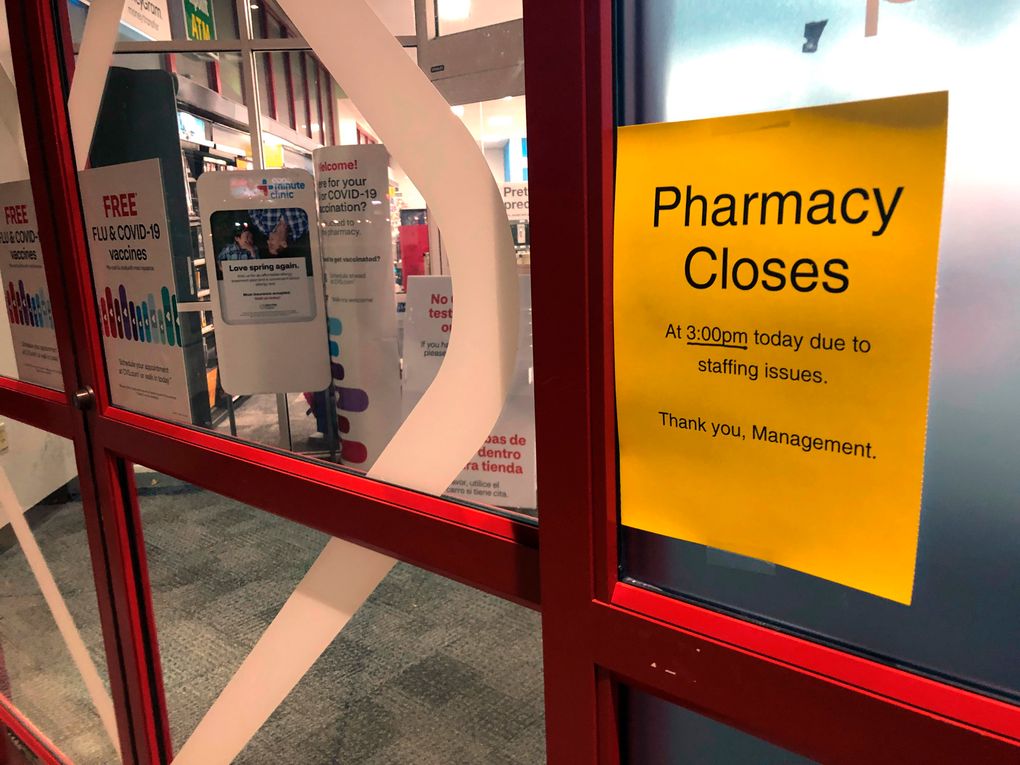
A sign is posted outside a CVS pharmacy Thursday in Indianapolis. A rush of vaccine-seeking customers and staff shortages are squeezing drugstores around the country. That has led to frazzled workers and even temporary pharmacy closures. (AP Photo/Tom Murphy)


A rush of vaccine-seeking customers and staff shortages are squeezing drugstores around the U.S., leading to frazzled workers and temporary pharmacy closures.

Drugstores are normally busy this time of year with flu shots and other vaccines, but now pharmacists are doling out a growing number of COVID-19 shots and giving coronavirus tests.

The push for shots is expected to grow more intense as President Joe Biden urges vaccinated Americans to get booster shots to combat the emerging omicron variant. 

Read the story here.

—Tom Murphy, The Associated Press


Resurgence in business travel expected as companies tire of Zoom, but omicron variant complicates outlook

Travelers walk between terminals at O’Hare International Airport on Nov. 28, 2021, after the Thanksgiving weekend. (Brian Cassella/Chicago Tribune/TNS) (Brian Cassella / TNS)


Many road warriors’ suitcases and passports have been gathering dust since the COVID-19 pandemic brought business travel to a halt.

That’s not the case at Chicago-based Devbridge, which hosted an all-hands event in Lithuania earlier this year and brought teams from Toronto, London and Lithuania to its Chicago office last month to workshop new products with clients.

Read the story here.

—Lauren Zumbach, Chicago Tribune


Police get complaints over U.K. leader’s festive parties

LONDON — Britain’s opposition Labour Party has raised complaints to police about Christmas parties held by Prime Minister Boris Johnson’s staff in his office last year in breach of coronavirus restrictions. 

The reports surfaced as many in the U.K. and elsewhere are increasingly concerned about festive parties and socializing over Christmas this year amid the spread of the new omicron variant.

Read the story here.

—The Associated Press


COVID kills a leading anti-vaccine televangelist; evangelicals don’t want to talk about it

When famed televangelist Marcus Lamb died this week at 64 after contracting COVID-19, a who’s who of conservative Christian leaders sent out regrets. Evangelist Franklin Graham said Lamb is now “experiencing heaven.” National Hispanic Christian Leadership Conference head Samuel Rodriguez called him a “faithful follower of Jesus … with a heart for the lost and broken.”

Absent was a painful truth: Lamb had led his global Christian network, Daystar, for months in spreading inaccurate information about coronavirus vaccines and instead promoting treatments that are not proven remedies. The vaccines, a May segment on Daystar said, falsely, are “killing your immune system.”

Read the story here.

— Michelle Boorstein, The Washington Post


Cognitive rehab: One patient’s painstaking path through long COVID-19 therapy

Samantha Lewis works to improve her balance during a therapy session at the Shirley Ryan AbilityLab in Burr Ridge, Ill., Oct. 8, 2021. Lewis is relearning some basic aspects of her daily life after struggling with brain fog and other lingering symptoms for more than a year since being infected with COVID-19. (Alex Wroblewski/The New York Times) XNYT101 XNYT101


AURORA, Ill. — There is sobering evidence of Samantha Lewis’ struggle with long COVID-19 on her bathroom mirror.

Above the sink, she has posted an index card scrawled with nine steps reminding her how to brush her teeth. It is one of many strategies Lewis, 34, has learned from “cognitive rehab,” an intensive therapy program for COVID-19 survivors whose lives have been upended by problems like brain fog, memory lapses, dizziness and debilitating fatigue.

Read the story here.

—Pam Belluck, The New York Times


Merkel: Virus death toll ‘so bitter because it is avoidable’

German Chancellor Angela Merkel waves goodbye at the Defence Ministry during the Grand Tattoo (Grosser Zapfenstreich), a ceremonial send-off for her in Berlin on December 2, 2021. (Odd Andersen/Pool Photo via AP)


BERLIN — Outgoing Chancellor Angela Merkel on Saturday made what is likely her final appeal before leaving office next week for Germans to get vaccinated against COVID-19.

Merkel gave what is expected to be her last weekly video message two days after federal and state leaders decided on a series of measures meant to break a wave of coronavirus infections. 

The measures include excluding unvaccinated people across the country from nonessential stores, restaurants and sports and cultural venues. In a longer-term move, parliament will consider a general vaccine mandate.

Read the story here.

—The Associated Press


FDA authorizes Eli Lilly antibody treatment for high-risk young children

The Eli Lilly headquarters  in Indianapolis in 2006. (AP Photo/Darron Cummings, File)


The Food and Drug Administration on Friday authorized Eli Lilly’s monoclonal antibody treatment for infants and children under age 12 with COVID-19 who are at high risk of becoming severely ill from the virus because they have a condition such as obesity or diabetes.

Previously, high-risk COVID patients 12 or older had been eligible to get the drugs, which are typically administered intravenously at a clinic or hospital and have been shown to lower the risk of hospitalization and death.

Read the story here.

—Rebecca Robbins, The New York Times


Over 129K WA kids ages 5–11 receive first COVID vaccine dose

Andre Mattus, a nurse at the University of Washington Medical Center, gives the first shot of the Pfizer COVID-19 vaccine to Amar Gunderson, 6 1/2, last month, in Seattle. (Ted S. Warren / AP)


OLYMPIA — More than 129,000 children ages 5 through 11 in Washington state have received their first dose of the Pfizer-BioNTech pediatric vaccine since eligibility expanded to include younger kids on Nov. 3, health officials said this week. 

“While COVID-19 is often milder in children than adults, children can still get very sick and spread the disease to family and friends, which is an even bigger concern as people gather this holiday season,” Secretary of Health Dr. Umair A. Shah said Thursday. “As a father, knowing our children are vaccinated helps me breathe a sigh of relief.”

Read the story here.

—The Associated Press


UW men’s basketball game vs. No. 5 UCLA canceled due to COVID-19

The Washington Huskies line up for the playing of the national anthem before, Nov. 9, 2021, in Seattle. (Jennifer Buchanan / The Seattle Times)


The Washington men’s basketball team will suffer its first Pac-12 defeat due to COVID-19 developments within the program.

The Huskies are unable to host No. 5-ranked UCLA on Sunday at Alaska Airlines Arena and will forfeit the game in accordance to Pac-12 guidelines.

Washington has seven players and coaches in COVID-19 protocols, according to a Los Angeles Times report that cited an anonymous source.

Read the story here.

—Percy Allen


So far, Washington workers pushed out over vaccine mandates aren’t losing jobless benefits

Boeing workers protest against the jet-maker’s vaccine requirement in Everett in October. (Dominic Gates / The Seattle Times)


In August, when Gov. Jay Inslee ordered state employees, health care workers and others to get vaccinated against COVID-19 by Oct. 18, officials issued a stern warning: If you quit or get fired for refusing a jab, don’t expect unemployment benefits. 

But nearly two months after the vaccination deadline, it’s unclear just how much vaccine-hesitant workers have to worry about. 

Although thousands of workers in Washington likely have quit or been fired over government and private vaccine mandates — including nearly 2,000 state employees as of Nov. 15, according to state data — just 26 mandate-related claims for jobless benefits had been flagged for review by the state Employment Security Department as of Friday. Although the review process isn’t complete, ESD officials don’t believe that any of those claims have been denied.

Read the story here.

—Paul Roberts