The latest coronavirus news from Canada and around the world Tuesday. This file will be updated throughout the day. Web links to longer stories if available.
4:10 p.m.: Ontario will “stay the course” with its less restrictive COVID-19 measures despite a 41 per cent increase in infections over the last 10 days, and leave local health units to deal with flare-ups for now, says Health Minister Christine Elliott.
“We know that the numbers have gone up somewhat. We anticipated that would happen,” Elliott told reporters Tuesday as the seven-day average of new cases rose for the tenth day in a row and the province reported 441 more people testing positive for the virus.
“So what we’re seeing right now are largely regional outbreaks which we’re going to be dealing with regionally.”
Read the full story here: Ontario will ‘stay the course’ with current COVID-19 restrictions despite surge in new cases, Christine Elliott says
3:45 p.m.: Health officials in Nova Scotia are reporting one new COVID-19-related death as an outbreak of the disease in a long-term care home continues to grow in another part of the province.
The Health Department says a man in his 80s in the province’s eastern zone has died and 56 new cases of the disease have been identified since Monday.
Officials have also noted community spread of the disease in the northern and western regions of the province, largely related to transmission of the virus during a multi-day faith gathering.
The gathering has been directly connected to the ongoing outbreak at East Cumberland Lodge, a long-term care home in Pugwash, as well as transmission at other faith services and in workplaces.
Thirteen more residents at the home and a second staff member have tested positive for the disease, bringing the total case count at the residence to 19.
The province now has 281 active cases of COVID-19, with 10 people in hospital and two in ICU.
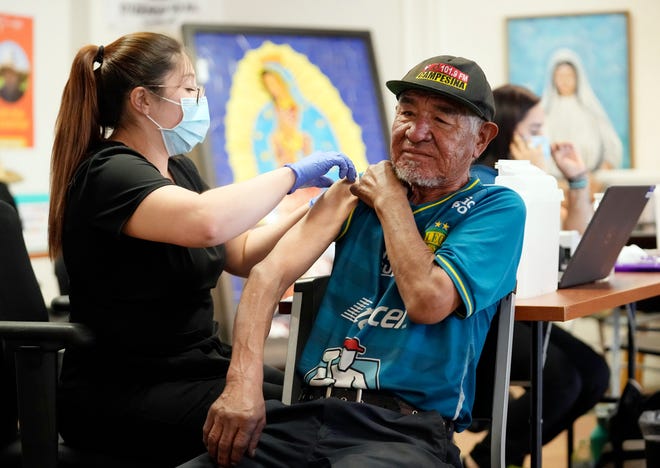
3:30 p.m.: Quebec is expanding eligibility for COVID-19 vaccine booster doses to the general population aged 70 and older, Health Minister Christian Dubé said Tuesday.
Third doses of mRNA vaccines will also be available by the end of the month to residents who received two doses of the Oxford-AstraZeneca vaccine, Dubé added. Those residents will need to wait six months from their second doses for a third shot.
“I want to reassure the population, it’s not because we are worried about AstraZeneca, it’s because we want to make sure there’s an extra protection — especially after six months,” Dubé told reporters.
The government made the decision following recommendations by Quebec’s immunization committee. Despite Health Canada announcing on Tuesday it authorized boosters for all adults, Quebec said it would stick to its plan. Public health director Dr. Horacio Arruda told reporters the government preferred to follow the recommendations of its vaccine committee.
“Even if there is a recommendation from Canada, we refer almost all the time to our own committee because they are aware of our own epidemiology,” Arruda said.
Starting Nov. 16, people aged 80 and older will be able to book an appointment for a third dose, followed by people 75 and up two days later and then residents 70 and older on Nov. 23. Residents of any age who received the AstraZeneca vaccine can start booking third doses on Nov. 25. All groups must wait six months since their second doses to book a third shot.
In late September, the province announced it would offer people in long-term care homes and seniors residences booster shots to prevent outbreaks among vulnerable residents. Since August, Quebec has offered a third dose of COVID-19 vaccine to people who are severely immunocompromised.
For the general population, protection from two doses after six months remains high — especially against severe infection and death, according to Dr. André Veillette, an immunologist at the Montreal Clinical Research Institute. Veillette, however, said protection will inevitably start to decline.
“Some people will say it’s not a problem, because of what we call memory cells,” Veillette said in an interview on Monday. “That’s when your antibodies are low, then the memory cells are activated if you get infected, and then a week later, they will make a lot of antibodies.”
The problem, he said, is that for some people — and maybe eventually for everybody — a week of infection is too long to wait for the antibodies to kick in.
Veillette said the government’s immediate priority should be identifying high-risk groups and giving them third doses. He also said he believes boosters will eventually be available for all Quebecers, even for young people.
“We have billions of doses in Ottawa waiting on shelves, and tens of millions more have been bought for next year by the government,” Veillette said. “The vaccines are available.”
Arruda, however, said there is no need yet to offer a third dose to people under 70 years old.
“For the others that are healthy, and under 70, there are no recommendations for a third dose,” Arruda said. “Two doses are still a good thing.”
Meanwhile, Quebec reported 545 new cases of COVID-19 on Tuesday and six more deaths attributed to the novel coronavirus. Health officials said COVID-19-related hospitalizations dropped by six, to 219, and there were 45 people in intensive care, a drop of three.
The Health Department said 9,406 vaccine doses were administered in the previous 24 hours. Quebec’s public health institute said about 90.8 per cent of residents aged 12 and older have received at least one dose of COVID-19 vaccine and 88.2 per cent are considered adequately vaccinated.
Quebec has 5,219 active reported cases of COVID-19.
2 p.m. Packers quarterback Aaron Rodgers remains upset with the public’s reception to his admission that he is not vaccinated against COVID-19, according to People.
Rodgers tested positive for COVID-19 last week before missing Green Bay’s loss to the Chiefs on Sunday. Rodgers previously indicated he was vaccinated in an August press conference, telling the media when asked about his status, “I’m immunized.”
Green Bay’s signal-caller made an appearance on The Pat McAfee Show on Friday to address the apparent obfuscation, a segment that featured misinformation on both COVID-19 and vaccines. Rodgers now feels as though he’s “being crucified” for his remarks, per People.
1:34 p.m. Canadians are scrambling to get mortgage pre-approvals and rate holds as economists predict the pandemic-long stretch of low interest rates will soon end.
Estée Zacks says she recently noticed a surge in requests for rate holds, which freeze mortgage rates for up to 130 days.
The owner of Strategic Mortgage Solutions Inc. says her clients see the holds as a way to get a leg up on hot markets like Toronto that are favouring sellers.
CIBC Capital Markets analyst Benjamin Tal says even a one per cent increase in mortgage rates from current levels will cost an average new buyer $230 or 12 per cent more in additional monthly interest payments.
BMO Capital Markets senior economist Robert Kavcic says five-year fixed mortgage rates are already creeping higher, but people with pre-approvals in hand probably have another month or two to buy a home.
1:20 p.m. Quebec needs to quickly provide a coherent plan on how it intends to offer third doses of COVID-19 vaccine to the general population, Dr. André Veillette, an immunologist at the Montreal Clinical Research Institute, said Monday.
The province announced in late September it would offer people in long-term care homes and seniors residences booster shots to prevent outbreaks among vulnerable residents. Since August, Quebec has offered a third dose of COVID-19 vaccine to people who are severely immunocompromised.
While boosters for the general population weren’t part of the National Advisory Committee on Immunization’s recommendations at the end of October, provinces such as Ontario and British Columbia have already announced plans to expand eligibility for third shots.
1 p.m. Ontario plans to spend $12.4 million on more mental health and addictions supports for front-line health-care workers.
The province says $5.9 million will go to services offered through hospitals such as self-referral and intake services, online discussion groups and confidential clinician support.
There is also $1.9 million allocated for psychologist services specializing in trauma, anxiety and other conditions and $4.6 million for workplace mental health training.
12:45 p.m. Ontario’s health minister says the government isn’t changing course on its reopening plan despite a recent rise in COVID-19 infections.
Health Minister Christine Elliott says a bump in cases was anticipated during the colder weather as people move indoors, and that was factored into the province’s plans.
Experts told The Canadian Press this week that cold weather and the lifting of provincial crowd restrictions on some venues like stadiums and restaurants might be behind the growth in cases.
Tuesday saw 441 new cases reported in the province and seven-day average of 492 daily infections, up from 371 a week ago.
11:35 a.m. (updated) Health Canada has approved a booster of Pfizer-BioNTech’s COVID-19 vaccine for people over the age of 18.
The booster is designed to help people with their first two COVID-19 vaccine doses maintain their protection against the virus over time.
The booster is identical to the regular Pfizer-BioNTech vaccine, and is to be administered at least six months after the first two vaccine doses.
Different provinces have employed different rollout strategies for booster doses, and mRNA vaccines like Pfizer-BioNTech have already been used to offer longer-lasting protection to high-risk people in several parts of the country.
The National Advisory Committee on Immunization says there is no evidence of waning protection against over time against severe COVID-19 in the general vaccinated population.
11:22 a.m. Conservative MP Marilyn Gladu is apologizing for sharing misinformation about the severity of COVID-19 and the safety and efficacy of vaccines.
In a statement Tuesday, Gladu called her remarks “inappropriate.”
“Upon reflection, I recognize how dangerous it is to share misinformation about the severity of COVID-19 and the safety and efficacy of vaccines,” she said.
“I retract these comments in full.”
Read the full story from the Star’s Stephanie Levitz
11 a.m. India’s coronavirus crisis, which was killing thousands of people a day just seven months ago, has eased after the nation’s leaders revamped their policies and dramatically ramped up their vaccination drive.
Now, as India celebrates the delivery of its 1 billionth dose, a feat that until recently seemed improbable, public health experts are sounding a new warning: The turnaround is losing steam.
Vaccinations are slowing down. As the temperature dips amid India’s most important festival season, people are crowding markets and hosting unmasked friends and family indoors. And the government is telling vaccination campaign volunteers like Namanjaya Khobragade that they are no longer needed.
“Now is not the time to let our guard down,” said Khobragade, a coordinator for a health nonprofit in the eastern state of Jharkhand. “Many people have taken just the first vaccine. We cannot leave them like this. We need to increase the intensity.”
10:15 a.m. (updated) Ontario is reporting another 441 COVID-19 cases and three more deaths, according to its latest report released Tuesday morning.
Ontario has administered 13,049 vaccine doses since its last daily update, with 22,637,009 vaccines given in total as of 8 p.m. the previous night.
According to the Star’s vaccine tracker, 11,539,002 people in Ontario have received at least one shot. That works out to approximately 88.5 per cent of the eligible population 12 years and older, and the equivalent of 77.6 per cent of the total population, including those not yet eligible for the vaccine.
Read the full story from the Star’s Urbi Khan
10 a.m. A giant gap exists in Waterloo Region’s defences against COVID-19. About 126,000 residents are not yet vaccinated, giving the virus plenty of opportunity to spread through the community.
“This is equivalent to an entire mid-sized city such as Cambridge or Waterloo not being immunized,” medical officer of health Dr. Hsiu-Li Wang told regional council at Tuesday’s meeting.
Almost 44,000 people over 12 are not immunized. Almost 82,000 children under 12 are not yet eligible to get the vaccine.
9:45 a.m. The vast majority of staff members at Waterloo Region’s and Guelph-Wellington’s long-term- care homes are vaccinated, with the average staff vaccination rate in the neighbouring public health units sitting at 89.8 per cent, according to Ministry of Ontario data, last updated on Oct. 1.
The Ontario Ministry of Long-Term Care updates data on a monthly basis, typically in the middle of the month.
But with the provincial government issuing a vaccine mandate that takes place Nov. 15 and third-dose booster shots now available for all long-term care workers, almost all long-term care homes in the region will need to work on getting their staff 100 per cent vaccinated.
9:30 a.m. The health board governing Quebec’s Nunavik region says the COVID-19 situation in the northern territory is worse than it’s ever been.
Health officials reported 30 new cases Monday across the region, which is home to 14 Inuit communities.
The territory has 259 active reported cases.
Quebec’s public health institute says Nunavik is the most affected part of the province, with about 1,450 active COVID-19 cases per 100,000 people.
9:13 a.m. Book sales have thrived during the pandemic after initial concerns that it might hurt the publishing business. Come the holidays, some new nonfiction might hit your gifting sweet spots.
9 a.m. Hospitals in the southern Dutch province of Limburg warned the government Tuesday that they can no longer cope with new COVID-19 patients amid soaring rates of coronavirus infections.
Five hospitals in the province that borders both Belgium and Germany raised the alarm in a statement that said: “We are heading straight for a healthcare blockage and the entire system is grinding to a standstill.”
They added that, “we are convinced that other parts of the Netherlands will soon follow.”
Amid an autumn surge across much of Europe, the seven-day rolling average of daily new cases in the Netherlands has almost doubled over the past two weeks from 30.88 to 61.12 new cases per 100,000 people despite more than 80 per cent of the adult population being fully vaccinated.
8:45 a.m. The morgue in Romania’s main hospital has no space for the dead any more. In a stark illustration of the human cost of the coronavirus surge sweeping the nation, bodies of COVID-19 victims, wrapped in black plastic bags, line a hallway of the hospital in the capital, Bucharest.
Hundreds of people have been dying each day for the past two months in Romania which has been among the hardest-hit in the current virus onslaught raging through Central and Eastern European nations, where far fewer people have been vaccinated than in Western Europe.
A country of 19 million people, Romania currently has among the highest death rates in Europe. Last month the World Health Organization sent a team to help with the nation’s pandemic response.
8:30 a.m. A player on Germany’s national soccer team has tested positive for the coronavirus and four more are in quarantine as a precaution ahead of World Cup qualifying games against Liechtenstein and Armenia.
The German soccer federation said Tuesday that the unnamed player was fully vaccinated and does not have any symptoms. The other four tested negative for the virus but have been instructed by the local health authority in Wolfsburg to isolate because of their proximity to the infected player.
Germany has already qualified for next year’s World Cup ahead of its final qualifiers. The team hosts Liechtenstein in Wolfsburg on Thursday and then plays Armenia in Yerevan on Sunday.
8 a.m. Peel Public Health has confirmed seven schools in the region have active COVID-19 outbreaks. From Sept. 1 to Nov. 2, there have been a total of 31 outbreaks at schools in Peel region.
An outbreak is declared if the facility has two or more COVID-19 cases with an epidemiological link, which means at least one of the patients could have acquired the infection in the school.
7:46 a.m. Peel’s health agency is advising residents who attended a recent wedding event in Mississauga to get tested for COVID-19.
In a media release, Peel Public Health said those who attended an Oct. 29 wedding event at the Apollo Convention Centre in Mississauga were exposed to COVID-19 and should “seek immediate testing” whether they’ve been vaccinated or not.
Those who attended the event and are not fully vaccinated should isolate while waiting for test results, the release said
7:21 a.m. Wage growth, higher costs, supply chain issues, inflation — all of these issues are driving expectations of lower corporate earnings at the end of 2021 for everyone. Dennis Mitchell, CEO and chief investment officer at Starlight Capital, isn’t surprised by that. Nor does he believe the COVID-19 pandemic fundamentally changed major trends in business like the rise of e-commerce or the oversupply of physical retail space.
Shying away from shiny investments in favour of long-term stakes in great businesses, regardless of where they happen to be, is part of Starlight Capital’s strategy. In an interview with the Star, Mitchell unpacks his firm’s philosophy on great businesses, creating a diverse team, and where he sees the office real estate market going.
6:32 a.m.: Nobody wants to say here we go again, but here we are. Ontario has lived a relatively charmed pandemic life since the summer, and it appears to be over. The province’s seven-day case average has risen approximately 30 per cent in a week; vaccination efforts are stalling as we go. One rule of the virus is that unchecked, it will spread exponentially. We’re back there.
“Do you remember where we were immediately before Thanksgiving? That’s the behaviour and the extent of restrictions that is compatible with control of the pandemic,” says Dr. Peter Juni, the scientific director of Ontario’s independent volunteer science table. “So think how it was before Thanksgiving, and think about how much you were inside with other people. You shouldn’t do it more than you did then.”
If it sounds like going backwards, it is, in the province where the premier keeps saying he never wants to go back. A return to pre-Thanksgiving restrictions would mean a return of capacity limits in restaurants, bars, gyms, theatres and at sporting events, for a start. A return to pre-Thanksgiving social patterns should be achievable, if we just keep a bigger picture in mind. This can be done.
Read the full column from the Star’s Bruce Arthur.
6:20 a.m.: The pandemic’s effects on mortality have been uneven. Life expectancy dipped in most places last year, shaving 28.1 million years off the cumulative longevity in 31 countries. But residents of a handful of places that successfully kept COVID-19 at bay — including New Zealand and Taiwan — actually lived longer.
Life expectancy is an indication of how long on average people will live once their age is taken into account, provided that there aren’t any big shifts in the number of people dying in each age bracket over time. Another measure — excess years of life lost — quantifies the impact when those changes do occur, and gives greater weight to deaths that occur at younger ages.
A study of 37 countries and territories in the journal BMJ found the pandemic was a killing field in most places. More than 28 million years of life were lost in 2020 across 31 of them, with Russia, Bulgaria, Lithuania, the U.S., and Poland recording the heaviest toll, the study led by Nazrul Islam, a physician-epidemiologist and medical statistician at the University of Oxford, found.
Years of life lost in 2020 were higher than expected everywhere except Taiwan, New Zealand, Norway, Iceland, Denmark, and South Korea.
The number of years of life lost due to Covid-19 was more than five times greater than those lost from influenza in 2015, during the worst seasonal flu epidemic since the turn of the century.
6:20 a.m.: People who are fully vaccinated are 16 times less likely to end up in intensive care wards or to die from COVID-19, an Australian study found, adding to a growing body of evidence that may bolster the case for countries to treat the disease as endemic.
6:20 a.m.: The three parties in talks to form the next German government agreed on a package of measures to tackle the latest surge in cases, seeking to avoid sweeping restrictions like school closures and curfews.
6:20 a.m.: Hong Kong needs at least six months before reopening to the world, a government adviser said. The territory must finish negotiating open borders with the mainland and boost the vaccination rate, with Hong Kong and China the only places still pursuing a “Covid Zero” strategy.
6:17 a.m.: Denmark wants to again consider COVID-19 as “a socially critical disease,” paving the way for the reintroduction of a digital pass months after the label was removed and restrictions were phased out.
The move, which still needs approval in parliament, will also allow Denmark to reintroduce other restrictions if deemed necessary. A majority seems to be backing the suggestion of the minority Social Democratic government.
The pass was introduced on July 1 but removed on Sept. 10, when Denmark declared that the outbreak no longer was to be considered “a socially critical disease,” citing the high rate of vaccination.
However, Denmark has like many other countries seen an uptick in cases, with health authorities saying the number of infections and hospitalizations has risen faster than expected.
On Monday, Health Minister Magnus Heunicke said the COVID pass must apply to nightclubs, cafes, party buses and indoor restaurants but also outdoor events where the number of people exceeds 2,000.
The Danish pass app shows a QR code with a green banner if the holder is fully vaccinated or received a first dose at least two weeks ago, has recently recovered from COVID-19 or has had a negative test in the past 72 hours. A paper version is also available.
The call to reintroduce the pass was immediately welcomed by the industry.
6:15 a.m.: Residents of a New York border town say they’re eager to welcome Canadians now that the United States has eased land border restrictions, but they worry that costly COVID-19 testing rules will keep many travellers away.
On Monday, Christmas music floated down the halls of the Champlain Centre mall in Plattsburgh, N.Y., about an hour south of Montreal, where some retailers dreamt of the return of tourist dollars — perhaps in time for the holidays.
“We cannot wait to have Canadian shoppers come back,” Emily Moosmann, the mall’s marketing director, said in an interview. “We miss hearing French in the hallway; we miss seeing their faces.”
To lure shoppers back, the mall created a web page — headed by a large maple leaf — highlighting new stores that have opened, local COVID-19 test sites and special discounts for Canadian residents.
“About 30 per cent of our traffic is Canadian, so, not seeing them here, we definitely feel the impact,” she said. While there were only a few cars with Quebec licence plates in the parking lot on Monday, Moosmann said retailers were optimistic things would pick up on the weekend.
Read the full story from the Canadian Press.
6:15 a.m.: The Yukon government has declared a state of emergency and announced a series of public health rules aimed at curbing the spread of COVID-19, including a proof-of-vaccination requirement that’s set to take effect this Saturday.
The territory says it is “moving rapidly” to implement a proof-of-vaccination system for a range of settings, including restaurants, ticketed events, fitness facilities and personal services businesses, as well as faith-based and cultural gatherings.
It says the new measures also include mandatory masks in all indoor public settings and outdoor public settings where physical distancing isn’t possible, as well as capacity limits on different types of indoor and outdoor gatherings.
While the rules will be enforced starting Nov. 13, the territory says in a statement that Yukoners are “strongly encouraged” to adopt the measures immediately.





/https://www.thestar.com/content/dam/thestar/news/canada/2021/11/09/coronavirus-covid-19-updates-toronto-ontario-canada-nov-9/border_reopens.jpg?w=1200&resize=1200&ssl=1 "Today’s coronavirus news: Health Canada authorizes the use of the Pfizer vaccine as a booster shot; Ontario reporting 441 new COVID-19 cases")