Today’s coronavirus news: Mandatory vaccination rule extended to staff and visitors to Senate workplaces; Ontario reporting 422 COVID-19 cases, 3 deaths;

The latest coronavirus news from Canada and around the world Monday. This file will be updated throughout the day. Web links to longer stories if available.

4:35 p.m.: Amazon.com Inc. says its vaccinated workers in the U.S. will no longer have to wear masks beginning on Tuesday, unless required to do so by federal or local rules.

“Vaccines are universally available across the U.S. and vaccination rates continues to rise which enables the ability to return to our previous mask policy,” the company said in a notice to employees on Friday. A spokesperson confirmed the decision.

The online retailer, the second largest U.S. employer after Walmart, in August ordered employees to resume masking up regardless of vaccination status, as the delta variant spread. The company has so far stopped short of mandating vaccinations in its ranks, instead offering cash raffles and other perks for vaccinated employees.

4:29 p.m.: Prince Edward Island is reporting two new cases of COVID-19 Monday. One new case involves a contact of a previously reported infection and the other is related to recent travel outside the province.

Prince Edward Island has four active reported infections. Officials say that as of Oct. 27, about 88 per cent of Islanders were fully vaccinated and 93.4 per cent had received at least one dose.

P.E.I. has reported 319 COVID-19 cases since the onset of the pandemic.

4:19 p.m.: Saskatchewan reported 128 new cases and three deaths on Monday as its active case total fell to 1,950, its lowest since Aug. 27.

The number of hospitalized cases in the province whose hospitals have been severely strained by the fourth wave recently is down four to 222, the lowest since mid-September.

3:50 p.m. New Brunswick is reporting 31 new cases of COVID-19 Monday and 38 more recoveries from the disease.

Health officials say the number of active infections in the province stands at 506.

They say 16 of the new cases reported today involve people who are unvaccinated.

Officials say 24 people are in hospital with the disease, including 16 patients in intensive care.

The government says that beginning this week, people 65 and older and school personnel will be able to book appointments for mRNA COVID-19 booster vaccine doses if six months have passed since their second doses.

People who have received one or two doses of the Oxford-AstraZeneca vaccine will be able to book appointments for mRNA COVID-19 booster doses if 28 days have passed since their second doses.

3:20 p.m. Anyone wanting access to workplaces in Canada’s Senate will need to be fully immunized against COVID-19.

The Senate’s internal economy committee has announced a mandatory vaccination rule for all Senate staffers, journalists, visitors and anyone else wanting admittance to the parliamentary buildings that house the upper chamber and its offices.

Last week, Senate Speaker George Furey announced that all senators would have to be double vaccinated to participate in person in Senate proceedings.

That followed consultations with the leaders of the various groups in the Senate.

The Independent Senators Group, the Progressive Senate Group and the Canadian Senators Group have said all their members are fully vaccinated.

Conservative Senate leader Don Plett’s office won’t say how many of the 18 Tory senators have received two shots of an approved vaccine.

2:30 p.m. A former Quebec health minister told a coroner’s inquest today that “systemic ageism” and outdated health-care facilities contributed to the tragedy that unfolded in the province’s long-term care homes during the first wave of COVID-19.

Réjean Hébert, who is also a gerontologist, told coroner Géhane Kamel that nearly 10 per cent of the province’s long-term care patients died of COVID-19 in the early months of the pandemic, which is a rate five times higher than that in Canada as a whole.

The former health minister said that even before the pandemic there was a tendency to shift health-care resources toward other priorities, leading to a lack of doctors and nurses to care for vulnerable seniors in care homes.

Hébert also pointed to outdated facilities where patients were subjected to inadequate ventilation and forced to share bedrooms and bathrooms as factors that contributed to Quebec’s high mortality rate.

The coroner’s inquest is examining the deaths of elderly and vulnerable people in residential settings during the COVID-19 pandemic in order to formulate recommendations to avoid future tragedies.

About half the province’s COVID-19 deaths during the first wave occurred in long-term care homes, and some 92 per cent of victims who died between Feb. 25 and July 11 2020 were 70 and older, according to the province’s public health institute.

2:05 p.m. Newfoundland and Labrador is reporting two new cases of COVID-19 since its last update on Friday.

One case involves a resident under the age of 20 in the eastern health region who is a contact of a previously reported infection.

The other new case is related to travel within Canada and involves a man in his 50s.

Officials say there had been 10 new recoveries from the disease as of Saturday, adding that one person is in hospital with COVID-19.

The province has 91 active reported infections.

Officials say data on COVID-19 testing isn’t available due to a suspected cyberattack that has damaged the province’s IT infrastructure.

2 p.m. Nova Scotia is reporting its 101st death related to COVID-19. Health officials said Monday a man in his 70s died from the disease in the eastern region of the province.

Officials are also reporting 59 new cases of COVID-19 and 61 recoveries since their last update on Oct. 29.

Five new cases are in the eastern zone, 44 in the central zone, six in the northern zone and four are located in the western zone.

1:55 p.m. As of Nov. 1, cruise ships are no longer banned in Canadian waters. “Canada is looking forward to welcoming them back into our waters for the 2022 cruise season,” says a tweet from Transport Canada.

1:40 p.m. Anticipating a green light from vaccine advisers, the Biden administration is assembling and shipping millions of COVID-19 shots for children ages 5-11, the White House said Monday. The first could go into kids’ arms by midweek.

“We are not waiting on the operations and logistics,” said coronavirus coordinator Jeff Zients.

By vaccinating children, the U.S. hopes to head off another coronavirus wave during the cold-weather months when people spend more time indoors and respiratory illnesses can spread more easily. Cases have been declining for weeks, but the virus has repeatedly shown its ability to stage a comeback and more easily transmissible mutations are a persistent threat.

1:25 p.m. A transit agency serving the Greater Toronto and Hamilton area says 89 bus trips were cancelled Monday as its COVID-19 vaccine mandate took effect.

Metrolinx says the number represents approximately six per cent of daily bus trips, and some train cancellations are also possible.

Employees at the transit agency had until Nov. 1 to get vaccinated, provide a medical exemption or be placed on leave without pay.

Spokeswoman Anne Marie Aikins says the agency was gathering final numbers Monday but estimated that between two and three per cent of staff were on leave.

1:10 p.m. Ontario’s health minister says she now has enough responses from hospitals and health-care groups across the province to inform her decision on a mandatory vaccine policy at hospitals.

Premier Doug Ford sent a letter last month to hospital CEOs, local medical officers of health and other related organizations asking for input on mandating vaccines for staff at hospitals.

He had asked for responses by Oct. 19, but last week Health Minister Christine Elliott said they were still waiting for responses from some hospitals so the government could make its decision.

She says today that she has now received most of them and is reviewing them in detail, so she can make a decision.

Elliott says one factor to consider is whether a vaccine mandate would lead to staff shortages affecting patient care, such as needing to cancel surgeries.

Several hospitals who have already implemented their own mandates have seen roughly two per cent of staff being placed on unpaid leave or terminated because of the policies.

12:45 p.m. A judge on Monday suspended a Dec. 31 deadline for Chicago police officers to be vaccinated against COVID-19 but didn’t interfere with a requirement that they be regularly tested.

Disputes over vaccinations should be submitted to an arbitrator as a labor grievance, Cook County Judge Raymond Mitchell said.

“The effect of this order is to send these parties back to the bargaining table and to promote labor peace by allowing them to pursue“ remedies under Illinois law, Mitchell said.

12:26 p.m. Chicago Blackhawks forward Patrick Kane has been removed from the NHL’s COVID-19 protocol.

Assistant coaches Tomas Mitell and Matt Meacham also have left the protocol.

The move means Kane is cleared to play when Chicago tries for its first win of the season Monday night against the Ottawa Senators.

11:55 a.m. Authorities in Russia’s Novgorod region on Monday ordered most residents to stay off work for one more week starting Nov. 8 as coronavirus infections and deaths remained at all-time highs.

The Novgorod region was the first region to extend the nationwide non-working period between Oct. 30-Nov. 7 that was ordered by President Vladimir Putin.

Russia’s state coronavirus task force on Monday reported more than 40,000 new confirmed COVID-19 cases for the third straight day and more than 1,100 deaths for the seventh day in a row – the highest levels in each category since the start of the pandemic.

Putin has said that governments in regions where the situation is the most dire could start the non-working days earlier and extend them if needed.

In Moscow, the non-working period started on Oct. 28, with city authorities shutting down many non-essential businesses. In the Novgorod region roughly 500 kilometers (310 miles) northwest of the Russian capital, non-working days began on Oct. 25.

On Monday, Novgorod’s regional coronavirus task force reported 284 new infections — double the daily tally from a month ago when just over 140 new confirmed cases were reported each day. Governor Andrei Nikitin said there is no reason to expect the situation improving any time soon.

Russia’s daily numbers of coronavirus infections and deaths have been surging for weeks amid low vaccine uptake, lax public attitudes toward taking precautions and the government’s reluctance to toughen restrictions. Less than 35 per cent of Russia’s nearly 146 million people have been fully vaccinated so far, even though Russia was among the first in the world to approve and roll out a coronavirus vaccine.

11:35 a.m. Peel Public Health (PPH) has announced its ambitious fall and winter COVID-19 vaccination plan, with aims to open a combination of large and small vaccine clinics.

As Dec. 1 draws closer, PPH is expected to double its vaccine system as new directives, including third and pediatrics doses, are approved by the province.

Top priorities include the “final push” for 90 per cent vaccine coverage, pediatric first doses for children aged 5-11 upon approval and expanded eligibility for third doses.

To achieve this, large and small clinics will be sprouting up across Peel so residents can choose the settings that best fits their needs.

11:10 a.m. Airlines are adding flights and capacity in the hope that passengers are eager to jump back onto flights after more than 18 long months of the COVID-19 pandemic.

“We’ve been going through the equivalent of about 11 years of historical growth over the past six months, so the growth has been really tremendous over a very, very short period of time,” says John Weatherill, chief commercial officer at WestJet.

After a near-grounding of flights, the Calgary-based airline expects to be at about 70 per cent its pre-COVID capacity by the end of December, fully restore its domestic business by next summer and see its international capacity fully return by the end of 2022.

10:45 a.m. When, not if, the next pandemic strikes, Canada and the United States need to work more closely together on a mutual, integrated strategy for managing risk at the shared border, rather than trying to shut it down entirely, a new report says.

A task force assembled by the D.C.-based Wilson Center, which included former Quebec premier Jean Charest and former Canadian justice minister Anne McLellan, concluded in its final report that closing the border entirely to non-essential travel likely did as much harm as good.

Next time — and there will be a next time, the panel warns — a plan to mitigate risk rather than trying to reduce it to zero would ultimately be a better solution, its members said Friday.

10:22 a.m. Biotechnology company Novavax Inc. says it has submitted its COVID-19 vaccine for approval in Canada.

The U.S. company says it has now completed the submission of all modules required by Health Canada for the regulatory evaluation of its protein-based COVID-19 vaccine.

The submission includes clinical data from a trial of 30,000 participants in the U.S. and Mexico.

The company says the trial found 100 per cent protection against moderate and severe disease and 90.4 per cent efficacy overall.

Novavax also recently announced regulatory filings for its vaccine in the United Kingdom and Australia and expects to complete additional regulatory filings shortly in several additional markets.

10:09 a.m. (updated) Ontario is reporting another 422 COVID-19 cases and three more deaths, according to its latest report released Monday morning.

Ontario has administered 7,427 vaccine doses since its last daily update, with 22,522,144 vaccines given in total as of 8 p.m. the previous night.

According to the Star’s vaccine tracker, 11,499,285 people in Ontario have received at least one shot. That works out to approximately 88.2 per cent of the eligible population 12 years and older, and the equivalent of 77.4 per cent of the total population, including those not yet eligible for the vaccine.

Read the full story from the Star’s Urbi Khan

10 a.m. Canadian musician Bryan Adams ducked out of a scheduled performance at the Rock & Roll Hall of Fame on Saturday night after testing positive for COVID-19.

His management team says Adams is fully vaccinated against the virus and is not experiencing any symptoms.

The rocker was to sing “It’s Only Love,” a duet he recorded with Tina Turner, who was inducted into the Hall of Fame at the ceremony.

9:36 a.m. With COVID-19 cases holding steady in Ontario, and the provincial government allowing full capacity for music venues and event spaces as of Nov. 15, concerts and other live events are happening once again, slowly creeping up to pre-pandemic levels.

Venues such as the Scotiabank Arena are mandating all guests 12 years and older to be fully vaccinated before attending events.

Whether you’re looking for a comedy show or a concert, here are several events worth checking out during the month of November.

8:45 a.m. Israel on Monday began welcoming individual tourists for the first time since the onset of the coronavirus pandemic.

Authorities hope that opening the country’s gates to solo travelers will breathe new life into the struggling tourism industry. Before the pandemic, the Christmas season saw hundreds of thousands of people visit Bethlehem, believed to be birthplace of Jesus, in the Israeli-occupied West Bank.

Israel had planned to reopen to tourists last spring but delayed the move amid a spike in cases driven by the highly contagious delta variant. Israel has since rolled out a booster campaign in which nearly half the population has received a third vaccine dose, driving cases back down.

Travelers must show proof of vaccination, a booster shot, or recovery from coronavirus within the last six months. Authorities recognize most vaccines, but those vaccinated with Russia’s Sputnik must undergo a serological test upon arrival. Travelers must also present a negative coronavirus test before boarding their flights and take another one upon arrival.

8:25 a.m. At a Georgia state House of Representatives hearing on prison conditions in September, a corrections officer called in to testify, interrupting his shift to tell lawmakers how dire conditions had become.

On a “good day,” he told lawmakers, he had maybe six or seven officers to supervise roughly 1,200 people. He said he had recently been assigned to look after 400 prisoners by himself. There weren’t enough nurses to provide medical care.

“All the officers … absolutely despise working there,” said the officer, who didn’t give his name for fear of retaliation.

Staff shortages have long been a challenge for prison agencies, given the low pay and grueling nature of the work. But the coronavirus pandemic — and its impact on the labor market — has pushed many corrections systems into crisis. Officers are retiring and quitting in droves, while officials struggle to recruit new employees. And some prisons whose prisioner populations dropped during the pandemic have seen their numbers rise again, exacerbating the problem

7:25 a.m. A move by Swiss police in a resort town to shutter a restaurant because its owners flouted a government requirement to check patrons’ COVID-19 passes has again brought to the forefront tensions with some people who view such measures as infringing on civil rights.

Swiss media reported on Monday that police in Zermatt, a resort town at the foot of the famed Matterhorn peak, swept into the 19th century Walliserkanne restaurant a day earlier and sealed it off after its owners had defied a closure order and kept serving.

The three owners who were taken into custody, had reportedly transformed a stack of cinder blocks that police had used to block off the front entrance into a makeshift bar and let patrons to enter from the back.

The showdown points to renewed tensions in Switzerland and beyond over government measures aimed to fight the coronavirus pandemic that some people claim are treading on civil liberties. The reports said dozens of people over the weekend turned out at the restaurant to protest the arrests.

7 a.m.: Researchers at McMaster University and the Offord Centre for Child Studies are tracking the impact of the pandemic on the health and well-being of families. In some key areas parents were worse off this year than last year.

“The overall depressive and anxiety symptoms were higher than our original findings during the first wave,” said lead researcher Andrea Gonzalez, associate professor and Tier II Canada Research Chair in Family Health and Preventative Interventions.

During the first wave they surveyed 7,434 parents and caregivers with children up to age 17. This year, between May 4 and July 3, during the third wave, they garnered input from 10,778 respondents.

Last year, 57 per cent of caregivers reported feeling significant depressive symptoms in the previous week, compared with 69 per cent this year. Also last year, 30 per cent reported moderate to high levels of anxiety, compared with 38 per cent this year.

Almost half of parents surveyed this year said they had sought help from a mental health professional and 40 per cent reported needing help at least once during the pandemic, but not getting it.

Read the full story from the Star’s Isabel Teotonio.

6:47 a.m.: Quebec is lifting capacity restrictions in bars and restaurants starting Monday, more than a year after imposing the limits to curb the spread of COVID-19.

Health Minister Christian Dubé announced last month that bars and restaurants across the province could operate at full capacity and resume normal operating hours starting Nov. 1.

Bars and restaurants gradually reopened in Quebec over the summer after being shuttered to in-person dining, but some restrictions remained.

Establishments that serve alcohol will now be allowed to stay open until 3 a.m. and the distance between tables will drop from two metres to one metre.

But there are still some rules in place — each table is limited to 10 people from no more than three different households.

The ban on dancing and singing remains in effect until further notice, and Quebecers are still required to present their vaccine passport before entering and wear masks when moving around indoors.

6:45 a.m.: South Korea on Monday began to allow larger social gatherings and lifted business-hour restrictions on restaurants in what officials described as the first step toward attempting to restore some pre-pandemic normalcy.

The capital area has been under the country’s strongest social distancing measures short of a lockdown since July. Citing pandemic fatigue and economic concerns, officials had eased the measures in mid-October to allow for gatherings of up to eight people if at least four were fully vaccinated.

Under the changes starting Monday, the limit on private social gatherings in the capital, Seoul, and nearby metropolitan areas was raised to 10 people and 12 in other regions, regardless of whether participants are fully vaccinated or not.

Restaurants and coffee shops are now allowed to open for 24 hours, rather than being forced to close at 10 p.m. in the greater Seoul area and at midnight in the rest of the country. However, high-risk entertainment venues such as nightclubs are required to close at midnight.

To use indoor sports facilities or visit patients at hospitals, people must show smartphone apps or documents issued by public health authorities proving that they are fully vaccinated or were tested negative for the virus within 48 hours.

The gathering limits on political rallies or social events such as exhibitions or weddings were raised to a maximum of 499 people if all the participants are fully vaccinated. Larger crowds will also be allowed at professional sports.

6:45 a.m.: Fireworks boomed as visitors at Shanghai Disneyland waited for COVID-19 test results, surrounded by health care workers dressed from head to toe in white protective suits.

Shanghai Disneyland announced suddenly Sunday evening that it was no longer accepting any new visitors and was cooperating with an epidemiological investigation from another province. They then locked down the park as Shanghai city healthcare workers and police rushed to conduct a mass testing of the visitors already inside.

After testing everyone, the park will remain shut on Monday and Tuesday as it continues to cooperate with pandemic prevention efforts, Shanghai Disneyland said in a statement Monday.

The park’s sudden lockdown and temporary closure underscored just how serious China is about enforcing its zero-tolerance pandemic prevention strategy.

Globally, many countries have turned to living with the virus, whether out of choice or necessity, although as virus surges come and go, many face overburdened health care systems and additional deaths.

6:45 a.m.: Sydney’s international airport came alive with tears, embraces and laughter on Monday as Australia opened its border for the first time in 20 months, with some arriving travelers removing mandatory masks to see the faces of loved ones they’ve been separated from for so long.

Australia and other countries in the Asia-Pacific have had some of the world’s strictest COVID-19 pandemic lockdown measures and travel restrictions, but with vaccination rates rising and cases falling, many are now starting to cautiously reopen.

Some, like China and Japan, remain essentially sealed off to foreign visitors, but Thailand also started to substantially reopen Monday and many others have already started, or plan to follow suit.

6:45 a.m.: The global death toll from COVID-19 topped 5 million on Monday, less than two years into a crisis that has not only devastated poor countries but also humbled wealthy ones with first-rate health care systems.

Together, the United States, the European Union, Britain and Brazil — all upper-middle- or high-income countries — account for one-eighth of the world’s population but nearly half of all reported deaths. The U.S. alone has recorded over 740,000 lives lost, more than any other nation.

“This is a defining moment in our lifetime,” said Dr. Albert Ko, an infectious disease specialist at the Yale School of Public Health. “What do we have to do to protect ourselves so we don’t get to another 5 million?”

The death toll, as tallied by Johns Hopkins University, is about equal to the populations of Los Angeles and San Francisco combined. It rivals the number of people killed in battles among nations since 1950, according to estimates from the Peace Research Institute Oslo. Globally, COVID-19 is now the third leading cause of death, after heart disease and stroke.

Neurological complications: COVID-19 vs. COVID-19 vaccines

Older adult receiving a vaccine from a healthcare workerShare on Pinterest
A health worker administers the AstraZeneca COVID-19 vaccine at a mass vaccination center at Holm View Leisure Centre on March 2, 2021, in Barry, Wales. Matthew Horwood/Getty Images
  • Vaccines are proving effective at reducing SARS-CoV-2 infections, hospitalizations, and deaths.
  • All approved vaccines have been through randomized clinical trials to test their quality, safety, and efficacy.
  • However, the rapid development of the COVID-19 vaccines means that these trials were not large enough to detect very rare adverse events.
  • A recent study found that the risk of neurological complications was higher in people with a positive COVID-19 test than in those who had received COVID vaccines.

COVID-19 vaccines undergo testing in large randomized clinical trials before being licensed for use.

The Oxford-AstraZeneca (ChAdOx1 nCoV-19) vaccine underwent testing in more than 11,000 people from across the United Kingdom and Brazil. Additionally, over 43,000 individuals engaged in testing for the Pfizer-BioNTech (BNT162b2) vaccine trial.

Despite the large size of these studies, they were not able to detect very rare adverse events — those that occur in fewer than 1 person out of 10,000.

As more of the world’s population becomes vaccinated against SARS-CoV-2, the risk–benefit evaluations of these vaccines are increasingly important.

Identifying rare adverse events associated with the vaccines is now a global scientific priority.

An increased risk of cerebral venous sinus thrombosis following the Oxford vaccine is one example of a rare adverse event associated with the vaccines. Some countries have limited the use of this vaccine in low-risk individuals until researchers have collected further information.

Scientists in the U.K. recently completed a large, population-based study. They compared the risk of neurological complications in people with a SARS-CoV-2 infection with individuals who had recently received a first dose of either the Oxford-AstraZeneca or Pfizer-BioNTech vaccines.

Their results appear in Nature Medicine.

Although SARS-CoV-2 predominantly affects the respiratory system, there is evidence that coronaviruses can attack the nervous system. This may result in various complications.

Very rare neurological events also have links with COVID-19 vaccines, including transverse myelitis, Guillain-Barré syndrome, and Bell’s palsy.

Researchers at the University of Oxford, U.K., led the recent study to investigate these very rare events by taking real-world data from over 32 million healthcare records of vaccinated people in England.

This data included 2 million individuals with a positive SARS-CoV-2 test — of these, about 90{cfdf3f5372635aeb15fd3e2aecc7cb5d7150695e02bd72e0a44f1581164ad809} tested positive before vaccination.

The scientists calculated the risk of developing neurological complications within 28 days of a first dose of either the Oxford-AstraZeneca or Pfizer-BioNTech vaccines or within 28 days of a positive SARS-CoV-2 PCR test.

The results indicated an increased but low risk of Guillain–Barré syndrome and Bell’s palsy following a first dose of the Oxford–AstraZeneca vaccine. There was also an increased but low risk of hemorrhagic stroke following a first dose of the Pfizer–BioNTech vaccine.

The authors estimated 60 excess cases of hemorrhagic stroke per 10 million people who had received the Pfizer-BioNTech vaccine and 123 extra events of encephalitis meningitis and myelitis per 10 million people with a SARS-CoV-2 infection.

They also estimated 38 excess cases of Guillain–Barré syndrome per 10 million people receiving the Oxford-AstraZeneca vaccine and 145 excess cases per 10 million individuals after a positive SARS-CoV-2 test.

Using a set of data from Scotland, the authors were able to replicate the key finding that the Oxford-AstraZeneca vaccine was associated with an increased risk of subsequent Guillain–Barré syndrome.

These results suggest a greater risk of developing neurological complications following a SAR-CoV-2 infection than following either vaccine.

Prof. Carol Coupland from the University of Nottingham in the U.K. — one of the authors of the paper — says, “this analysis provides important information about which neurological conditions could be linked with COVID-19 vaccination or infection.”

“Overall, the findings from this study show that the risks of hospital admission with nervous system complications associated with COVID-19 infection are greater than the risks associated with COVID-19 vaccinations; highlighting the benefits of the ongoing vaccination programs.”

– Prof. Coupland

The authors of the paper note there were limitations to this study, which need acknowledging:

  • The data came only from England, although there was some data from Scotland in the secondary analysis. Therefore, rates of complications might vary between populations.
  • The analysis only looked at hospital admissions and mortality, meaning it may not have included anyone with milder neurological conditions. Therefore, the scientists could have underestimated the overall rates of neurological adverse events from vaccination and infection.
  • Due to data limitations, the researchers could only examine risks associated with the first vaccine dose.

Scientists will need to monitor these rare events continually as younger people are vaccinated. Although rare, these events can cause lifelong problems, including disabilities, which may require long-term care.

The study authors say that further work is necessary to investigate the link between the Oxford-Astrazeneca vaccine and Guillain-Barré syndrome. They suggest antibodies against the vaccine may react with components of the peripheral nerves.

The authors hope this study provides information that may help with earlier diagnosis and planning the allocation of healthcare resources. Understanding these events will also help establish clinical practice moving forward with a vaccinated population.

Dr. Martina Patone, a medical statistician at the Nuffield Department of Primary Care Health Sciences at the University of Oxford, and co-lead author, tweeted:

“Due to limited sample size, clinical trials cannot detect very rare adverse events [rarer than 1 in 10,000]. Therefore, vaccine surveillance continues after the vaccine is in use. Understanding the adverse events of each vaccine may change or update recommendations and assure their safety.”

Medical News Today spoke with Prof. Saad Shakir, Director of the Drug Safety Research Unit in Southampton, U.K., who was not involved in the study. For him, the take-home message is that “COVID-19 vaccines have been remarkably safe. [And] there has been only a small number of very rare adverse reactions.”

For live updates on the latest developments regarding the novel coronavirus and COVID-19, click here.

Today’s coronavirus news: Ontario reporting 304 cases of COVID-19, 4 deaths; White House details plans to vaccinate 28M children age 5-11

The latest coronavirus news from Canada and around the world Wednesday. This file will be updated throughout the day. Web links to longer stories if available.

3:40 p.m.: It seems Manitoba politicians may not have needed to apologize for recently appearing maskless in pictures at an art gallery event.

Chief public health officer Dr. Brent Roussin says while he doesn’t know details of what happened, people are allowed to remove their masks briefly to take photos.

Manitoba requires mask use in all indoor public places under its COVID-19 public health orders.

The orders spell out some exemptions, such as temporarily removing a mask to eat or drink, to give a speech or to receive a service that requires the mask to be off.

Last weekend, three Manitoba cabinet ministers and a Winnipeg city councillor were seen in pictures on social media without masks and standing alongside other people at the Winnipeg Art Gallery.

They later said they were sorry.

“For the most part, that mask should be on. There are brief periods where it’s reasonable for it to come off,” Roussin said Wednesday.

“If it was simply to remove a mask for the purposes of getting a photograph, and then you put it back on, then … that’s in keeping with advice we’ve provided.”

Health Minister Audrey Gordon and Winnipeg Coun. Markus Chambers have both said they removed their masks while sitting down to eat and stood up briefly to pose for the pictures. Families Minister Rochelle Squires and Sport, Culture and Heritage Minister Cathy Cox were also photographed maskless while standing.

Health officials reported 51 new COVID-19 cases Wednesday and one additional death. Almost half of the new cases came in the southern health region, an area that makes up 15 per cent of the province’s population and has low vaccination rates.

The province also said it is preparing to distribute Pfizer-BioNTech vaccines to kids ages five to 11 as early as the end of November, if federal regulators approve the lower age eligibility that Pfizer applied for this week. Children of that age would be given smaller doses, with smaller needles, than what has been supplied to date.

“We have spoken with Pfizer as recently as yesterday,” said Dr. Joss Reimer, medical lead of Manitoba’s vaccination effort.

“They haven’t provided us with any numbers but are signaling generally that we can expect a large supply to be available fairly quickly after approval occurs.”

— With files from CTV Winnipeg

3:11 p.m. A Brazilian Senate report recommended Wednesday pursuing crimes against humanity and other charges against President Jair Bolsonaro for allegedly bungling Brazil’s response to COVID-19 and contributing to the country having the world’s second-highest pandemic death toll.

Sen. Renan Calheiros presented the proposal to a committee of colleagues that has spent six months investigating the Brazilian government’s management of the pandemic. The decision on whether to file most of the charges would be up to Brazil’s prosecutor-general, a Bolsonaro appointee and ally.

In a nearly 1,200-page report based on the committee’s work, Calheiros called for Bolsonaro’s indictment on charges ranging from charlatanism and inciting crime to misuse of public funds and crimes against humanity. The report can be modified before the 11-member senatorial committee considers endorsing it; a vote is set for Oct. 26.

The committee “collected evidence that abundantly demonstrated that the federal government was silent and chose to act in a non-technical and reckless manner,” the report states.

Bolsonaro has consistently downplayed the threat of the coronavirus and touted misinformation and unproven COVID-19 treatments while ignoring international health guidelines for curtailing the spread of the the disease. He steadfastly rejected restricting activity during the worst of Brazil’s outbreak, claiming the poor would suffer worse hardship if the economy ground to a halt.

Read more from The Associated Press.

3:05 p.m. Nova Scotia is reporting six new cases of COVID-19 today.

Officials have identified three cases in the Halifax area, two cases in the province’s western zone and one case in the northern zone. Among the cases is a fourth patient who tested positive for novel coronavirus as part of a small outbreak at the Valley Regional Hospital in Kentville, N.S.

Officials say testing is continuing for the hospital’s patients, staff and doctors who have been identified as close contacts.

The province now has 165 active infections with 16 people hospitalized, including five who are in intensive care.

According to provincial data, 82.6 per cent of the province’s population have had at least one shot of a COVID-19 vaccine, while 77.2 per cent are fully vaccinated.

3 p.m. Health officials in New Brunswick say another five people have died, bringing the number of COVID-19-related deaths in the province to 99.

In a statement, Premier Blaine Higgs said his thoughts are with the family and friends mourning their loved ones.

There are 69 new COVID-19 cases today and 761 active cases in the province. There are 55 people hospitalized, including 16 in intensive care. Officials say 14 of the people listed in intensive care are unvaccinated.

Currently 82.9 per cent of eligible New Brunswickers are fully vaccinated while 91.8 per cent have received at least one dose of vaccine.

2:50 p.m. Ontario’s Liberals are being accused of saying one thing and doing another after their Thunder Bay MPP sought special treatment for a personal support worker who was about to become unemployed for refusing to be vaccinated against COVID-19.

Michael Gravelle (Thunder-Bay Superior North) made the request in an Oct. 14 email to Health Minister Christine Elliott and Long-Term Care Minister Rod Phillips despite Liberal party policy, which urges Premier Doug Ford to make full vaccination mandatory for all health-care and education workers.

Elliott’s office took aim at Liberal Leader Steven Del Duca as it released the email Wednesday.

“Steven Del Duca’s Liberals continue to say one thing in the media and another behind closed doors,” a statement said.

Read more from the Star’s Rob Ferguson.

2:45 p.m. Premier François Legault says that while the province plans to lift the pandemic state of emergency after younger children have been vaccinated, some health measures may stick around longer.

Legault told reporters in Quebec City Wednesday the state of emergency has given the province flexibility to introduce measures such as masking rules and a website to recruit health-care help. He said the province would look at measures one-by-one and introduce a bill to maintain those that are needed.

“We have to see what we have the right to do and then what we need to do once the children between the ages of five and 11 are going to be vaccinated,” Legault said. “We think that, for the most part, we will be able to remove most of the measures, but it is possible that some should be kept.”

Legault had been vague about when the health emergency might end, but said Tuesday it could come in early 2022, depending on how quickly vaccination begins for younger children.

2:15 p.m. The first easy-to-use COVID-19 treatment could be available in the U.S. by the end of this year, but it is unlikely to reach developing countries, where hundreds of millions of people remain without access to vaccines until at least the middle of 2022, according to public health officials.

The Bill and Melinda Gates Foundation announced Wednesday that it would attempt to expedite the timetable for getting the drug, the antiviral molnupiravir, to low-income countries. It pledged an initial investment of up to $120 million to prompt eight generic drugmakers that have signed licensing agreements with the drug’s developer Merck to start producing the medicine now, a sort of insurance policy gambling that it will be approved by regulatory bodies.

Molnupiravir was developed in record speed by Merck and Ridgeback Biotherapeutics, who have submitted an application to the Food and Drug Administration for emergency use authorization. Merck is already manufacturing the drug in anticipation of that approval, which could come in December.

The U.S. government has a prepurchase contract for 1.7 billion courses of the medication, a simple pill that in a large clinical trial halved the risk of hospitalizations and death from the coronavirus among high-risk people who took it in the first days of infection.

2:05 p.m. The campaign to vaccinate young children in the U.S against the coronavirus will not look like it did for adults. There will be no mass inoculation sites. Pediatricians will be enlisted to help work with parents. Even the vials — and the needles to administer doses — will be smaller.

Biden administration officials, anticipating that regulators will make the vaccines available to 5- to 11-year-olds in the coming weeks, laid out plans on Wednesday to ensure that some 25,000 pediatric or primary care offices, thousands of pharmacies, and hundreds of school and rural health clinics will be ready to administer shots if the vaccine receives federal authorization.

The campaign aims to fulfill the unique needs of patients largely still in elementary school — and an age group containing far more people than the teenage cohort already approved to receive the vaccine — while absorbing the lessons from the rollout of vaccines to other age groups.

This month, Pfizer and BioNTech asked the Food and Drug Administration to authorize emergency use of their vaccine for 5- to 11-year-olds, a move that could help protect more than 28 million people in the U.S. A meeting to discuss the authorization is set for Oct. 26, and an FDA ruling could come in the days after, possibly clearing a path for the Centers for Disease Control and Prevention to make recommendations on a pediatric dose in early November.

1:50 p.m. A pair of unmasked NYPD cops shoved a straphanger out of a Manhattan subway station on Tuesday after he says he repeatedly asked them why they weren’t following a state rule that requires people to cover their faces in mass transit facilities.

Andy Gilbert, 27, said he got off his downtown W train at 8th St. in the East Village around 8:40 a.m. when he saw the cops standing on the platform without masks.

“Recently I started doing short videos whenever I see that and ask why the cops aren’t wearing masks,” said Gilbert, who lives in Queens.

“This morning I did the same thing. I asked both of them if they realize it’s illegal to not have a mask on in the subway. I asked, ‘Why don’t you just put on a mask?’”

A state rule that took effect in September 2020 requires everyone to cover their faces on the subway or face a $50 (U.S.) fine.

1:40 p.m. Newfoundland and Labrador is reporting nine new cases of COVID-19 and 46 active reported infections across the province.

The province’s acting chief medical officer of health says there are still 76,000 people who are eligible to be immunized against COVID-19 but are not yet fully vaccinated.

That group represents about 16 per cent of those eligible and Dr. Rosann Seviour said they pose one of the greatest challenges to public health officials as they battle the pandemic’s fourth wave.

1:30 p.m. Under pressure from rising infections and worried health experts, the British government on Wednesday urged millions of people to get booster vaccine shots but resisted calls to reimpose coronavirus restrictions such as mandatory mask-wearing.

Health Secretary Sajid Javid said the government would “stay vigilant, preparing for all eventualities,” but would not trigger its “Plan B” of bringing back restrictions on daily life.

Britain is relying heavily on vaccines to keep the virus at bay during the fall and winter months. Almost 80 per cent of people 12 and over in the U.K. have received two vaccine doses and millions are being offered a booster shot, including everyone over 50.

But critics say the booster campaign is moving more slowly than the virus. The U.K. recorded 49,139 new infections on Wednesday, by far the highest total in Europe, and cases are averaging more than 45,000 a day, up 17 per cent from a week earlier.

1:15 p.m. A Florida battalion chief has been fired for refusing to discipline workers who hadn’t gotten a COVID-19 vaccine in violation of a requirement for county employees.

Orange County Fire Rescue battalion chief Stephen Davis was fired Tuesday for failure to follow a direct order and issue disciplinary actions earlier this month, said Lisa McDonald, a spokeswoman for the fire department in metro Orlando.

But a union representing firefighters told WFTV that Davis didn’t write up the disciplines because the workers on his list were mistakenly identified as unvaccinated or hadn’t gotten their requests for religious exemptions in on time.

“He didn’t do what he was asked to do because he realized some people on the spreadsheet that he received were fully vaccinated and had religious exemptions at the time and he knew it was unlawful and violating state law,” firefighter Jason Wheat told the Orlando television station.

12:35 p.m. (updated) The federal Conservatives are challenging the decision-making process behind the move to require mandatory COVID-19 vaccinations on Parliament Hill.

On Tuesday evening, the group of MPs charged with setting rules for the House of Commons declared that as of Nov. 22, all members of Parliament and their staff members will need to be fully vaccinated against COVID-19 in order to enter the Parliament buildings.

While the decision was heralded by the Liberals and New Democratic Party, both of which have advocated for that approach, the Conservatives were initially silent.

But on Wednesday, one of the Conservative MPs on the board of internal economy, which made the decision, said his party objects to the way it was made.

Read the full story from the Star’s Stephanie Levitz

12:20 p.m. The Vancouver Coastal Health Authority is taking over operations of a Vancouver care home where dozens of residents died during a COVID-19 outbreak that began last November and took months to contain.

A statement from the health authority says the Ministry of Health has approved the transfer of operations and assets from Little Mountain Residential Care and Housing Society.

The transfer includes Little Mountain Place, a 116-bed long-term care home for seniors, where 41 deaths and many more COVID-19 illnesses were reported last winter.

The statement says the transition, which also includes a 96-unit independent living facility and a 73-bed long-term care home for younger adults with complex needs, is expected to be completed in the next few months.

12:10 p.m. Quebec is reporting 458 new COVID-19 cases and two more deaths attributed to the coronavirus.

The Health Department reports there are 287 people hospitalized with the virus, 10 fewer than the day before, and 72 of those patients are in intensive care, a decline of three.

According to the province’s public health institute, 90.2 per cent of those aged 12 and older have received at least one dose of vaccine, with 87.2 per cent considered adequately vaccinated against COVID-19.

Health Minister Christian Dubé tweeted a chart today showing that since he delayed mandatory vaccinations for health-care workers last week by one month, about 1,000 have received a first dose and 2,000 have received their second dose.

11:45 a.m. Canada’s Olympic and Paralympic athletes must be vaccinated to compete at the 2022 Winter Games in Beijing.

The Canadian Olympic and Paralympic Committees announced a COVID-19 vaccine mandate on Wednesday, saying the decision was made with support of the boards of directors and athlete commissions.

Canadian Olympic Committee CEO David Shoemaker pointed out that 840 coaches and staff travelled to the Tokyo 2020 Olympics this past summer without a positive case.

“We want to do the same for Beijing,” he said in a statement.

The United Stated Olympic Committee announced a similar vaccine mandate recently.

The Olympic open Feb. 4 and the Paralympics on March 4.

11:20 a.m. CaféTO, Toronto’s popular pandemic innovation that saw restaurant and bar patios spill into sidewalks and roadways, will become permanent if city council approves a proposal supported by Mayor John Tory.

A city staff report going to Tory’s executive committee next week, and then city council, suggests making the program permanent through a “phased” approach.

The report also advocates waiving fees for next year to give a further boost to hospitality businesses hit hard by COVID-19 restrictions.

The hastily developed, enthusiastically received way to let pandemic-struck eateries and bars expand patios onto new public and private spaces was launched in June 2020 amid fears over infection risk from indoor dining.

Read the full story from the Star’s David Rider

10:45 a.m. A&W Revenue Royalties Income Fund says its same-store sales grew nearly 17 per cent in its latest quarter as COVID-19 public health restrictions eased, allowing the fast-food chain to reopen more restaurants and serve more customers.

The Vancouver-based company’s gross sales in the royalty pool totalled $409.5 million for the three months ended Sept. 12, up from $340.6 million in the same quarter of 2020.

The company reported net income excluding non-cash items of $9.2 million for the third quarter, up from $7.7 million in the same period the previous year.

It says there were 994 open restaurants in the royalty pool at the end of the quarter, compared to 971 in 2020.

The company says its monthly distribution rate will increase to 15.5 cents per unit, up from 15 cents per unit, beginning with its October 2021 distribution payable Nov. 30.

A&W Revenue Royalties Income Fund owns the A&W trademarks used in the A&W quick service restaurant business in Canada.

10:15 a.m. (updated) Ontario is reporting another 304 COVID-19 cases and four more deaths, according to its latest report released Wednesday morning.

Ontario has administered 25,284 vaccine doses since its last daily update, with 22,290,203 vaccines given in total as of 8 p.m. the previous night.

According to the Star’s vaccine tracker, 11,421,523 people in Ontario have received at least one shot. That works out to approximately 87.6 per cent of the eligible population 12 years and older, and the equivalent of 76.8 per cent of the total population, including those not yet eligible for the vaccine.

Read the full story from the Star’s Urbi Khan

10 a.m. Morocco is suspending until further notice all flights to and from the United Kingdom, Germany and the Netherlands amid rising coronavirus infections in those countries. The new restriction will come into force just before midnight Wednesday, the North African kingdom’s airports authority said.

In a tweet, national carrier Royal Air Maroc said the move was due to “the pandemic situation.” It did not provide further detail.

Morocco’s Health Ministry warned Monday of the threat of a new virus surge, stressing “the need to avoid possible a relapse of serious and critical cases and COVID-19-related deaths, which have occurred in several European countries.”

COVID-19 cases have been rising sharply in the Netherlands over the past two weeks and also are climbing in Germany.

9:50 a.m. (updated) Finance Minister Peter Bethlenfalvy will table a mini-budget on Nov. 4 to outline the Progressive Conservatives’ plans for tackling the economic fallout of the COVID-19 pandemic.

Bethlenfalvy emphasized “the job is not done” in dealing with a global health crisis that has killed more than 9,800 Ontarians since March 2020 and upended the province’s economy.

“Our government’s next fiscal update (is) a plan that will protect the hard work and sacrifice of the people of Ontario in our fight against the COVID-19 pandemic,” he said Wednesday.

Read the full story from the Star’s Robert Benzie

9:45 a.m. Russian President Vladimir Putin on Wednesday ordered the country’s workers to stay off work for a week starting later this month amid rising coronavirus infection and death numbers, and he strongly urged reluctant citizens to get vaccinated.

The government task force on Wednesday reported 1,028 coronavirus deaths over the past 24 hours, the highest number since the start of the pandemic. That brought Russia’s total death toll to 226,353 which is by far the highest in Europe.

Putin said Wednesday he supports the Cabinet’s proposal to introduce a nonworking period starting Oct. 30 and extending through the following week, when four of seven days already are state holidays. He added in some regions where the situation is the most threatening, the nonworking period could start as early as Saturday and be extended after Nov. 7.

9:30 a.m. Children age 5 to 11 will soon be able to get a COVID-19 shot at their pediatrician’s office, local pharmacy and potentially even their school, the White House said Wednesday as it detailed plans for the expected authorization of the Pfizer shot for younger children in a matter of weeks.

Federal regulators will meet over the next two weeks to weigh the benefits of giving shots to kids, after lengthy studies meant to ensure the safety of the vaccines.

Within hours of formal approval, expected after the Centers for Disease Control and Prevention advisory meeting scheduled for Nov. 2-3, doses will begin shipping to providers across the country, along with smaller needles necessary for injecting young kids, and within days will be ready to go into the arms of kids on a wide scale.

“We’re completing the operational planning to ensure vaccinations for kids ages 5-11 are available, easy and convenient,” said White House COVID-19 coordinator Jeff Zients on Wednesday.

9:10 a.m. It’s a scary Halloween season for retailers that are scrambling to stock their shelves in time for the holiday.

Geoff Waszek, owner of Candy’s Costume Shop in Toronto, said he was wary of placing orders in January, as is customary in the industry for Halloween, out of fears that another lockdown would cancel the festivities.

Once he did start ordering, Waszek said he had to scrounge to source stock from a patchwork of suppliers who were struggling with supply chain issues.

U.S.-based HalloweenCostumes.com, which ships directly to Canadian consumers, said many of the goods they ordered won’t even arrive until after the holiday.

8:45 a.m. Statistics Canada says the annual pace of inflation picked up in September to reach its highest level since February 2003.

The agency says its consumer price index in September was up 4.4 per cent compared with a year ago.

The reading compared with a year-over-year increase of 4.1 per cent in August.

Driving most of the increase were prices at the pumps as consumers paid 32.8 per cent more last month for gasoline than in September 2020.

The statistics agency says the annual inflation rate would have been 3.5 per cent had it excluded gasoline prices from its calculation.

Statistics Canada also says that food prices overall rose 3.9 per cent year-over-year, compared to the 2.7 per cent recorded in August.

8 a.m. Immigration authorities in Singapore seized 23,100 tablets of the parasite-killing drug ivermectinat the country’s border in recent weeks. Despite the Centers for Disease Control’s warnings, ivermectin has surged in popularity as a bogus COVID-19 cure.

Singapore’s Immigration and Checkpoints Authority stopped the thousands of tablets from entering the country between Sept. 10 and Oct. 6 and posted a spicy Facebook meme about it Tuesday.

In three of the ICA’s five busts, the tablets were not declared at all. In one bust, they were labeled “health care products” and in another they were described as a “supplement pharma product.” One of the “no declaration” shipments included 2,000 tablets of hydroxychloroquine, the ICA said.

Side effects of ivermectin include nausea, comas, seizures, vomiting and diarrhea. In severe cases, it can be fatal to take ivermectin.

7:40 a.m. Canadian airline ticket prices are bouncing back from their deep pandemic lows — and with Christmas around the corner consumers can expect sky high prices for the holidays.

Experts say a perfect storm of pent-up demand, higher costs and rising fuel prices mean round-trip tickets this holiday season may be higher than ever.

As recently as June, one-way flights between Toronto and Vancouver were as low as $114. While there are still low-cost tickets available from now until mid-December, tickets closer to Christmas are back up to seasonal highs, currently going for between $450 and $1,200 each way for economy flights from Toronto to Vancouver on Air Canada and WestJet.

Read the full story from the Star’s Rosa Saba

7:20 a.m. New York City will require police officers, firefighters and other municipal workers to be vaccinated against COVID-19 or be placed on unpaid leave, Mayor Bill de Blasio said Wednesday, giving an ultimatum to public employees who’ve refused and ensuring a fight with some of the unions representing them.

The mandate affecting the nation’s largest police department and more than 100,000 other Big Apple workers — including trash haulers and building inspectors — carries a Nov. 1 deadline for getting the first vaccine dose, de Blasio announced.

Jailers on Rikers Island, where the city has been grappling with staffing shortages creating unsafe conditions, will be subject to the mandate on Dec. 1.

Of the workers affected by the new mandate, 71 per cent have already received at least one dose of the vaccine, according to the city.

The city previously mandated vaccines for public school teachers and the state has previously mandated vaccines for hospital workers.

6:25 a.m.: What do you call someone who graduates last in their class at medical school? Doctor. It’s an old joke, but the point is that not everyone who attains the rank has the same level of acumen. Monday, two doctors were censured by the College of Physicians and Surgeons of Ontario for peddling flimsy vaccine, masking, and even COVID test exemptions. Physicians, heal thyselves.

By Tuesday, there were four such quacks on the docket, and there are clearly more. It’s a clear breach of proper medical practice, and in this time of plague, it’s clearly a loophole that needs to be filled. So, how?

Read the full column from the Star’s Bruce Arthur here.

6:24 a.m.: An Ontario mayor who has pushed COVID-19 disinformation may lose part of his pay following a scathing report by an integrity commissioner.

West Lincoln Mayor David Bylsma is one of a small band of politicians in the fiercely conservative communities of western Niagara who have embraced anti-vaccination or anti-lockdown rhetoric. He is the only one to face sanctions from the political bodies he is a part of.

First, his own council stripped him of most of his powers, and now the regional council that his mayoralty entitles him to sit on will consider suspending his pay.

Bylsma’s decision earlier this year to ask a St. Catharines woman, Emily Spanton, through Facebook if the COVID-19 vaccine impacted her menstruation was “alarmingly invasive,” “arguably insulting” and “irresponsible,” Niagara Region’s integrity commissioner found in an Oct. 8 report.

Read the full story from Torstar’s Grant LaFleche here.

6:22 a.m.: Russia’s coronavirus deaths surged to another daily record Wednesday as soaring infections prompted the Cabinet to suggest declaring a nonworking week to stem contagion.

The government task force reported 1,028 coronavirus deaths over the past 24 hours, the highest number since the start of the pandemic. That brought the total death toll to 226,353 — by far the highest in Europe.

Amid a spike in infections and deaths, Deputy Prime Minister Tatyana Golikova suggested introducing a nonworking period starting Oct. 30 and extending through the following week, when four of seven days already are state holidays. The proposal is yet to be authorized by Russian President Vladimir Putin.

The daily coronavirus mortality numbers have been surging for weeks and topped 1,000 for the first time over the weekend amid sluggish vaccination rates, lax public attitude toward taking precautions and the government’s reluctance to toughen restrictions. About 45 million Russians, or 32{cfdf3f5372635aeb15fd3e2aecc7cb5d7150695e02bd72e0a44f1581164ad809} of the country’s nearly 146 million people, are fully vaccinated.

6:21 a.m.: The Czech Republic has been hit by a steep rise in coronavirus infections that have reached levels unseen since late April, the Health Ministry said on Wednesday.

The government was set to meet later in the day to approve new measures to tame the surge.

The day-to-day increase in new cases reached 3,246 on Tuesday, more than double the cases a week ago when it was 1,507. It was the highest number since April 20.

The new infections surpassed 100 per 100,000 people in seven days with 117 positive cases.

The fast rise of infections is accompanied by increasing numbers of people who need hospitalization and those who die.

6:20 a.m.: The World Health Organization said there was a 7{cfdf3f5372635aeb15fd3e2aecc7cb5d7150695e02bd72e0a44f1581164ad809} rise in new coronavirus cases across Europe last week, the only region in the world where cases increased.

In its weekly assessment of the pandemic released late Tuesday, the U.N. health agency said there were about 2.7 million new COVID-19 cases and more than 46,000 deaths last week, similar to the numbers reported the previous week. Britain, Russia and Turkey accounted for the most cases.

The biggest drop in COVID-19 cases were seen in Africa and the Western Pacific, where infections fell by about 18{cfdf3f5372635aeb15fd3e2aecc7cb5d7150695e02bd72e0a44f1581164ad809} and 16{cfdf3f5372635aeb15fd3e2aecc7cb5d7150695e02bd72e0a44f1581164ad809}, respectively. The number of deaths in Africa also declined by about a quarter, despite the dire shortage of vaccines on the continent. Other regions including the Americas and the Middle East, reported similar numbers to the previous week, WHO said.

But for the third consecutive week, coronavirus cases have jumped in Europe, with about 1.3 million new cases. More than half of countries in the region reported a rise in their COVID-19 numbers, WHO said.

In the past week, Russia has repeatedly broken new daily records for COVID-19 cases and the number of infections in the U.K. has surged to levels not seen since mid-July.

6:19 a.m.: Statistics Canada is scheduled to say this morning what the country’s headline inflation barometer registered in September.

The consumer price index in August rose 4.1 per cent compared with the same month one year earlier, marking the largest year-over-year increase since March 2003.

The pace of increases in August reflected the rebound in prices from the lows witnessed one year earlier, a surge in consumer demand and supply-chain bottlenecks that have driven up transport costs being passed on to buyers.

RBC economists Nathan Janzen and Claire Fan say they expect to see an annual inflation rate of 4.2 per cent in September with home and gasoline costs as key drivers.

They also write in a note that supply-chain issues may be more persistent and over time fuel higher, longer-run inflation expectations for households and businesses.

Bank of Canada governor Tiff Macklem has said the central bank would act to rein in inflation if the current bout of price increases look to become more than one-off pressure points.

6:18 a.m.: It’s a scary Halloween season for retailers that are scrambling to stock their shelves in time for the holiday.

Geoff Waszek, owner of Candy’s Costume Shop in Toronto, said he was wary of placing orders in January, as is customary in the industry for Halloween, out of fears that another lockdown would cancel the festivities.

Once he did start ordering, Waszek said he had to scrounge to source stock from a patchwork of suppliers who were struggling with supply chain issues.

U.S.-based HalloweenCostumes.com, which ships directly to Canadian consumers, said many of the goods they ordered won’t even arrive until after the holiday.

Spokeswoman Ashley Theis said the company will just have to use the late items as stock for next year.

The retailers said supply shortages made it difficult to bounce back from a dismal 2020, when many didn’t celebrate Halloween because of high COVID-19 numbers. This year, however, Waszek says he’s happy to see how excited people are to celebrate the holiday again.

6:15 a.m.: Prime Minister Justin Trudeau will continue today consulting with opposition leaders about how the House of Commons should resume work and what the priorities should be once it is back in operation.

He is scheduled to have separate phone conversations with Conservative Leader Erin O’Toole, NDP Leader Jagmeet Singh and the parliamentary leader of the Greens, Elizabeth May.

On Tuesday, he exchanged ideas on the resumption of Parliament with Bloc Québécois Leader Yves-Francois Blanchet.

First on the agenda is whether the House of Commons should resume the hybrid sittings adopted to get through the COVID-19 pandemic or return to normal in-person operations.

That is likely to be a testy topic with O’Toole in the wake of a decision Tuesday by the multi-party board of internal economy to allow only fully vaccinated individuals to have admittance to the House of Commons precinct.

The Liberals, Bloc Québécois and NDP all support mandatory vaccinations and have said all their MPs have had two shots of approved vaccines; but O’Toole has refused to say whether all his 118 MPs are fully vaccinated and has opposed making it mandatory.

Coronavirus daily news updates, Oct. 16: What to know today about COVID-19 in the Seattle area, Washington state and the world

Editor’s note: This is a live account of COVID-19 updates from Saturday October 16, as the day unfolded. It is no longer being updated. Click here to see all the most recent news about the pandemic, and click here to find additional resources.

Federal and state health officials are laying the groundwork to offer Pfizer vaccines to children ages 5 to 11, within a few weeks.

The massive expansion of public-health efforts could add as many as 28 million kids to the ranks of the vaccinated.

And in another sign of progress, Harborview Medical Center will allow visitors to return Tuesday, if they show proof of vaccination or a negative COVID test.

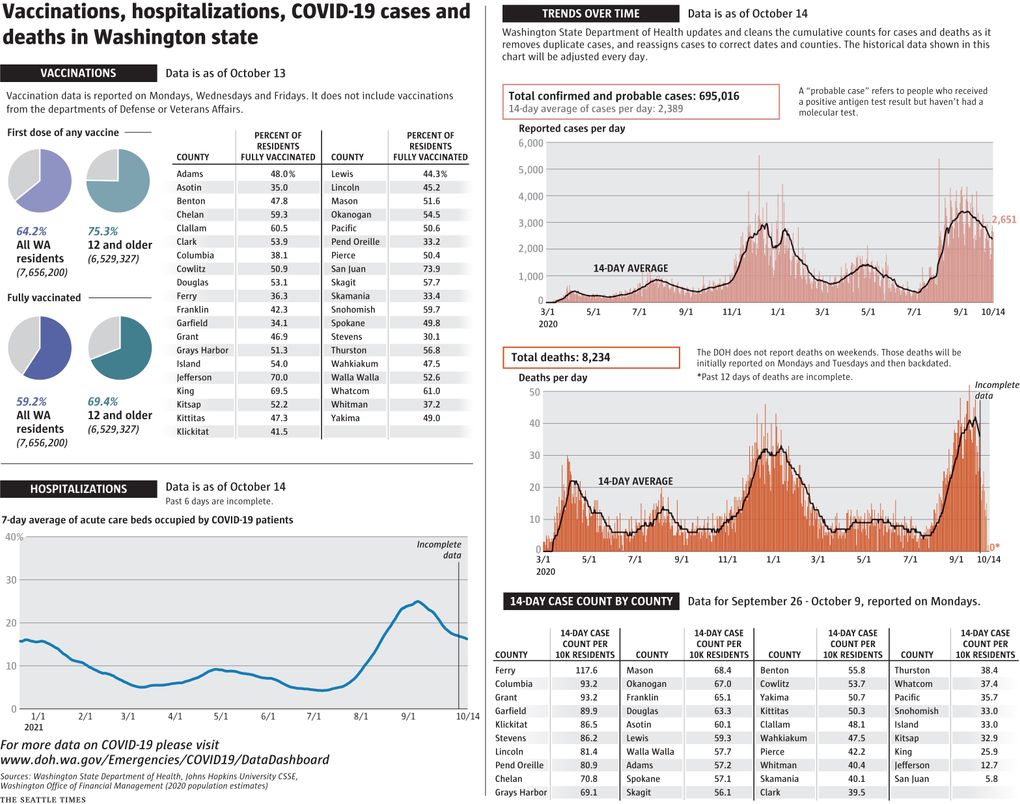
Washington state reported 36 coronavirus-related deaths Friday, bringing the total to 8,234 deaths. Providers are giving an average 18,507 vaccine shots per day.

Major cities, including Seattle, Chicago and Los Angeles, are facing showdowns with large numbers of police who oppose vaccine mandates.

Hundreds of Boeing workers protested the company’s vaccine mandate in Everett on Friday.

Gov. Jay Inslee’s deadline of Monday is fast approaching for state workers to provide proof of vaccinations, or seek religious or medical exemptions.

Over at Washington State Ferries, already short of crew to operate all 10 routes, about 200 workers have yet to supply proof of vaccination, out of 1,900 total employees, spokesperson Ian Sterling said Friday afternoon. It’s unknown how many will be suspended, retire, or seek other work. Service is cut by half on several lines effective Saturday.

We’re updating this page with the latest news about the COVID-19 pandemic and its effects on the Seattle area, the U.S. and the world. Click here to see previous days’ live updates and all our other coronavirus coverage, and here to see how we track the daily spread across Washington.


Deworming drug now at center of COVID lawsuits

Mask rules, vaccination mandates and business shutdowns have all landed in the courts during the COVID-19 outbreak, confronting judges with questions of science and government authority. Now they are increasingly being asked to weigh in on the deworming drug ivermectin.

At least two dozen lawsuits have been filed around the U.S., many in recent weeks, by people seeking to force hospitals to give their COVID-stricken loved ones ivermectin, a drug for parasites that has been promoted by conservative commentators as a treatment despite a lack of conclusive evidence that it helps people with the virus.

Interest in the drug started rising toward the end of last year and the beginning of this one, when studies — some later withdrawn, in other countries — seemed to suggest ivermectin had some potential and it became a hot topic of conversation among conservatives on social media.

Read the full story from the Associated Press here.


Lawsuits demand unproven ivermectin for COVID patients

Mask rules, vaccination mandates and business shutdowns have all landed in the courts during the COVID-19 outbreak, confronting judges with questions of science and government authority. Now they are increasingly being asked to weigh in on the deworming drug ivermectin.

At least two dozen lawsuits have been filed around the U.S., many in recent weeks, by people seeking to force hospitals to give their COVID-stricken loved ones ivermectin, a drug for parasites that has been promoted by conservative commentators as a treatment despite a lack of conclusive evidence that it helps people with the virus.

Interest in the drug started rising toward the end of last year and the beginning of this one, when studies — some later withdrawn, in other countries — seemed to suggest ivermectin had some potential and it became a hot topic of conversation among conservatives on social media.

The lawsuits, several of them filed by the same western New York lawyer, cover similar ground. The families have gotten prescriptions for ivermectin, but hospitals have refused to use it on their loved ones, who are often on ventilators and facing death.

Read the full story here.

—The Associated Press


Why vaccine resisters changed their minds

NEW YORK — In the Bronx, a youth counselor closed his eyes and steeled himself for the shot. In Queens, a nurse calmed herself by humming gospel music. In Manhattan, a graduate student asked one last question about fertility while reviewing the consent form.

With a mixture of nervousness, resentment and, sometimes, relief, hundreds of thousands of New Yorkers finally got a dose of coronavirus vaccine in recent weeks. In some cases, it was because they had a change of heart; perhaps, more commonly, it was to keep their jobs.

The uptick in vaccinations has contributed, experts say, to a flattening of the virus curve in the city, where the numbers of new infections and hospitalizations have been falling — a trend across the United States as well.

Read the full story here, from the New York Times.


What Oregon’s vaccine deadline means for State Police and juvenile corrections

Oregon State Police employees who have not complied with Monday’s vaccine deadline will be placed on administrative leave the following day, the agency said.

As of Friday, 73{cfdf3f5372635aeb15fd3e2aecc7cb5d7150695e02bd72e0a44f1581164ad809} of the agency’s 1,270 employees had been fully vaccinated and 12{cfdf3f5372635aeb15fd3e2aecc7cb5d7150695e02bd72e0a44f1581164ad809} had obtained exceptions to the mandate, with most of the exemptions citing religious grounds.

That leaves 15{cfdf3f5372635aeb15fd3e2aecc7cb5d7150695e02bd72e0a44f1581164ad809} – about 200 workers – who have not taken any steps to comply, according to the Oregon Department of Administrative Services.

State police Capt. Stephanie Bigman said the agency doesn’t anticipate “any impact to public safety” despite the possibility of placing dozens of patrol troopers on leave.

Senior Trooper Joshua Wetzel, president of the union that represents about 750 troopers, sergeants and other workers in the agency, said that’s an unrealistic expectation.

Read the full story here.

—oregonlive.com


Vaccine mandates stoked fears of labor shortages. But hospitals say they’re working.

At Houston Methodist – one of the first American health-care institutions to require workers to get vaccinated against the coronavirus – the backlash was short-lived.

More than 150 employees were fired. There were legal battles and protests. But President and CEO Marc Boom has no regrets: 98{cfdf3f5372635aeb15fd3e2aecc7cb5d7150695e02bd72e0a44f1581164ad809} of staff have been vaccinated, and they and patients are safer as a result, he said.

“I can unequivocally say [it was] the best decision we ever made,” Boom said in an interview.

Houston Methodist is not alone in requiring its employees to be vaccinated. About 41{cfdf3f5372635aeb15fd3e2aecc7cb5d7150695e02bd72e0a44f1581164ad809} of hospitals nationwide – roughly 2,570 facilities – have some sort of vaccine mandate, according to data collected by the American Hospital Association, a trade group. Others are expected to follow after President Biden announced last month that he would require most health-care facilities that accept Medicaid or Medicare funding – many of which also treat immunocompromised people who are at high risk of getting severely ill from covid – to vaccinate their employees.

Most health-care systems that require vaccination have touted widespread compliance. In interviews, administrators at some of the nation’s largest hospital systems said the mandates worked: Officials said that they have very high vaccination rates they attributed to the requirement and that they have seen coronavirus infections – and sick leaves – noticeably drop.

Read the full story here.

—The Washington Post


Russia’s daily COVID-19 deaths top 1,000 for first time

Russia’s daily death toll from COVID-19 has exceeded 1,000 for the first time as the country faces a sustained wave of rising infections.

The national coronavirus task force on Saturday reported 1,002 deaths in the previous day, up from 999 on Friday, along with 33,208 new confirmed COVID-19 cases, more than 1,000 higher than the day before.

Russian authorities have tried to speed up the pace of vaccinations with lotteries, bonuses and other incentives, but widespread vaccine skepticism and conflicting signals from officials stymied the efforts. The government said this week that about 43 million Russians, or about 29{cfdf3f5372635aeb15fd3e2aecc7cb5d7150695e02bd72e0a44f1581164ad809} of the country’s nearly 146 million people, are fully vaccinated.

Despite the mounting toll, the Kremlin has ruled out a new nationwide lockdown like the one early on in the pandemic that badly hurt the economy, eroding President Vladimir Putin’s popularity. Instead, it has delegated the power to enforce coronavirus restrictions to regional authorities.

Read the full story here.

—The Associated Press


Washington physician assistant’s license suspended over COVID actions

The Washington Medical Commission has suspended the license of a pediatric health care provider in southwestern Washington.

The suspension came this week after an investigation into more than a dozen complaints against physician assistant Scott C. Miller, who runs Miller Family Pediatrics in Washougal, The Columbian reported.

The complaints say he interfered with the care of hospitalized COVID-19 patients, engaged in a threatening public campaign against hospitals and doctors, and also prescribed medications without seeing patients.

The commission’s findings say Miller also “began a public campaign touting the use of ivermectin in treating coronavirus disease,” despite no reliable clinical evidence showing the drug is effective in treating COVID-19.

Read the full story here.

—The Associated Press


New Zealand dispenses record number of jabs at ‘Vaxathon’

New Zealand health care workers administered a record number of vaccine jabs Saturday as the nation held a festival aimed at getting more people inoculated against the coronavirus.

Musicians, sports stars and celebrities pitched in for the “Vaxathon” event which was broadcast on television and online for eight hours straight. By late afternoon, more than 120,000 people had gotten shots, eclipsing the daily record of 93,000 set in August. The event stretched into the evening.

A throwback to TV fundraising “telethon” events that were popular from the 1970s through the 1990s, it comes as New Zealand faces its biggest threat since the pandemic began, with an outbreak of the delta variant spreading through the largest city of Auckland and beyond.

Prime Minister Jacinda Ardern, who chatted with motorists at a drive-through vaccination center in Wellington, initially set a target of 100,000 jabs for the day but upped that to 150,000 after the first target was met.

She also set a target of 25,000 shots for Indigenous Maori, whose vaccination numbers have been lagging and who have been hit hard by the latest outbreak.

Read the full story here.

—The Associated Press


In New Hampshire, vaccine fights and misinformation roil GOP

Republican Rep. Ken Weyler was known around the New Hampshire Statehouse for dismissing the benefits of COVID-19 vaccines and opposing tens of millions of dollars in federal funds to promote vaccinations.

But when the 79-year-old Weyler, a retired commercial pilot and Massachusetts Institute of Technology graduate who chaired the legislature’s powerful fiscal committee, sent a 52-page report likening vaccines to “organized mass murder,” Republican leaders were compelled to act.

“I don’t know of anyone who agrees with it. It’s absolute craziness,” said Republican House Speaker Sherman Packard, who quickly accepted Weyler’s resignation from his committee post.

The episode was especially piercing in New Hampshire, where the previous House speaker died of COVID-19 last year. It has also exposed Republicans’ persistent struggle to root out the misinformation that has taken hold in its ranks across the country.

A year and a half into the pandemic, surveys show Republicans are less worried about the threat from COVID-19 or its variants, less confident in science, less likely to be vaccinated than Democrats and independents and more opposed to vaccine mandates.

Read the full story here.

—The Associated Press


Workers protest angrily near Boeing’s Everett plant against vaccination mandate

Several hundred anti-vaccination protesters, most of them Boeing blue-collar workers, voiced loud and angry opposition to the company’s newly announced vaccine mandate Friday outside the Machinists union hall in Everett.

Lining Airport Way on both sides and undeterred by pouring rain, the crowd waved signs and U.S. flags while chanting anti-vax and anti-government slogans.

The loud scene was made deafening at times as most cars and trucks driving by showed their support with gestures and honking of horns. Several supersized pickups deliberately spun tires and slid sideways across the roadway, burning rubber and slowing the traffic behind them but delighting the protest crowd.

One big pickup flew a U.S. flag and two “Thin Blue Line” flags from the truck bed. A sprinkling of MAGA hats and Donald Trump signs lent a distinctly political edge to the protest as chants broke out directing an obscenity at President Joe Biden.

Workers interviewed at the protest said they are determined to resist Boeing’s mandate, even ready to lose their jobs.

Read the full story here.

—Dominic Gates


With state’s vaccine mandate looming, will Nick Rolovich still be WSU’s football coach next week?

Will Nick Rolovich be Washington State’s football coach after Monday?  

After weeks of speculation, commentary, debate and Rolovich’s refusal to answer questions about his vaccination status, we should know soon. 

That’s because if Rolovich, the state’s highest paid employee ($3.2 million annual salary), is not in compliance with the state’s COVID-19 vaccination mandate that takes effect Monday, he can no longer work as WSU’s football coach. 

To continue coaching, Rolovich needs three things to happen: have his exemption request decided upon (which is no sure thing); have it approved; and if that happens, have his supervisor, WSU Athletic Director Pat Chun, determine that Rolovich can effectively do his job while keeping the public safe. 

WSU employees were encouraged to make exemption requests by Oct. 4, but there is no guarantee that all requests will be processed by Monday. WSU employees still waiting for their exemption request to be ruled upon when the mandate takes effect will be unable to work until it is decided upon — and approved. 

Read the full story here.

—Scott Hanson


Seattle Schools cuts more than 100 bus routes

Beginning Monday, Seattle Public Schools is suspending 142 school bus routes, a move made necessary because of a national bus driver shortage and because some drivers are declining the state-mandated coronavirus vaccine for public employees, district officials say.

Out of the 18,000 students who are eligible for bus rides, about 6,740 could be affected by the bus route cuts, but the actual number could be lower, district spokesperson Tim Robinson said.

The 142 bus routes that are being cut will not affect students in special education classes, students with Individualized Education Programs, students whose disabilities make them eligible for public transportation services, students experiencing homelessness or foster students. Schools at interim sites or those that serve “high proportions of historically underserved students” won’t be affected either, according to an email to parents sent Friday afternoon.  

Seattle Schools does not know how many students will be affected by route shortages because the number of students who ride the bus fluctuates every day, Robinson said. Of the 18,000 students in the district who are eligible for transportation services, it’s estimated about half ride the bus.

Read the full story here.

—Monica Velez


Washington state trooper who died of COVID hadn’t been vaccinated yet, family says

Washington State Patrol Trooper Eric Gunderson, who died from COVID-19 at age 38 last month, was unvaccinated but likely would have gotten a vaccine this fall, family members said in a statement Friday.

Gunderson was best known for leading the State Patrol’s part of the Amtrak 501 investigation, when a speeding passenger train flew off a curve at DuPont, killing three people and injuring dozens in late 2017. A detective specializing in accident reconstruction, Gunderson mapped the scene using drone footage, and was a pioneer in the use of unmanned aircraft to reduce the length of road closures after crashes, the WSP has said.

He died Sept. 26, and is the 32nd trooper to die in the line of duty, according to Chief John Batiste.

Gunderson contracted the coronavirus while traveling for work, said the family’s statement, which was issued Friday by WSP Communications Director Chris Loftis. Though State Patrol officials earlier had said Gunderson caught the virus that causes COVID-19 while on the job, they did not disclose Gunderson’s vaccination status, which prompted questions from news organizations.

Read the full story here.

—Mike Lindblom


The pandemic pushed some students out of Washington’s schools. New data tells us who left.

When the coronavirus pandemic first emerged in the U.S. in early 2020 and forced shutdowns in schools across the nation, most experts assumed that in-person learning would be paused for only a few weeks. Instead, it took many months before children returned to the classroom — and in the Seattle area, it took more than a year. Teachers and districts scrambled to put together online learning, often with little or no training on what works best.

What happened to children during that year of virtual schooling? Educators still don’t have a good measure of how they fared academically, because standardized testing and even simple screening tools to measure specific skills, like reading comprehension, were put on hold. But evidence suggests that students lagged academic expectations by several months or more, and that there were sharp increases in the number of students who failed courses, especially among students from low-income households and students of color.

Many students, especially those from low-income households, struggled with internet access, making it difficult for them to attend virtual school. Children whose parents had to report to work in person were left with a patchwork of caregiving arrangements. Thousands of homeless children in Washington disappeared from school enrollment counts, even as homelessness grew around the Puget Sound area. The pandemic was especially hard on children with learning disabilities, and some districts — like Seattle — were called out by the state superintendent’s office for doing a poor job of supporting those students.

Click here to read the full story.

—Seattle Times staff


What to know about Monday’s COVID vaccine deadline in Washington state

The deadline for most state government, health care and school workers in Washington to get their COVID-19 vaccination is days away. When Gov. Jay Inslee issued the sweeping order this summer, his announcement was clear: Show proof of vaccination on or before Oct. 18 or lose your job.

Since then, however, labor unions have worked on ironing out conditions of employment, thousands of workers have requested exemptions and the state has granted new extensions for certain employees.

In the past few months, more and more questions have emerged.

We rounded up some of the most pressing ones and answered them. Click here to find out what you need to know.

—Elise Takahama


Harborview to allow visitors again Tuesday

Harborview Medical Center will soon reopen its doors to visitors, with a new requirement that they must show proof of vaccination or a negative coronavirus test to be allowed inside, the Seattle hospital announced Friday.

Most visits were banned during the COVID-19 pandemic.

Visitors are expected to wear a medical-grade mask, or put on a free multi-layer surgical mask available at the entrances. Similar policies are expected eventually at all UW Medicine hospitals and clinics.

Read the full story here.


After months in lockdown, a weary world is ready to dance

Even in the depths of the pandemic — even when the world locked down, leaving billions isolated and desolated — there were those who danced.

“I did not stop dancing for a second,” says Federico Carrizo, who competed in the Tango World Championship in Buenos Aires last month. “In the kitchen, on the street, on the balcony …”

Some danced alone. Some danced alone and yet together, swaying and twirling across the internet. Some danced to be freed of the shackles of the coronavirus, if only for a moment.

“It was very hard to be for a year and a half without being able to go out to the recreation center to dance,” says Joaquin Bruzon. “Sometimes during the quarantine at home we would dance to try to improve our spirits.”

Now, once again, the Failde Orchestra of Matanzas, Cuba, can perform danzóns like “El Naranjero” and “Cuba Libre,” “A La Habana me Voy” and “Nievecita.” And once again, Bruzon and his wife, Milagros Cousett, can glide across the dance floor.

Maybe it’s because of the advent of COVID-19 vaccines. Maybe it is because feet can be repressed for just so long. But it seems that everywhere, dancers are letting loose.

Read the full story here.

—The Associated Press

Lifting COVID-19 restrictions could lead to a large flu outbreak

black and white photo of bedsheets and crumpled tissuesShare on Pinterest
COVID-19 restrictions might have weakened inhabitants immunity, so lifting the limitations could induce a flu outbreak. nito100/Getty Illustrations or photos
  • Flu infections dropped by 60{cfdf3f5372635aeb15fd3e2aecc7cb5d7150695e02bd72e0a44f1581164ad809} following the introduction of COVID-19 constraints.
  • This diminished exposure to influenza may possibly mean lessened populace immunity.
  • The lifting of COVID-19 controls could guide to a large flu outbreak.
  • Anybody provided a flu vaccination should choose it to reduce the hazard.

A examine in the Journal of Infectious Ailments has predicted a extreme influenza outbreak as soon as COVID-19 regulate actions are lifted, with elevated levels of flu in the pursuing many years.

The researchers from Columbia University Mailman Faculty of Wellbeing used computer modeling to quantify the reduction in transmission and incidence of flu just after the implementation of control steps. They utilised these knowledge with each other with information from the Centers for Condition Command and Avoidance (CDC) FluView web-site to venture influenza transmission over the up coming 5 years.

Non-pharmaceutical interventions (NPIs), these types of as mask-sporting, physical distancing, journey limitations, and university closures, led to a 60{cfdf3f5372635aeb15fd3e2aecc7cb5d7150695e02bd72e0a44f1581164ad809} fall in flu bacterial infections throughout the 10 weeks after their introduction final 12 months. The review suggests that the lessened publicity to flu all through the handle actions will have led to reduced immunity.

Keep knowledgeable with are living updates on the present COVID-19 outbreak and visit our coronavirus hub for far more assistance on avoidance and treatment method.

Dr. Jonathan Stoye, head of virology at the Francis Crick Institute in London, United Kingdom, told Healthcare News These days: “This modeling research […] suggests that the minimized quantities of bacterial infections in 2020 will lead to waning inhabitants immunity and that this may well, in transform, lead to a surge in flu infections for numerous several years.”

The scientists forecast that comforting steps could direct to a massive-scale flu outbreak, significantly in pieces of the United States where by there had been significant stages of COVID-19 control compliance. They also anticipate that the small concentrations of flu in the course of the pandemic may perhaps make it tough to predict which circulating flu strains they will need to use to inform the future vaccines. This could decrease the efficiency of influenza vaccines.

On a more optimistic note, the authors concede that the predicted bad flu time is not unavoidable. Because of the focus on COVID-19, flu may perhaps have been underreported last yr, so extra men and women may well have been uncovered to the virus than their modeling acknowledges.

Alternatively, since of lessened flu transmission, the virus will have experienced much less prospect to mutate and produce new variants. People might consequently have immunity from previously flu infections, which would guide to a less severe outbreak.

Prof. William Schaffner, Professor of Preventive Medication at Vanderbilt College College of Drugs, TN, is not certain by the suggestion of underreporting: “Last 12 months had the most affordable incidence of flu any of us can keep in mind thanks to the restraints for COVID-19. I do not imagine there was underreporting of influenza. We did not detect a important drop in testing, but minimal flu was detected. I imagine the small flu price was authentic.”

But Dr. Stoye agrees that the severity of an outbreak depends on the variety of variants: “It will be appealing to see regardless of whether such an raise does, in actuality, manifest as charges of viral an infection are driven by various variables, this sort of as adjustments in the rate of physical appearance of new viral variants.”

Prof. Schaffner factors out that other respiratory bacterial infections have greater as daily life starts to return to regular, which would propose that we require to take the warning of a undesirable flu period critically. This summer season, with fewer limits and the return of youngsters to faculty, there has been a surge in instances of respiratory syncytial virus, an infection generally seen only in the winter months. “This could be a harbinger of factors to come,” he pointed out.

“This 12 months, it’s much more essential than at any time to get your flu shot. Although we’re rightly targeted on safeguarding ourselves in opposition to COVID-19, we shouldn’t forget about about the flu, which can be fatal.”

– Senior writer Dr. Sen Pei, Ph.D, Assistant Professor of Environmental Wellness Sciences, Mailman Faculty of Community Well being, Columbia.

“Predicting flu is a hazardous profession,” Prof. Schaffner states. “Because we have had these types of a very low earlier flu time, has our immunity waned in such a way that we are vulnerable to additional transmission and more severe ailment? Flu is fickle — we’ll just have to hold out and see.”

His suggestions is unequivocal: “Take the jab.”

For reside updates on the most recent developments pertaining to the novel coronavirus and COVID-19, simply click in this article.

Live: Coronavirus daily news updates, October 15: What to know today about COVID-19 in the Seattle area, Washington state and the world

While case counts are decreasing across the state, all large events in Washington will soon require proof of vaccination or a negative test. Gov. Jay Inslee announced the new policy Thursday, which applies to indoor events with more than 1,000 people and outdoor events with more than 10,000.

Meanwhile, U.S. health advisers said Thursday that some Americans who received Moderna’s COVID-19 vaccine at least six months ago should get a half-dose booster to rev up protection against the coronavirus.

We’re updating this page with the latest news about the COVID-19 pandemic and its effects on the Seattle area, the U.S. and the world. Click here to see previous days’ live updates and all our other coronavirus coverage, and here to see how we track the daily spread across Washington.


Anchorage mask rule in effect after override of mayor’s veto

The governing body of Alaska’s largest city has overridden the mayor’s veto of an emergency order instituting a mask mandate for 60 days.

The Anchorage Assembly on Thursday overturned, on a 9-2 vote, Mayor Dave Bronson’s veto of the measure requiring masks on most everyone in indoor public spaces, Alaska Public Media reported.

The assembly had held a public hearing for a regular mask measure that drew so much opposition and had so many people wanting to comment, it stretched over multiple days.

But during a meeting Tuesday in which the proposal was not being heard, the Assembly approved an emergency ordinance putting a mask mandate in place.

Bronson, a staunch critic of COVID-19 mandates, had vetoed the ordinance Wednesday.

Read the story here.

—The Associated Press


New Mexico judge denies lab workers’ claim in vaccine fight

A New Mexico judge on Friday denied a request by dozens of scientists and others at Los Alamos National Laboratory to block a vaccine mandate, meaning workers risk being fired if they don’t comply with the lab’s afternoon deadline.

The case comes as New Mexico extends a mask mandate for indoor spaces across the state, citing persistently high levels of community spread. Nearly 263,000 COVID-19 cases have been reported in the state since the pandemic began in 2020.

While the vaccination rate among adults in New Mexico continues to hover around 71.5{cfdf3f5372635aeb15fd3e2aecc7cb5d7150695e02bd72e0a44f1581164ad809}, the rate among lab employees and contractors is much higher. The lab said last week that more than 96{cfdf3f5372635aeb15fd3e2aecc7cb5d7150695e02bd72e0a44f1581164ad809} of workers had at least one shot, but it’s not known how many have since become fully vaccinated, how many have requested exemptions or how many could end up being fired for declining the shots.

The legal challenge was backed by 114 scientists, nuclear engineers, research technicians, designers, project managers and other workers at the lab. Some are specialists and have high security clearance for the work they do, which ranges from national defense to infrastructure improvements and COVID-19 research.

The workers claim the mandate is a violation of their constitutional rights and that lab management has created a hostile work environment.

Attorneys for the lab argued in court Thursday that being vaccinated was a condition of working at Los Alamos. Lab management had announced the vaccine requirement in August.

Read the story here.

—The Associated Press


Pfizer-BioNTech ask EU agency to OK vaccine for kids 5-11

FILE – In this June 6, 2021 file photo, a youth receives a Pfizer-BioNTech COVID-19 vaccine in the central Israeli city of Rishon LeZion. The pharmaceuticals Pfizer and BioNTech say they have requested that their coronavirus vaccine be licensed for children aged 5 to 11 across the European Union. If authorized, it would be the first opportunity for younger children in Europe to be get immunized against COVID-19. (AP Photo/Sebastian Scheiner)


Pharmaceutical company Pfizer and biotechnology company BioNTech said Friday they have requested to have their coronavirus vaccine licensed for children ages 5 to 11 across the European Union. If EU regulators agree, it would be the first opportunity for younger children in Europe to get immunized against COVID-19.

Pfizer and BioNTech said they submitted data to the European Medicines Agency, including late-stage results from a study testing their COVID-19 vaccine in more than 2,200 children ages 6 months to 11 years. The children received a lower dose than what’s normally given to adults.

The companies said in a statement that the results showed a “strong immune response” in the children and that the vaccine was also found to be safe. There are currently no COVID-19 vaccines licensed for use in children younger than 12 in Europe or North America; the ones made by Pfizer-BioNTech and Moderna are authorized for children 12 and older in the European Union.

Read the story here.

—The Associated Press


FDA panel endorses booster shot for J&J COVID-19 vaccine

A panel of U.S. health advisers endorsed booster doses of Johnson & Johnson’s single-shot COVID-19 vaccine Friday, saying they should be offered at least two months after immunization.

J&J has asked the Food and Drug Administration for flexibility with its booster, arguing the extra dose adds important protection as early as two months after initial vaccination — but that it might work better if people wait until six months later.

The FDA’s advisory panel voted unanimously that a booster should be offered without setting a firm time. The advisers cited growing worry that recipients of J&J’s vaccination seem to be less protected than people who got two-dose Pfizer or Moderna options — and that most got that single dose many months ago.

Read the story here.

—The Associated Press


UK: 43,000 may have received false negative COVID results

A COVID-19 testing sight opposite Wolverhampton Science Park, England, where the Immensa Health laboratory is based Friday, Oct. 15, 2021. British health officials said Friday that 43,000 people may have been wrongly told they don’t have the coronavirus because of problems at a private laboratory. The U.K. Health Security Agency said the Immensa Health Clinic Ltd. lab in Wolverhampton, central England has been suspended from processing swabs after the false negatives. Will Welfare, the agency’s public health incident director, said it was working “to determine the laboratory technical issues” behind the inaccurate tests. (Jacob King/PA via AP)


 British health officials said Friday that 43,000 people may have been wrongly told they don’t have the coronavirus because of problems at a private laboratory.

The U.K. Health Security Agency said the Immensa Health Clinic Ltd. lab in the central England city of Wolverhampton has been suspended from processing swabs after the false negatives.

Will Welfare, the agency’s public health incident director, said it was working “to determine the laboratory technical issues” behind the inaccurate tests.

The issue was uncovered after some people who were positive for COVID-19 when they took rapid tests went on to show up as negative on more accurate PCR tests.

The health agency said that “around 400,000 samples have been processed through the lab, the vast majority of which will have been negative results, but an estimated 43,000 people may have been given incorrect negative PCR test results,” mostly in southwest England. The incorrect results were given between Sept. 8 and Oct. 12.

Read the story here.

—Jill Lawless, The Associated Press


FDA panel takes up tough questions on J&J COVID-19 boosters

U.S. health advisers on Friday tackled who should get boosters of Johnson & Johnson’s single-shot COVID-19 vaccine and when — and whether using a competing brand for the second dose might provide better protection.

The push for boosters kicked off last month after the Food and Drug Administration authorized third doses of the Pfizer vaccine for seniors and younger adults with health problems, jobs or living conditions that place them at higher risk from the coronavirus. On Thursday, an FDA advisory panel unanimously recommended a half-dose booster of the similar Moderna vaccine for the same groups.

Friday, the same panel discussed a booster of J&J’s vaccine — but the decision is more complex. Moderna and Pfizer asked the FDA to OK boosters at least six months after immunization, but J&J proposed a sliding schedule with an extra dose as early as two months later.

Adding another twist, the experts also will discuss preliminary data from a government “mix-and-match” study that suggested J&J recipients may have a far stronger immune response if they get either a Moderna or Pfizer booster rather than a second J&J dose.

The FDA will use its advisers’ recommendations to decide whether to authorize boosters for both J&J and Moderna, likely next week, after which another government agency will rule on who should roll up their sleeves.

Read the story here.

—Lauran Neergaard and Matthew Perrone, The Associated Press


Russia breaks record again for COVID-19 deaths, infections

Russia’s daily tolls of coronavirus infections and deaths surged to another record on Friday, a quickly mounting figure that has put a severe strain on the country’s health care system.

The government’s coronavirus task force reported 32,196 new confirmed coronavirus cases and 999 deaths in the past 24 hours.

The record for daily COVID-19 deaths in Russia has been broken repeatedly over the past few weeks, as fatalities steadily approach 1,000 in a single day. It comes amid increasing infections and a reluctance by authorities to toughen restrictions that would further cripple the economy.

The government said this week that about 43 million Russians, or just about 29{cfdf3f5372635aeb15fd3e2aecc7cb5d7150695e02bd72e0a44f1581164ad809} of the country’s nearly 146 million people, are fully vaccinated. Authorities have tried to speed up the pace of vaccination with lotteries, bonuses and other incentives, but widespread vaccine skepticism and conflicting signals from officials stymied the efforts.

Despite the mounting toll, the Kremlin has also ruled out a new nationwide lockdown like the one early on in the pandemic that badly hurt the economy, eroding President Vladimir Putin’s popularity.

Read the story here.

—Vladimir Isachenkov, The Associated Press


Newly discovered bat viruses give hints to COVID’s origins

An undated photo provided by Kevin K. Caldwell, shows a least horseshoe bat, Rhinolophus pusillus, one of three species of horseshoe bat observed in a recent study. Coronaviruses discovered in Laotian bats are surprisingly adept at infecting human cells, showing that such deadly features can indeed evolve outside of a lab. (Kevin K. Caldwell via The New York Times) — NO SALES; FOR EDITORIAL USE ONLY WITH NYT STORY SCI-VIRUS-BATS BY CARL ZIMMER FOR OCT. 14, 2021. ALL OTHER USE PROHIBITED. — XNYT XNYT


In the summer of 2020, half a year into the coronavirus pandemic, scientists traveled into the forests of northern Laos to catch bats that might harbor close cousins of the pathogen.

The fecal samples the collected turned out to contain coronaviruses, which the scientists studied in high-security biosafety labs, known as BSL-3, using specialized protective gear and air filters.

Three of the Laos coronaviruses were unusual: They carried a molecular hook on their surface that was very similar to the hook on the virus that causes COVID-19, called SARS-CoV-2. Like SARS-CoV-2, their hook allowed them to latch onto human cells.

“It is even better than early strains of SARS-CoV-2,” said Marc Eloit, a virus expert at the Pasteur Institute in Paris who led the study, referring to how well the hook on the Laos coronaviruses binds to human cells.

The findings have significant implications for the charged debate over COVID’s origins, experts say. Some people have speculated that SARS-CoV-2’s impressive ability to infect human cells could not have evolved through a natural spillover from an animal. But the new findings seem to suggest otherwise.

Read the story here.

—Carl Zimmer, The New York Times


Wyoming district where student arrested extends mask mandate

High School junior Grace Smith, 16, and her father Andy Smith poses in the Laramie Boomerang newsroom in Laramie Wyo., Thursday, Oct. 7, 2021. Police had arrested Grace Smith earlier that day when she violated a school mask mandate and allegedly refused to leave Laramie High School. The school district voted Wednesday Oct. 13, 2021, to extend the mask mandate another month. (Greg Johnson/Laramie Boomerang via AP)


A mask-wearing mandate will continue for at least another month in a Wyoming school district where a student who wouldn’t wear a mask got arrested for allegedly refusing to leave her high school.

Grace Smith, 16, might not be involved in future confrontations at Laramie High School, however. The junior said she was withdrawing after being “bullied, discriminated against and worst of all, legitimately threatened.”

Albany County School District No. 1 trustees voted 6-1 later in the meeting to extend the district’s mask mandate for everybody inside district buildings until Nov. 12. The mask requirement had been set to expire this Friday.

Wyoming has had one of the lowest vaccination rates and highest COVID-19 rates in the U.S. but the district is among just a few in Wyoming to require masks this fall. Smith’s anti-mask stance is widespread in this conservative state, where Republican Gov. Mark Gordon has vowed not to return to mask mandates since imposing an unpopular one last winter.

Laramie — home to the University of Wyoming, which has been requiring masks in most of its buildings this fall — has been somewhat more receptive to masks than many Wyoming communities which also have had heated debates over masks this fall.

Police arrested Smith at her high school Oct. 7 after she served two consecutive, two-day suspensions for not wearing a mask.

Read the story here.

—Mead Gruver, The Associated Press


Catch up on the past 24 hours

—Kris Higginson